

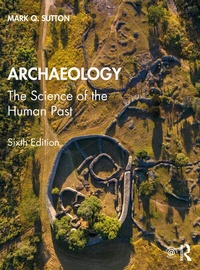
Archaeology
The Science of the Human Past
6th Edition
Published on 31. March 2021
Book
Paperback/Softback
404 pages
978-0-367-61780-6 (ISBN)
Description
Archaeology: The Science of the Human Past provides students with a thorough understanding of what archaeology is and how it operates and familiarizes them with fundamental archaeological concepts and methods.
This volume introduces the basic components of archaeology, including sites, artifacts, ecofacts, remote sensing, and excavation. It discusses how archaeologists obtain and classify information and how they analyze this information to formulate and test models of what happened in the past. Cultural resource management and the laws and regulations that deal with archaeology around the world are described. Archaeology is placed in the context of contemporary issues, from environmental problems to issues affecting Indigenous populations. The sixth edition has been updated and simplified to create a more streamlined volume to meet the needs of the students and teachers for whom it is designed, reflecting the latest developments in archaeological techniques and approaches.
Allowing students to understand the theoretical and scientific aspects of archaeology and how various archaeological perspectives and techniques help us understand how and what we know about the past, Archaeology: The Science of the Human Past is an ideal introduction to archaeology.
This volume introduces the basic components of archaeology, including sites, artifacts, ecofacts, remote sensing, and excavation. It discusses how archaeologists obtain and classify information and how they analyze this information to formulate and test models of what happened in the past. Cultural resource management and the laws and regulations that deal with archaeology around the world are described. Archaeology is placed in the context of contemporary issues, from environmental problems to issues affecting Indigenous populations. The sixth edition has been updated and simplified to create a more streamlined volume to meet the needs of the students and teachers for whom it is designed, reflecting the latest developments in archaeological techniques and approaches.
Allowing students to understand the theoretical and scientific aspects of archaeology and how various archaeological perspectives and techniques help us understand how and what we know about the past, Archaeology: The Science of the Human Past is an ideal introduction to archaeology.
More details
Edition
6th edition
Language
English
Place of publication
London
United Kingdom
Publishing group
Taylor & Francis Ltd
Target group
College/higher education
Illustrations
119 s/w Abbildungen, 110 s/w Photographien bzw. Rasterbilder, 9 s/w Zeichnungen, 24 s/w Tabellen
24 Tables, black and white; 9 Line drawings, black and white; 110 Halftones, black and white; 119 Illustrations, black and white
Dimensions
Height: 254 mm
Width: 191 mm
Weight
952 gr
ISBN-13
978-0-367-61780-6 (9780367617806)
Copyright in bibliographic data and cover images is held by Nielsen Book Services Limited or by the publishers or by their respective licensors: all rights reserved.
Schweitzer Classification
Other editions
New editions
Book
01/2025
7th Edition
Routledge
€148.68
Shipment within 10-20 days
Additional editions
Book
03/2021
6th Edition
Routledge
€272.36
Article exhausted; check for reprint
Previous edition
Book
08/2018
5th Edition
Routledge
€185.70
Article exhausted; check for reprint
Person
Mark Q. Sutton is an emeritus professor of anthropology at California State University, Bakersfield, USA.
Content
Part I What is Archaeology?; 1 The Science of Archaeology; 2 Background of Archaeology; 3 The Development of Contemporary Archaeology; Part II Obtaining Information about the Past; 4 The Archaeological Record; 5 Conducting Fieldwork; 6 Classification and Analysis of Artifacts; 7 Determining Time; 8 Bioarchaeology: Human Remains; Part III Interpreting the Past; 9 Environment and Adaptation; 10 Understanding Past Settlement and Subsistence; 11 Interpreting Past Cultural Systems; 12 Understanding Change; Part IV Public Archaeology; 13 Cultural Resource Management; 14 Archaeology in Today's World