

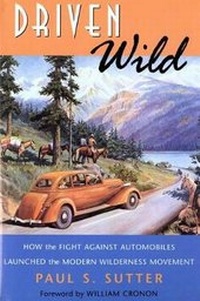
Driven Wild
How the Fight Against Automobiles Launched the Modern Wilderness Movement
Published on 1. March 2002
Book
Hardback
360 pages
978-0-295-98219-9 (ISBN)
Description
In its infancy, the movement to protect wilderness areas in the United States was motivated less by perceived threats from industrial and agricultural activities than by concern over the impacts of automobile owners seeking recreational opportunities in wild areas. Countless commercial and government purveyors vigorously promoted the mystique of travel to breathtakingly scenic places, and roads and highways were built to facilitate such travel. By the early 1930s, New Deal public works programs brought these trends to a startling crescendo. The dilemma faced by stewards of the nation's public lands was how to protect the wild qualities of those places while accommodating, and often encouraging, automobile-based tourism. By 1935, the founders of the Wilderness Society had become convinced of the impossibility of doing both. In Driven Wild, Paul Sutter traces the intellectual and cultural roots of the modern wilderness movement from about 1910 through the 1930s, with tightly drawn portraits of four Wilderness Society founders - Aldo Leopold, Robert Sterling Yard, Benton MacKaye, and Bob Marshall.
Each man brought a different background and perspective to the advocacy for wilderness preservation, yet each was spurred by a fear of what growing numbers of automobiles, aggressive road building, and the meteoric increase in Americans turning to nature for their leisure would do to the country's wild places. As Sutter discovered, the founders of the Wilderness Society were "driven wild" - pushed by a rapidly changing country to construct a new preservationist ideal. Sutter demonstrates that the birth of the movement to protect wilderness areas reflected a growing belief among an important group of conservationists that the modern forces of capitalism, industrialism, urbanism, and mass consumer culture were gradually eroding not just the ecology of North America, but crucial American values as well. For them, wilderness stood for something deeply sacred that was in danger of being lost, so that the movement to protect it was about saving not just wild nature, but ourselves as well.
Each man brought a different background and perspective to the advocacy for wilderness preservation, yet each was spurred by a fear of what growing numbers of automobiles, aggressive road building, and the meteoric increase in Americans turning to nature for their leisure would do to the country's wild places. As Sutter discovered, the founders of the Wilderness Society were "driven wild" - pushed by a rapidly changing country to construct a new preservationist ideal. Sutter demonstrates that the birth of the movement to protect wilderness areas reflected a growing belief among an important group of conservationists that the modern forces of capitalism, industrialism, urbanism, and mass consumer culture were gradually eroding not just the ecology of North America, but crucial American values as well. For them, wilderness stood for something deeply sacred that was in danger of being lost, so that the movement to protect it was about saving not just wild nature, but ourselves as well.
Reviews / Votes
"Sutter's most striking contribution in this book is to argue that the movement to protect wilderness had less to do with staving off threats posed by the rapacious activities of an industrial economy than with resisting the onslaught of automobile-owning consumers seeking recreational opportunities in rural and wild places." - from the Introduction by William Cronon "Napoleon famously said that an army travels on its stomach. The destruction of wilderness, however, travels by road. The pioneers of wilderness area protection know this well, as Paul Sutter clearly shows in Driven Wild. All thinking conservationists must read this powerful new exploration of early environmentalism in America." - Dave Foreman, chairman, The Wildlands Project "The preservation of wilderness is one of America's greatest cultural achievements, and it is worth remembering how much complex thought has gone into making it happen. Paul Sutter restores to us a generation of activists who demand our respectful attention. They were subtle in their thinking, compassionate in their social sympathies, and critical in their response to consumer society. Well researched and skillfully written, this book will do much to elevate the contemporary debate over wilderness to higher ground." - Donald Worster, University of Kansas "Driven Wild is an important and long-needed book capturing the social, cultural, and intellectual milieu at the dawn of the organized wilderness movement in the United States." - Mark Harvey, author of A Symbol of Wilderness: Echo Park and the American Conservation MovementMore details
Language
English
Place of publication
Seattle
United States
Target group
Professional and scholarly
Illustrations
24 illus.
Dimensions
Height: 229 mm
Width: 152 mm
Weight
749 gr
ISBN-13
978-0-295-98219-9 (9780295982199)
Copyright in bibliographic data and cover images is held by Nielsen Book Services Limited or by the publishers or by their respective licensors: all rights reserved.
Schweitzer Classification
Other editions
Additional editions
E-Book
11/2009
1st Edition
University of Washington Press
€29.49
Available for download