

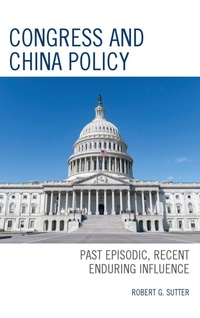
Congress and China Policy
Past Episodic, Recent Enduring Influence
Published on 20. November 2023
Book
Hardback
316 pages
978-1-6669-2948-5 (ISBN)
Description
Congress and China Policy: Past Episodic, Recent Enduring Influence supports findings that bipartisan majorities in Congress have been instrumental in driving the fundamental shift in American policy toward China carried out during the past six years. Filling major gaps in the inadequate treatment of Congress in assessments of US policy toward China, this book compares recent Congressional influence with the episodes of Congressional activism in China policy over the past 200 years, showing Congress recently has been more important than ever. The findings also show that partisan politics, Congressional-executive competition for policy control, swings in public and media opinion, and influences by special interests-longstanding drivers of past Congressional involvement in China policy-have been of secondary or lesser importance as the Congressional members have grappled with the acute dangers posed by Chinese economic, security and governance challenges. Steady and determined efforts by this cohort of bipartisan Congressional majorities to defend America from Chinese challenges have proven more resolute than the erratic practices of President Trump and previously dismissive Joseph Biden who came late to a tougher policy. This volume forecasts that US policy will remain heavily influenced by these members as they serve out their terms in the years ahead.
Reviews / Votes
Sutter, an authoritative China scholar who spent 24 years with the Congressional Research Service, offers an impressive interpretation of Congress's role in US-China relations. Though this study looks at a 200-yearperiod, its primary focus is how the US has engaged with China since the early 1970s, Nixon-Mao era. Sutter uses questions from James Lindsay's The Domestic Sources of American Foreign Policy (2018) to ascertain whether Americans believed they faced external threats, inclining Congress to rally behind the president. If members of Congress perceived the president's policy had dubious benefits to them or their constituents, they responded in a partisan fashion (for example, the policy hiccup with the passage of the Taiwan Relations Act in 1979). A less important factor was whether the president's party controlled Congress. However, since 2017, strongly bipartisan majorities have collaborated with both Trump and Biden administration leaders "in carrying out the remarkable US government hardening against very serious Chinese challenges to American interests" (p. 215). Sutter believes this hardening approach will continue in future years. Highly recommended. General readers through faculty; professionals. * Choice Reviews * Robert G. Sutter brings to this impressive study a half-century of first-hand experience as a respected scholar of US-China relations and a former Congressional staff member and US government official. He has written the definitive study of this highly important, but neglected, aspect of the Sino-American relationship. It should be read by every member of Congress, their staff, and all those who seek to understand the dynamics of US policies towards China. -- David Shambaugh, George Washington University No one is in a better position than Robert G. Sutter to write about the evolving role of the US Congress in America's China policy since the beginning of engagement with China in the 1970s. This authoritative book draws from Sutter's personal experiences as a research staff in Congress and his thorough research as a scholar. Anyone interested in the US-China relation, US foreign policy, Chinese foreign policy, and great power dynamics cannot afford to miss this unique and fascinating book. -- Suisheng Zhao, University of Denver and editor of Journal of Contemporary China Robert G. Sutter, a former National Intelligence Officer for East Asia and the Pacific, presents a clear-eyed, dispassionate view of U.S. China policy since the Nixon-Mao era. This book argues that congress has never been more important in policymaking than in the past five-plus years of America's hardening against Chinese challenges and predicts that its influence will endure for the foreseeable future. -- June Teufel Dreyer, University of MiamiMore details
Language
English
Place of publication
United States
Publishing group
Bloomsbury Publishing Plc
Target group
Professional and scholarly
Dimensions
Height: 235 mm
Width: 157 mm
Thickness: 22 mm
Weight
640 gr
ISBN-13
978-1-6669-2948-5 (9781666929485)
Copyright in bibliographic data and cover images is held by Nielsen Book Services Limited or by the publishers or by their respective licensors: all rights reserved.
Schweitzer Classification
Other editions
Additional editions
E-Book
11/2023
1st Edition
Lexington Books
€94.99
Available for download
E-Book
11/2023
1st Edition
Lexington Books
€94.99
Available for download
Person
Robert G. Sutter is professor of international affairs in the Elliott School of International Affairs (ESIA) at George Washington University.
Content
Chapter 1. Congressional Activism in China Policy Before the Nixon-Mao Opening
Chapter 2. Congress and the Nixon-Mao Opening and Rapprochement
Chapter 3. Congress Resists as Carter Advances Engagement
Chapter 4. Congress and Reagan Administration China Policy
Chapter 5. Congress and China Policy with George H.W. Bush and Bill Clinton
Chapter 6. Congress and China Policy with George W. Bush and Barack Obama
Chapter 7. Congress and America's Negative Turn against China, 2017-2023
Conclusion: The Importance of Congress in China Policy
Chapter 2. Congress and the Nixon-Mao Opening and Rapprochement
Chapter 3. Congress Resists as Carter Advances Engagement
Chapter 4. Congress and Reagan Administration China Policy
Chapter 5. Congress and China Policy with George H.W. Bush and Bill Clinton
Chapter 6. Congress and China Policy with George W. Bush and Barack Obama
Chapter 7. Congress and America's Negative Turn against China, 2017-2023
Conclusion: The Importance of Congress in China Policy