

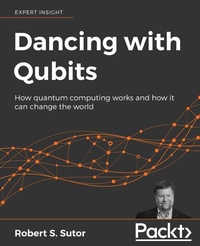
Dancing with Qubits
How quantum computing works and how it can change the world
Published on 28. November 2019
Book
Paperback/Softback
516 pages
978-1-83882-736-6 (ISBN)
Description
Explore the principles and practicalities of quantum computing
Key Features
Discover how quantum computing works and delve into the math behind it with this quantum computing textbook
Learn how it may become the most important new computer technology of the century
Explore the inner workings of quantum computing technology to quickly process complex cloud data and solve problems
Book DescriptionQuantum computing is making us change the way we think about computers. Quantum bits, a.k.a. qubits, can make it possible to solve problems that would otherwise be intractable with current computing technology.
Dancing with Qubits is a quantum computing textbook that starts with an overview of why quantum computing is so different from classical computing and describes several industry use cases where it can have a major impact. From there it moves on to a fuller description of classical computing and the mathematical underpinnings necessary to understand such concepts as superposition, entanglement, and interference. Next up is circuits and algorithms, both basic and more sophisticated. It then nicely moves on to provide a survey of the physics and engineering ideas behind how quantum computing hardware is built. Finally, the book looks to the future and gives you guidance on understanding how further developments will affect you.
Really understanding quantum computing requires a lot of math, and this book doesn't shy away from the necessary math concepts you'll need. Each topic is introduced and explained thoroughly, in clear English with helpful examples.What you will learn
See how quantum computing works, delve into the math behind it, what makes it different, and why it is so powerful with this quantum computing textbook
Discover the complex, mind-bending mechanics that underpin quantum systems
Understand the necessary concepts behind classical and quantum computing
Refresh and extend your grasp of essential mathematics, computing, and quantum theory
Explore the main applications of quantum computing to the fields of scientific computing, AI, and elsewhere
Examine a detailed overview of qubits, quantum circuits, and quantum algorithm
Who this book is forDancing with Qubits is a quantum computing textbook for those who want to deeply explore the inner workings of quantum computing. This entails some sophisticated mathematical exposition and is therefore best suited for those with a healthy interest in mathematics, physics, engineering, and computer science.
Key Features
Discover how quantum computing works and delve into the math behind it with this quantum computing textbook
Learn how it may become the most important new computer technology of the century
Explore the inner workings of quantum computing technology to quickly process complex cloud data and solve problems
Book DescriptionQuantum computing is making us change the way we think about computers. Quantum bits, a.k.a. qubits, can make it possible to solve problems that would otherwise be intractable with current computing technology.
Dancing with Qubits is a quantum computing textbook that starts with an overview of why quantum computing is so different from classical computing and describes several industry use cases where it can have a major impact. From there it moves on to a fuller description of classical computing and the mathematical underpinnings necessary to understand such concepts as superposition, entanglement, and interference. Next up is circuits and algorithms, both basic and more sophisticated. It then nicely moves on to provide a survey of the physics and engineering ideas behind how quantum computing hardware is built. Finally, the book looks to the future and gives you guidance on understanding how further developments will affect you.
Really understanding quantum computing requires a lot of math, and this book doesn't shy away from the necessary math concepts you'll need. Each topic is introduced and explained thoroughly, in clear English with helpful examples.What you will learn
See how quantum computing works, delve into the math behind it, what makes it different, and why it is so powerful with this quantum computing textbook
Discover the complex, mind-bending mechanics that underpin quantum systems
Understand the necessary concepts behind classical and quantum computing
Refresh and extend your grasp of essential mathematics, computing, and quantum theory
Explore the main applications of quantum computing to the fields of scientific computing, AI, and elsewhere
Examine a detailed overview of qubits, quantum circuits, and quantum algorithm
Who this book is forDancing with Qubits is a quantum computing textbook for those who want to deeply explore the inner workings of quantum computing. This entails some sophisticated mathematical exposition and is therefore best suited for those with a healthy interest in mathematics, physics, engineering, and computer science.
More details
Language
English
Place of publication
Birmingham
United Kingdom
Dimensions
Height: 235 mm
Width: 191 mm
Thickness: 28 mm
Weight
953 gr
ISBN-13
978-1-83882-736-6 (9781838827366)
Copyright in bibliographic data and cover images is held by Nielsen Book Services Limited or by the publishers or by their respective licensors: all rights reserved.
Schweitzer Classification
Other editions
Additional editions
E-Book
06/2024
1st Edition
Packt Publishing Limited
from
€29.99
Available for download
Person
Robert S. Sutor has been a technical leader and executive in the IT industry for over 40 years. More than two decades of that were spent in IBM Research in Yorktown Heights, New York USA. During his time there, he worked on and led efforts in symbolic mathematical computation, mathematical programming languages, optimization, AI, blockchain, and quantum computing. He is the author of Dancing with Qubits: How quantum computing works and how it can change the world and Dancing with Python: Learn Python software development from scratch and get started with quantum computing, also with Packt. He is the published co-author of several research papers and the book Axiom: The Scientific Computation System with the late Richard D. Jenks.
Sutor was an IBM executive on the software side of the business in areas including Java web application servers, emerging industry standards, software on Linux, mobile, and open source. He was the Vice President of Corporate Development and, later, Chief Quantum Advocate, at Infleqtion, a quantum computing and quantum sensing company based in Boulder, Colorado USA. He is currently an Adjunct Professor in the Department of Computer Science and Engineering at the University at Buffalo, New York, USA.
He is a theoretical mathematician by training, has a Ph.D. from Princeton University, and an undergraduate degree from Harvard College. He started coding when he was 15 and has used most of the programming languages that have come along.
Sutor was an IBM executive on the software side of the business in areas including Java web application servers, emerging industry standards, software on Linux, mobile, and open source. He was the Vice President of Corporate Development and, later, Chief Quantum Advocate, at Infleqtion, a quantum computing and quantum sensing company based in Boulder, Colorado USA. He is currently an Adjunct Professor in the Department of Computer Science and Engineering at the University at Buffalo, New York, USA.
He is a theoretical mathematician by training, has a Ph.D. from Princeton University, and an undergraduate degree from Harvard College. He started coding when he was 15 and has used most of the programming languages that have come along.
Content
Table of Contents
Why Quantum Computing?
They're Not Old, They're Classics
More Numbers than You Can Imagine
Planes and Circles and Spheres, Oh My
Dimensions
What Do You Mean "Probably"?
One Qubit
Two Cubits, Three
Wiring Up the Circuits
From Circuits to Algorithms
Getting Physical
Questions about the Future
Why Quantum Computing?
They're Not Old, They're Classics
More Numbers than You Can Imagine
Planes and Circles and Spheres, Oh My
Dimensions
What Do You Mean "Probably"?
One Qubit
Two Cubits, Three
Wiring Up the Circuits
From Circuits to Algorithms
Getting Physical
Questions about the Future