

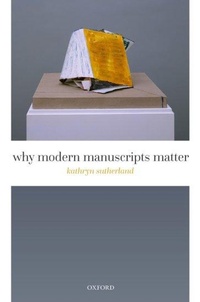
Why Modern Manuscripts Matter
Published on 17. March 2022
Book
Hardback
288 pages
978-0-19-285651-7 (ISBN)
Description
This is a study of the politics, the commerce, and the aesthetics of heritage culture in the shape of authors' manuscripts. Draft or working manuscripts survive in quantity from the eighteenth century when, with the rise of print, readers learnt to value 'the hand' as an index of individuality and the blotted page, criss-crossed by deletion and revision, as a sign of genius. Since then, collectors have fought over manuscripts, libraries have curated them, the rich have stashed them away in investment portfolios, students have squeezed meaning from them, and we have all stared at them behind exhibition glass. Why do we trade them, conserve them, and covet them? Most, after all, are just the stuff left over after the novel or book of poetry goes into print. Poised on the boundary where precious treasure becomes abject waste, litter, and mess, modern literary manuscripts hover between riches and rubbish.
In a series of case studies, this book explores manuscript's expressive agency and its capacity to provoke passion--a capacity ever more to the fore in the twenty-first century now that books are assembled via word-processing software and authors no longer leave in such quantity those paper trails behind them. It considers manuscripts as residues of meaning that print is unable to capture: manuscript as fragment art, as property, as waste paper. It asks what it might mean to re-read print in the shadow of manuscript. Case studies of Samuel Johnson, James Boswell, Walter Scott, Frances Burney, and Jane Austen--writers from the first great period of manuscript survival--are interspersed with discussions of William Godwin's record keeping, the Cairo genizah, Katie Paterson's 'Future Library' project, Andy Warhol's and Muriel Spark's self-archiving, Cornelia Parker's reclamation art, and more.
In a series of case studies, this book explores manuscript's expressive agency and its capacity to provoke passion--a capacity ever more to the fore in the twenty-first century now that books are assembled via word-processing software and authors no longer leave in such quantity those paper trails behind them. It considers manuscripts as residues of meaning that print is unable to capture: manuscript as fragment art, as property, as waste paper. It asks what it might mean to re-read print in the shadow of manuscript. Case studies of Samuel Johnson, James Boswell, Walter Scott, Frances Burney, and Jane Austen--writers from the first great period of manuscript survival--are interspersed with discussions of William Godwin's record keeping, the Cairo genizah, Katie Paterson's 'Future Library' project, Andy Warhol's and Muriel Spark's self-archiving, Cornelia Parker's reclamation art, and more.
Reviews / Votes
Sutherland...amply shows the variety of ways in which manuscripts acquired new significance in the eighteenth and nineteenth centuries. * Rachael Scarborough King, Modern Philosophy *More details
Language
English
Place of publication
Oxford
United Kingdom
Target group
College/higher education
Product notice
sewn/stitched
Cloth over boards
Dimensions
Height: 238 mm
Width: 165 mm
Thickness: 23 mm
Weight
635 gr
ISBN-13
978-0-19-285651-7 (9780192856517)
Copyright in bibliographic data and cover images is held by Nielsen Book Services Limited or by the publishers or by their respective licensors: all rights reserved.
Schweitzer Classification
Other editions
Additional editions
Kathryn Sutherland
Why Modern Manuscripts Matter
E-Book
03/2022
1st Edition
OUP eBook
€21.99
Available for download
Kathryn Sutherland
Why Modern Manuscripts Matter
E-Book
03/2022
1st Edition
OUP eBook
€21.99
Available for download
Person
Kathryn Sutherland is Senior Research Fellow at St Anne's College, University of Oxford. She is the author of Jane Austen's Textual Lives: From Aeschylus to Bollywood (OUP, 2005) and editor of Jane Austen's Fiction Manuscripts (OUP, 2018).
Content
Introduction
1: Dealing with the Leftovers
2: Samuel Johnson and the Origins of Writing
3: 'this warm scribe my hand': The Autograph Craze
4: Nothing Wasted: Frances Burney's Fiction Manuscripts
5: Whose Property? Walter Scott's Manuscripts
6: Jane Austen Fragment Artist
Afterword
1: Dealing with the Leftovers
2: Samuel Johnson and the Origins of Writing
3: 'this warm scribe my hand': The Autograph Craze
4: Nothing Wasted: Frances Burney's Fiction Manuscripts
5: Whose Property? Walter Scott's Manuscripts
6: Jane Austen Fragment Artist
Afterword