

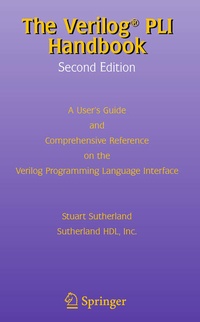
The Verilog PLI Handbook
A User's Guide and Comprehensive Reference on the Verilog Programming Language Interface
2nd Edition
Published on 28. February 2002
Book
Mixed media product
XXIV, 784 pages
978-0-7923-7658-3 (ISBN)
Description
by Maq Mannan President and CEO, DSM Technologies Chairman of the IEEE 1364 Verilog Standards Group Past Chairman of Open Verilog International One of the major strengths of the Verilog language is the Programming Language Interface (PLI), which allows users and Verilog application developers to infinitely extend the capabilities of the Verilog language and the Verilog simulator. In fact, the overwhelming success of the Verilog language can be partly attributed to the exi- ence of its PLI. Using the PLI, add-on products, such as graphical waveform displays or pre and post simulation analysis tools, can be easily developed. These products can then be used with any Verilog simulator that supports the Verilog PLI. This ability to create thi- party add-on products for Verilog simulators has created new markets and provided the Verilog user base with multiple sources of software tools. Hardware design engineers can, and should, use the Verilog PLI to customize their Verilog simulation environment. A Company that designs graphics chips, for ex- ple, may wish to see the simulation results of a new design in some custom graphical display. The Verilog PLI makes it possible, and even trivial, to integrate custom so- ware, such as a graphical display program, into a Verilog simulator. The simulation results can then dynamically be displayed in the custom format during simulation. And, if the company uses Verilog simulators from multiple simulator vendors, this integrated graphical display will work with all the simulators.
Reviews / Votes
"The Verilog PLI Handbook is the best book written about the PLI. Use it once, and it will pay for itself by saving you a great deal of time. The book brings clarity to the Verilog Programming Language Interface. The descriptions and extensive examples shed new light on the many dark corners of the PLI. Stuart Sutherland has produced the definitive guide, covering all versions and uses for the PLI. I recommend this book to all Verilog users who want to learn about the PLI."(Chris Spear, Verification Consultant, Synopsys, Inc.)
More details
Series
Edition
2nd ed. 2002
Language
English
Place of publication
New York
United States
Target group
Professional and scholarly
Research
Edition type
Revised edition
Illustrations
XXIV, 784 p. With CD-ROM.
Dimensions
Height: 243 mm
Width: 165 mm
Thickness: 42 mm
Weight
1243 gr
ISBN-13
978-0-7923-7658-3 (9780792376583)
DOI
10.1007/b116513
Schweitzer Classification
Other editions
Additional editions
Stuart Sutherland
The Verilog PLI Handbook
A User's Guide and Comprehensive Reference on the Verilog Programming Language Interface
Book
04/2013
2nd Edition
Springer
€213.99
Shipment within 15-20 days
Stuart Sutherland
The Verilog PLI Handbook
A User's Guide and Comprehensive Reference on the Verilog Programming Language Interface
E-Book
04/2006
2nd Edition
Kluwer Academic Publishers
€213.99
Available for download
Content
The VPI Portion of the Verilog PLI Standard.- Creating PLI Applications Using VPI Routines.- Interfacing VPI Applications to Verilog Simulators.- How to Use the VPI Routines.- Details about the VPI Routine Library.- Reading and Modifying Values Using VPI Routines.- Synchronizing to Simulations Using VPI Callbacks.- The TF/ACC Portion of the Verilog PLI Standard.- Creating PLI Applications Using TF and ACC Routines.- Interfacing TF/ACC Applications to Verilog Simulators.- How to Use the TF Routines.- Reading and Writing Values Using TF Routines.- Synchronizing to Simulations Using Misctf Routines.- Interfacing to C Models Using TF Routines.- How to Use the ACC Routines.- Details on the ACC Routine Library.- Reading and Modifying Values Using ACC Routines.- Using the Value Change Link (VCL).- Interfacing to C Models Using ACC Routines.- Interfacing to C Models Using VPI Routines.