

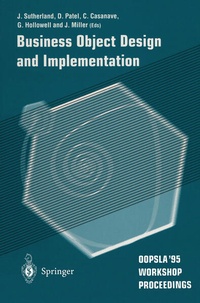
Business Object Design and Implementation
OOPSLA '95 Workshop Proceedings 16 October 1995, Austin, Texas
Published on 28. April 1997
Book
Paperback/Softback
VIII, 167 pages
978-3-540-76096-2 (ISBN)
Description
Over the past 10 years, object technology has gained widespread acceptance within the software industry. Within a wider context, however, it has made little impact on the core applications which support businesses in carrying out their tasks. This volume contains a collection of papers establishing the need for Business Objects, with particular reference to work undertaken by the Object Management Group (OMG). The emphasis is on defining an agenda for establishing Business Object standards and architectures, for developing software technology to support Business Objects applications and managing object oriented development projects. The wide variety of papers presented, and their authors' expertise, make this book a significant contribution to the development of Business Objects and their management.
More details
Edition
Softcover reprint of the original 1st ed. 1997
Language
English
Place of publication
London
United Kingdom
Publishing group
Springer Berlin
Target group
Professional and scholarly
Professional/practitioner
Illustrations
19 s/w Abbildungen
VIII, 167 p. 19 illus.
Dimensions
Height: 235 mm
Width: 155 mm
Thickness: 10 mm
Weight
277 gr
ISBN-13
978-3-540-76096-2 (9783540760962)
DOI
10.1007/978-1-4471-0947-1
Schweitzer Classification
Other editions
Additional editions
Jeffrey V. Sutherland | Dilip Patel | Cory Casanave
Business Object Design and Implementation
OOPSLA '95 Workshop Proceedings 16 October 1995, Austin, Texas
E-Book
12/2012
Springer
€96.29
Available for download
Content
Business Objects Standards and Architectures.- Business-Object Architectures and Standards.- The Object Technology Architecture: Business Objects for Corporate Information Systems.- The OMG Business Object Facility and the OMG Business Object.- An Architecture Framework: From Business Strategies to Implementation.- Object Oriented Technology and Interoperability.- An Architectural Framework for Semantic Inter-Operability in Distributed Object Systems.- Semantics: The Key to Interoperability.- Business Objects Applications.- Object Business Modelling, Requirements and Approach.- Implementing Business Objects: CORBA Interfaces for Legacy Systems.- Modeling Business Enterprises as Value-Added Process Hierarchies with Resource-Event-Agent Object Templates.- Managing Object Oriented Software Development Projects.- SCRUM Development Process.- Experiences with a Manufacturing Framework.- Business Application Components.- Author Index.