

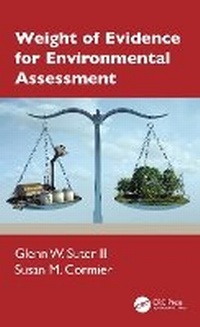
Weight of Evidence for Environmental Assessment
1st Edition
Will be published approx. on 28. October 2026
Book
Hardback
344 pages
978-1-041-03998-3 (ISBN)
Description
Laws and regulations in the U.S. and some other nations require weight of evidence, as do any assessments that involve multiple pieces of evidence. However, environmental assessors are frequently unaware of the need for defensible practices. This book provides the first clear framework for weight of evidence (WoE) for environmental protection based on U.S. EPA guidelines as well as comparison with alternative methods. Real-world case studies illustrate the implementation and application of weight of evidence for making diverse inferences and decisions that influence our environment and our lives.
Features
Written by experts who developed guidance on environmental assessment and weight of evidence for the United States government.
Explains how weight of evidence is applied to different types of environmental and health decisions.
Includes alternative frameworks and practices from other organizations that may be appropriate in particular cases.
Uses an engaging style and draws on the authors' decades of practical experiences.
Expands on the U.S. EPA guidelines that have been a basis for weight of evidence guidance in Europe, Australia, and elsewhere.
This book is for senior and graduate students in environmental sciences and management and for assessment practitioners who want to understand the use of weight of evidence to achieve the purposes of environmental assessments.
Features
Written by experts who developed guidance on environmental assessment and weight of evidence for the United States government.
Explains how weight of evidence is applied to different types of environmental and health decisions.
Includes alternative frameworks and practices from other organizations that may be appropriate in particular cases.
Uses an engaging style and draws on the authors' decades of practical experiences.
Expands on the U.S. EPA guidelines that have been a basis for weight of evidence guidance in Europe, Australia, and elsewhere.
This book is for senior and graduate students in environmental sciences and management and for assessment practitioners who want to understand the use of weight of evidence to achieve the purposes of environmental assessments.
More details
Language
English
Place of publication
London
United Kingdom
Publishing group
Taylor & Francis Ltd
Target group
College/higher education
Professional and scholarly
Postgraduate, Professional Practice & Development, and Undergraduate Advanced
Illustrations
22 s/w Zeichnungen, 42 s/w Tabellen, 24 s/w Abbildungen, 2 s/w Photographien bzw. Rasterbilder
42 Tables, black and white; 22 Line drawings, black and white; 2 Halftones, black and white; 24 Illustrations, black and white
Dimensions
Height: 234 mm
Width: 156 mm
ISBN-13
978-1-041-03998-3 (9781041039983)
Copyright in bibliographic data and cover images is held by Nielsen Book Services Limited or by the publishers or by their respective licensors: all rights reserved.
Schweitzer Classification
Other editions
Additional editions
Glenn W. Suter II | Susan M. Cormier
Weight of Evidence for Environmental Assessment
E-Book
approx. 10/2026
CRC Press
€172.99
Not yet available
Glenn W. Suter II | Susan M. Cormier
Weight of Evidence for Environmental Assessment
E-Book
approx. 10/2026
CRC Press
€172.99
Not yet available
Persons
Glenn W. Suter II is a retired environmental assessor. During his 20 years at the U.S. Environmental Protection Agency, he served as the Science Advisor to the Director of the National Center for Environmental Assessment in Cincinnati and as Chairman of the Risk Assessment Forum's Ecological Oversight Committee. Before that he worked for 23 years in the Environmental Sciences Division of Oak Ridge National Laboratory. He has more than 300 publications including four authored books and four edited books.
Susan M. Cormier, now retired, has been a university professor, and senior scientist and science advisor in the Office of Research and Development in the U.S. Environmental Protection Agency. She was recruited to join the EPA and committed herself for the next 36 years to developing effective ways to assess and protect aquatic resources. She developed EPA methods, guidance, and applications for condition, causal, and criterion research and assessments, all of which depend on weight of evidence. Much of her work was co-authored with her long-time colleague and coauthor Glenn W. Suter II.
Susan M. Cormier, now retired, has been a university professor, and senior scientist and science advisor in the Office of Research and Development in the U.S. Environmental Protection Agency. She was recruited to join the EPA and committed herself for the next 36 years to developing effective ways to assess and protect aquatic resources. She developed EPA methods, guidance, and applications for condition, causal, and criterion research and assessments, all of which depend on weight of evidence. Much of her work was co-authored with her long-time colleague and coauthor Glenn W. Suter II.
Content
Part I. Background of Weight of Evidence. 1. History, Scope, and Definition of Weight of Evidence. 2. Weight of Evidence Methods. 3. Alternatives to Weight of Evidence. 4. The Context of Weight of Evidence. Part II. Implementing Weight of Evidence. 5. Frameworks for Weight of Evidence. 6. Assembling Evidence. 7. Weight the Evidence. 8. Weigh the Body of Evidence. 9. Reassessment. 10. Communication. 11. Verification and Justification for Weight of Evidence. 12. Inference for Deriving Quantities. Part III. Using Weight of Evidence. 13. Setting Goals and Endpoints. 14. Condition, Causation, and Environmental Epidemiology. 15. Benchmark Values. 16. Evaluating Chemicals and Other Agents. 17. Contaminated Sites. 18. Proposed Actions. 19. Deriving and Selecting Models. 20. Analogies. 21. Resource Management. 22. Evidence-to-Decision Frameworks. 23. Future Weight of Evidence. Part IV. Supporting Material. 24. Weight of Evidence Epilogue. Appendix A. Qualitative Questions for which Evidence is Weighed in Different Types of Assessments. Appendix B. Characteristics of Inferred Qualities. Appendix C. Strategic Tips.