

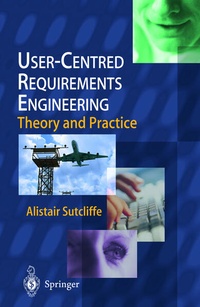
User-Centred Requirements Engineering
Published on 28. May 2002
Book
Paperback/Softback
XII, 215 pages
978-1-85233-517-5 (ISBN)
Description
If you have picked up this book and are browsing the Preface, you may well be asking yourself"What makes this book different from the large number I can find on amazon. com?". Well, the answer is a blend of the academic and the practical, and views of the subject you won't get from anybody else: how psychology and linguistics influence the field of requirements engineering (RE). The title might seem to be a bit of a conundrum; after all, surely requirements come from people so all requirements should be user-centred. Sadly, that is not always so; many system disasters have been caused simply because requirements engineering was not user-centred or, worse still, was not practised at all. So this book is about putting the people back into com puting, although not simply from the HCI (human-computer interaction) sense; instead, the focus is on how to understand what people want and then build appropriate computer systems.
More details
Edition
Softcover reprint of the original 1st ed. 2002
Language
English
Place of publication
London
United Kingdom
Target group
Professional and scholarly
Professional/practitioner
Illustrations
239 s/w Abbildungen
XII, 215 p. 239 illus.
Dimensions
Height: 235 mm
Width: 155 mm
Thickness: 13 mm
Weight
359 gr
ISBN-13
978-1-85233-517-5 (9781852335175)
DOI
10.1007/978-1-4471-0217-5
Schweitzer Classification
Person
Alistair Sutcliffe is Professor of Systems Engineering in the Manchester Business School, University of Manchester. He has been principal investigator on fifteen EPSRC and European Union projects on requirements engineering, multimedia user interfaces, safety critical systems and cognitive modelling for information retrieval. Currently funded research projects include EPSRC/ESRC Developing Theory for Evolving Socio-technical Systems (TESS), which is investigating technology-mediated social and work relationships based on Dunbars Social Brain Theory; EPSRC e-Science project ADaptive VISualisation tools for E-Science collaboration (ADVISES), which is producing interactive visualization tools for health informatics researchers; and EPSRC Artificial Cultures, which is researching evolutionary computing simulations for complex socio-technical systems. His research interests span a wide area within human computer interaction and software engineering. In HCI particular interests are interaction theory, and user interface design methods for the web, multimedia, and safety-critical systems; application of cognitive theory to design, and design of complex socio-technical systems. In software engineering, he specializes in requirements engineering methods and tools, scenario-based design, knowledge reuse and theories of domain knowledge. Alistair Sutcliffe is a leading member of both the international HCI and requirements engineering communities. He serves on the editorial boards of ACM-TOCHI, REJ and JASE. He is founder of IFIP TC-13 Working Group 13.2 Methodology for User-Centred Design and a member of IFIP working groups 8.1 (Information Systems) and 2.9 (Requirements Engineering) and is the editor of the ISO standard 14915, on Multimedia user interface design. He has over 200 publications, including five books, and several edited volumes of papers. He was awarded the IFIP Silver Core in 2000.
Content
1 Introduction.- 2 Understanding People.- 3 RE Tasks and Processes.- 4 Understanding Requirements Conversations.- 5 Representing the Problem.- 6 Scenario-Based Requirements Engineering (SCRAM).- 7 Requirements Analysis for Safety Critical Systems.- 8 Future Directions.- References.