

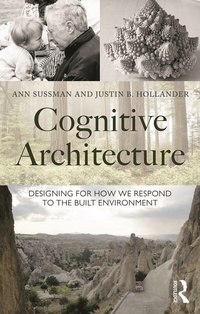
Cognitive Architecture
Designing for How We Respond to the Built Environment
1st Edition
Published on 15. October 2014
Book
Paperback/Softback
194 pages
978-0-415-72469-2 (ISBN)
Description
*Winner of the Environmental Design Research Association 2016 Place Research Award!*
In Cognitive Architecture, the authors review new findings in psychology and neuroscience to help architects and planners better understand their clients as the sophisticated mammals they are, arriving in the world with built-in responses to the environment that have evolved over millennia.
The book outlines four main principles---Edges Matter, the fact people are a?thigmotactic?or a 'wall-hugging' species; Patterns Matter, how we are visually-oriented; Shapes Carry Weight, how our preference for bilateral symmetrical forms is biological; and finally, Storytelling is Key, how our narrative proclivities, unique to our species, play a role in successful place-making. The book takes an inside-out approach to design, arguing that the more we understand human behavior, the better we can design for it. The text suggests new ways to analyze current designs before they are built, allowing the designer to anticipate a user's future experience. More than one hundred photographs and drawings illustrate its key concepts. Six exercises and additional case studies suggest particular topics - from the significance of face-processing in the human brain to our fascination with fractals - for further study.
In Cognitive Architecture, the authors review new findings in psychology and neuroscience to help architects and planners better understand their clients as the sophisticated mammals they are, arriving in the world with built-in responses to the environment that have evolved over millennia.
The book outlines four main principles---Edges Matter, the fact people are a?thigmotactic?or a 'wall-hugging' species; Patterns Matter, how we are visually-oriented; Shapes Carry Weight, how our preference for bilateral symmetrical forms is biological; and finally, Storytelling is Key, how our narrative proclivities, unique to our species, play a role in successful place-making. The book takes an inside-out approach to design, arguing that the more we understand human behavior, the better we can design for it. The text suggests new ways to analyze current designs before they are built, allowing the designer to anticipate a user's future experience. More than one hundred photographs and drawings illustrate its key concepts. Six exercises and additional case studies suggest particular topics - from the significance of face-processing in the human brain to our fascination with fractals - for further study.
Reviews / Votes
'The authors' intent to "encourage many more creative approaches to the [design] task, and not proscribe one specific architectural or planning style" has bee achieved, and within an admirably compact compass.' - Harold Henderson, Planning Magazine'At a time where architecture is all about spectacle, Hollander and Sussman remind us in Cognitive Architecture that buildings and cities profoundly affect our lives. Design impacts our senses, our psyche and our disposition, drawing on our history and our evolution as a species. The book brings us back to fundamentals, insisting that architectural design must consider and respond to our basic sensibilities. It returns architectural discourse to a place where the public at large can partake in the assessment of the built environment.' - Moshe Safdie, international architect and founder of Safdie Architects
'Cognitive Architecture is an important and insightful book that significantly links our responses to seemingly lifeless buildings to the very foundations of our inborn affinity for life. It takes our ancient intuitions about bringing buildings to life into the modern realm of rapidly unfolding discoveries in evolutionary biology and neuroscience. It critically goes beyond theory and science to the application of this knowledge to a better and more beneficial architecture and urban design.' - Stephen R. Kellert, Professor Emeritus and Senior Research Scholar, Yale University, and author of "Birthright: People and Nature in the Modern World.
'Cognitive Architecture is an inspiring book which introduces the reader to our sense of aesthetics that is at the core of human cognition in which we shape our built environment. This book will be of great value to architects, environmentalists, designers, geographers and planners, as well as students of those fields.'- Andreas Luescher, a Swiss architect and professor of architecture and environmental design, Bowling Green State University, Ohio
'Buildings are intended to be viewed, traversed, and lived in by people, but theoreticians and practitioners of architecture have rarely thought deeply about human nature and why and how it needs to be taken seriously when designing buildings and urban areas. In this short book, one of a small but growing number of contributions that are rectifying this deficiency, Sussman and Hollander clearly describe why our attraction to edges, faces, symmetry, curves, and stories, all of which have deep evolutionary roots, should influence architecture and urban design. Every person who wishes to design buildings should read and internalize the message of this book before putting pen to paper.' - Gordon H.Orians, Professor Emeritus of Biology, University of Washington, Seattle (Author of "Snakes, Sunrises, and Shakespeare. How Evolution Shapes Our Loves and Fears")
'As most apparent in the student exercises at the end of each chapter, this slender volume is didactic; those desiring a greater awareness of their built environments may find it useful. Summing Up: Recommended. All readership levels.' - CHOICE, A. J. Wharton, Duke University
'Sussman and Hollander have delivered a major advance in the creative union of human biology and architecture in the service of happiness.' - Edward O. Wilson, University Professor Emeritus, Harvard University, USA
'Cognitive Architecture expands the dialogue relating to communities and the urban environment by integrating research from seemingly unrelated fields into the design discourse. As a result of this approach, the book is one that is relevant across a wide array of disciplines, either situated in design or within other fields. In this regard, the book can also add an additional layer of depth and context to other social disciplines that evaluate the cognitively based relationships between people and their environments, including environmental psychology, place attachment, and even tourism.' - Courtney Grunninger Bonney, Clemson University
More details
Language
English
Place of publication
London
United Kingdom
Publishing group
Taylor & Francis Ltd
Target group
College/higher education
Professional and scholarly
Illustrations
29 Line drawings, black and white; 65 Halftones, black and white; 3 Tables, black and white; 9 Illustrations, black and white
Dimensions
Height: 216 mm
Width: 138 mm
Weight
317 gr
ISBN-13
978-0-415-72469-2 (9780415724692)
Copyright in bibliographic data and cover images is held by Nielsen Book Services Limited or by the publishers or by their respective licensors: all rights reserved.
Schweitzer Classification
Other editions
New editions
Ann Sussman | Justin Hollander
Cognitive Architecture
Designing for How We Respond to the Built Environment
Book
07/2021
2nd Edition
Routledge
€56.00
Shipment within 15-20 days
Additional editions
Ann Sussman | Justin Hollander
Cognitive Architecture
Designing for How We Respond to the Built Environment
Book
10/2014
1st Edition
Routledge
€237.70
Withdrawn from sale
Persons
Ann Sussman, AIA, an architect, works as an artist, writer and community organizer. With Justin Hollander, she created the Open Neighborhood Project, using art, craft and technological tools to increase public participation in planning, and earning the Commonwealth's "Gold Star Award" in 2010. Her studio is at ArtScape in the Bradford Mill, an art and business enclave in Concord, Massachusetts, USA.?
Justin Hollander, PhD, AICP is an Associate Professor in the Department of Urban and Environmental Policy and Planning at Tufts University, Medford, Massachusetts, USA, and the author of three previous books on city planning and design: Polluted and Dangerous (2009), Principles of Brownfield Regeneration (2010), and Sunburnt Cities (2011).
Justin Hollander, PhD, AICP is an Associate Professor in the Department of Urban and Environmental Policy and Planning at Tufts University, Medford, Massachusetts, USA, and the author of three previous books on city planning and design: Polluted and Dangerous (2009), Principles of Brownfield Regeneration (2010), and Sunburnt Cities (2011).
Content
1. A New Foundation: Darwin, Biology and Cognitive Science 2. Edges Matter: Thigmotaxis ('wall-hugging') 3. Patterns Matter: Faces and Spaces 4. Shapes carry Weight: Bilateral Symmetry, (Hierarchy), Curves and Complexity 5. Storytelling is Key: We're Wired for Narrative 6. Nature is our Context: Biophilia and Biophilic Design Appendix: More on the Morphology and Function of the Human Brain. Acknowledgments. Index