

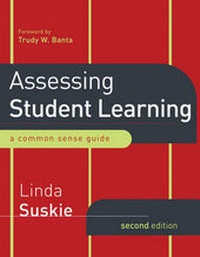
Assessing Student Learning
A Common Sense Guide
Published on 3. April 2009
Book
Paperback/Softback
384 pages
978-0-470-28964-8 (ISBN)
Description
The first edition of Assessing Student Learning has become the standard reference for college faculty and administrators who are charged with the task of assessing student learning within their institutions. The second edition of this landmark book offers the same practical guidance and is designed to meet ever-increasing demands for improvement and accountability. This edition includes expanded coverage of vital assessment topics such as promoting an assessment culture, characteristics of good assessment, audiences for assessment, organizing and coordinating assessment, assessing attitudes and values, setting benchmarks and standards, and using results to inform and improve teaching, learning, planning, and decision making. Praise for the Second Edition of Assessing Student Learning "All of us engaged in assessing student learning will benefit from Linda Suskie's continued work to define and refine assessment concepts and strategies. She asks, and answers, the hard questions we all need to address to plan and implement a successful assessment program." Randy L.
Swing, executive director, Association for Institutional Research "Once again, Linda Suskie provides a clear and comprehensive guide to assessment. Her truly commonsense approach distills vast amounts of scholarship on the topic and provides excellent examples of good practice. This book will be an invaluable resource to faculty and administrators working on assessment." Madeleine F. Green, vice president for international initiatives, American Council on Education "This book is a self-contained manual to assist anyone with the implementation of outcomes-based assessment. I highly recommend it to all of my students because Linda Suskie illustrates each step in great detail and answers common assessment questions clearly. I own two copies of the first edition, because one is always in use by one or more of my colleagues." Marilee J. Bresciani, associate professor, Administration, Rehabilitation, and Postsecondary Education, and codirector, Center for Educational Leadership, Innovation, and Policy, San Diego State University
Swing, executive director, Association for Institutional Research "Once again, Linda Suskie provides a clear and comprehensive guide to assessment. Her truly commonsense approach distills vast amounts of scholarship on the topic and provides excellent examples of good practice. This book will be an invaluable resource to faculty and administrators working on assessment." Madeleine F. Green, vice president for international initiatives, American Council on Education "This book is a self-contained manual to assist anyone with the implementation of outcomes-based assessment. I highly recommend it to all of my students because Linda Suskie illustrates each step in great detail and answers common assessment questions clearly. I own two copies of the first edition, because one is always in use by one or more of my colleagues." Marilee J. Bresciani, associate professor, Administration, Rehabilitation, and Postsecondary Education, and codirector, Center for Educational Leadership, Innovation, and Policy, San Diego State University
Reviews / Votes
"All of us engaged in assessing student learning will benefit from Linda Suskie's continued work to define and refine assessment concepts and strategies. She asks, and answers, the hard questions we all need to address to plan and implement a successful assessment program."?Randy L. Swing, executive director, Association for Institutional Research"Once again, Linda Suskie provides a clear and comprehensive guide to assessment. Her truly commonsense approach distills vast amounts of scholarship on the topic and provides excellent examples of good practice. This book will be an invaluable resource to faculty and administrators working on assessment."?Madeleine F. Green, vice president for international initiatives, American Council on Education
"This book is a self-contained manual to assist anyone with the implementation of outcomes-based assessment. I highly recommend it to all of my students because Linda Suskie illustrates each step in great detail and answers common assessment questions clearly. I own two copies of the first edition, because one is always in use by one or more of my colleagues." ?Marilee J. Bresciani, associate professor, Administration, Rehabilitation, and Postsecondary Education, and codirector, Center for Educational Leadership, Innovation, and Policy, San Diego State University
More details
Language
English
Place of publication
Chichester
United Kingdom
Publishing group
John Wiley and Sons Ltd
Dimensions
Height: 279 mm
Width: 216 mm
Thickness: 17 mm
Weight
887 gr
ISBN-13
978-0-470-28964-8 (9780470289648)
Copyright in bibliographic data and cover images is held by Nielsen Book Services Limited or by the publishers or by their respective licensors: all rights reserved.
Schweitzer Classification
Other editions
New editions
Book
04/2018
3rd Edition
Jossey-Bass
€45.00
Shipment within 15-20 days
Additional editions
E-Book
08/2010
2nd Edition
Jossey-Bass
€37.99
Available for download
E-Book
08/2010
2nd Edition
Jossey-Bass
€37.99
Available for download
Persons
Linda Suskie, internationally acclaimed writer, speaker, trainer, and consultant on higher education assessment, is a vice president of the Middle States Commission on Higher Education.
Content
About the Author. Foreword. Preface. Acknowledgments. Introduction. PART ONE: UNDERSTANDING ASSESSMENT. 1. What Is Assessment? 2. How Can Student Learning Be Assessed? 3. What Is Good Assessment? PART TWO: PLANNING FOR ASSESSMENT SUCCESS. 4. Why Are You Assessing Student Learning? 5. The Keys to a Culture of Assessment: Tangible Value and Respect. 6. Supporting Assessment Efforts with Time, Infrastructure, and Resources. 7. Organizing an Assessment Process. 8. Developing Learning Goals. PART THREE: THE ASSESSMENT TOOLBOX. 9. Using a Scoring Guide or Rubric to Plan and Evaluate an Assignment. 10. Creating an Effective Assignment. 11. Writing a Traditional Test. 12. Assessing Values, Attitudes, Dispositions, and Habits of Mind. 13. Assembling Assessment Information into Portfolios. 14. Selecting a Published Test or Survey. PART FOUR: UNDERSTANDING AND USING ASSESSMENT RESULTS. 15. Setting Benchmarks or Standards. 16. Summarizing and Analyzing Assessment Results. 17. Sharing Assessment Results with Internal and External Audiences. 18. Using Assessment Results Effectively and Appropriately. 19. Keeping the Momentum Going. References. Recommended Readings. Assessment Resources. Index.