

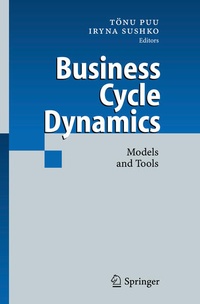
Business Cycle Dynamics
Models and Tools
Published on 14. October 2010
Book
Paperback/Softback
VIII, 336 pages
978-3-642-06879-9 (ISBN)
Description
Business cycle theory has been one of the fastest growing fields in modern nonlinear economic dynamics. The book is centered around models of multiplier-accelerator type, emerging from Samuelson's seminal work, later developed into nonlinear formats by Hicks and Goodwin. These models left open ends, as the tools then available did not permit more systematic analysis. The present situation is different, due to the emergence of new methods also focusing global analysis. The focus on classical, causal or recursive models implies a deviation from current main stream business cycle theory, based on "rational expectations", which in view of the possibility of mathematical chaos becomes untenable. This book is a rejoinder to
Puu and Sushko, Oligopoly Dynamics - Models and Tools
, (Springer 2002).
More details
Edition
Softcover reprint of hardcover 1st ed. 2006
Language
English
Place of publication
Berlin
Germany
Publishing group
Springer Berlin
Target group
Professional and scholarly
Research
Illustrations
VIII, 336 p.
Dimensions
Height: 235 mm
Width: 155 mm
Thickness: 19 mm
Weight
522 gr
ISBN-13
978-3-642-06879-9 (9783642068799)
DOI
10.1007/3-540-32168-3
Schweitzer Classification
Other editions
Additional editions
Book
05/2006
1st Edition
Springer
€106.99
Shipment within 10-15 days
Content
Aims and Scope.- Some Methods for the Global Analysis of Closed Invariant Curves in Two-Dimensional Maps.- Center Bifurcation for a Two-Dimensional Piecewise Linear Map.- Short History of the Multiplier-Accelerator Model.- Multiplier-Accelerator Models with Random Perturbations.- Non-Autonomous Business Cycle Model.- The Hicksian Model with Investment Floor and Income Ceiling.- Growth Cycles in a Modified Hicksian Business Cycle Model.- Coexistence of Attractors and Homoclinic Loops in a Kaldor-Like Business Cycle Model.- Expectations and the Multiplier-Accelerator Model.- 'Floors' and/or 'Ceilings' and the Persistence of Business Cycles.- A Goodwin-Type Model with Cubic Investment Function.- A Goodwin-Type Model with a Piecewise Linear Investment Function.