

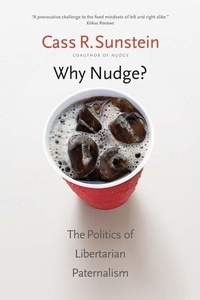
Why Nudge?
The Politics of Libertarian Paternalism
Published on 15. June 2015
Book
Paperback/Softback
208 pages
978-0-300-21269-3 (ISBN)
Description
The bestselling author of Simpler offers a powerful, provocative, and convincing argument for protecting people from their own mistakes
Based on a series of pathbreaking lectures given at Yale University in 2012, this powerful, thought-provoking work by national best-selling author Cass R. Sunstein combines legal theory with behavioral economics to make a fresh argument about the legitimate scope of government, bearing on obesity, smoking, distracted driving, health care, food safety, and other highly volatile, high-profile public issues. Behavioral economists have established that people often make decisions that run counter to their best interests-producing what Sunstein describes as "behavioral market failures." Sometimes we disregard the long term; sometimes we are unrealistically optimistic; sometimes we do not see what is in front of us. With this evidence in mind, Sunstein argues for a new form of paternalism, one that protects people against serious errors but also recognizes the risk of government overreaching and usually preserves freedom of choice.
Against those who reject paternalism of any kind, Sunstein shows that "choice architecture"-government-imposed structures that affect our choices-is inevitable, and hence that a form of paternalism cannot be avoided. He urges that there are profoundly moral reasons to ensure that choice architecture is helpful rather than harmful-and that it makes people's lives better and longer.
Based on a series of pathbreaking lectures given at Yale University in 2012, this powerful, thought-provoking work by national best-selling author Cass R. Sunstein combines legal theory with behavioral economics to make a fresh argument about the legitimate scope of government, bearing on obesity, smoking, distracted driving, health care, food safety, and other highly volatile, high-profile public issues. Behavioral economists have established that people often make decisions that run counter to their best interests-producing what Sunstein describes as "behavioral market failures." Sometimes we disregard the long term; sometimes we are unrealistically optimistic; sometimes we do not see what is in front of us. With this evidence in mind, Sunstein argues for a new form of paternalism, one that protects people against serious errors but also recognizes the risk of government overreaching and usually preserves freedom of choice.
Against those who reject paternalism of any kind, Sunstein shows that "choice architecture"-government-imposed structures that affect our choices-is inevitable, and hence that a form of paternalism cannot be avoided. He urges that there are profoundly moral reasons to ensure that choice architecture is helpful rather than harmful-and that it makes people's lives better and longer.
Reviews / Votes
"Cass Sunstein's quest is an important one."-Andrew Stark, TLS"While we tend to think that offering information merely allows us to choose our means more carefully, without affecting what ends we actually want to pursue, Sunstein argues quite convincingly that for that government to highlight certain information may actually affect our goals."-Sarah Conly, author of Against Autonomy: Justifying Coercive Paternalism
More details
Series
Language
English
Place of publication
United States
Target group
College/higher education
Professional and scholarly
Product notice
Paperback (trade)
Illustrations
3 b-w illus.
Dimensions
Height: 208 mm
Width: 134 mm
Thickness: 20 mm
Weight
245 gr
ISBN-13
978-0-300-21269-3 (9780300212693)
Copyright in bibliographic data and cover images is held by Nielsen Book Services Limited or by the publishers or by their respective licensors: all rights reserved.
Schweitzer Classification
Other editions
Previous edition
Book
03/2014
Yale University Press
€21.03
Article exhausted; check for reprint
Person
Cass R. Sunstein, the Robert Walmsley University Professor at Harvard University, is the author of several books, including Simpler: The Future of Government and, with coauthor Richard H. Thaler, Nudge: Improving Decisions About Health, Wealth, and Happiness. He lives in Cambridge, MA.