

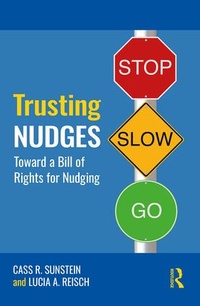
Trusting Nudges
Toward A Bill of Rights for Nudging
1st Edition
Published on 17. January 2019
Book
Hardback
146 pages
978-1-138-32278-3 (ISBN)
Description
Many "nudges" aim to make life simpler, safer, or easier for people to navigate, but what do members of the public really think about these policies? Drawing on surveys from numerous nations around the world, Sunstein and Reisch explore whether citizens approve of nudge policies. Their most important finding is simple and striking. In diverse countries, both democratic and nondemocratic, strong majorities approve of nudges designed to promote health, safety, and environmental protection-and their approval cuts across political divisions.
In recent years, many governments have implemented behaviorally informed policies, focusing on nudges-understood as interventions that preserve freedom of choice, but that also steer people in certain directions. In some circles, nudges have become controversial, with questions raised about whether they amount to forms of manipulation. This fascinating book carefully considers these criticisms and answers important questions. What do citizens actually think about behaviorally informed policies? Do citizens have identifiable principles in mind when they approve or disapprove of the policies? Do citizens of different nations agree with each other?
From the answers to these questions, the authors identify six principles of legitimacy-a "bill of rights" for nudging that build on strong public support for nudging policies around the world, while also recognizing what citizens disapprove of. Their bill of rights is designed to capture citizens' central concerns, reflecting widespread commitments to freedom and welfare that transcend national boundaries.
In recent years, many governments have implemented behaviorally informed policies, focusing on nudges-understood as interventions that preserve freedom of choice, but that also steer people in certain directions. In some circles, nudges have become controversial, with questions raised about whether they amount to forms of manipulation. This fascinating book carefully considers these criticisms and answers important questions. What do citizens actually think about behaviorally informed policies? Do citizens have identifiable principles in mind when they approve or disapprove of the policies? Do citizens of different nations agree with each other?
From the answers to these questions, the authors identify six principles of legitimacy-a "bill of rights" for nudging that build on strong public support for nudging policies around the world, while also recognizing what citizens disapprove of. Their bill of rights is designed to capture citizens' central concerns, reflecting widespread commitments to freedom and welfare that transcend national boundaries.
Reviews / Votes
"This is a fantastic book that will be required reading for the growing number of people around the world who want to nudge for good!", Owain Service, UK Behavioural Insights Team"Nudges can save lives, but only if people let them. Drawing on surveys from around the world, Sunstein and Reisch find surprising regularities in the policies people support, regularities that generalize across nations and nudges. This book is essential reading for prudent policymakers.", Barbara Ann Mellers, I. George Heyman University Professor, Wharton University of Pennsylvania, USA
"The results of carefully collected survey data from several countries inform the design of a convincing "bill of rights" for nudges by government, a list of rights that is also consistent with broadly accepted normative principles. The book is thus an important guide for research and practice going forward.", Jonathan Baron, Professor of Psychology, School of Arts and Sciences, University of Pennsylvania, USA "A short, thoughtful, measured and important analysis of what citizens actually think about nudging and why that matters." Julian Baggini, Financial Times
"Trusting Nudges is a timely contribution to prudent policymaking...For those who have followed nudge hypothesis, this book is a welcome addition to the growing literature on a subject that captures central concerns in legitimising the role of nudges in civic life." Sudhirendar Sharma, The Hindu Business Line
"This is a fantastic book that will be required reading for the growing number of people around the world who want to nudge for good!", Owain Service, UK Behavioural Insights Team
"Trusting Nudges is an important contribution to the literature of behaviourally informed policy...The comparison between countries is particularly necessary to establish a common base for nudges. Trusting Nudges has collected a small arsenal of evidence for this purpose that may inspire further research about how and why people will accept behaviourally informed policies.", D.O. Kasdan, Journal of Consumer Policy
"Nudges can save lives, but only if people let them. Drawing on surveys from around the world, Sunstein and Reisch find surprising regularities in the policies people support, regularities that generalize across nations and nudges. This book is essential reading for prudent policymakers.", Barbara Ann Mellers, I. George Heyman University Professor, Wharton University of Pennsylvania, USA
"The results of carefully collected survey data from several countries inform the design of a convincing "bill of rights" for nudges by government, a list of rights that is also consistent with broadly accepted normative principles. The book is thus an important guide for research and practice going forward.", Jonathan Baron, Professor of Psychology, School of Arts and Sciences, University of Pennsylvania, USA
"In some circles, nudges have become controversial, with questions raised about whether they amount to forms of manipulation. This fascinating book carefully considers these criticisms and answers important questions -H.-W. Micklitz, Journal of Consumer Policy
More details
Series
Language
English
Place of publication
London
United Kingdom
Publishing group
Taylor & Francis Ltd
Target group
College/higher education
Professional and scholarly
Postgraduate, Professional Practice & Development, and Undergraduate
Illustrations
53 s/w Abbildungen, 1 s/w Photographie bzw. Rasterbild, 52 s/w Zeichnungen, 36 s/w Tabellen
36 Tables, black and white; 52 Line drawings, black and white; 1 Halftones, black and white; 53 Illustrations, black and white
Dimensions
Height: 234 mm
Width: 156 mm
Weight
384 gr
ISBN-13
978-1-138-32278-3 (9781138322783)
Copyright in bibliographic data and cover images is held by Nielsen Book Services Limited or by the publishers or by their respective licensors: all rights reserved.
Schweitzer Classification
Other editions
Additional editions
Book
12/2019
1st Edition
Routledge
€38.40
Shipment within 15-20 days
E-Book
01/2019
1st Edition
Routledge
€27.49
Available for download
E-Book
01/2019
1st Edition
Routledge
€27.49
Available for download
Persons
Cass R. Sunstein is the Robert Walmsley University Professor at Harvard, USA. From 2009 to 2012, he was Administrator of the White House Office of Information and Regulatory Affairs. He is the founder and director of the Program on Behavioral Economics and Public Policy at Harvard Law School.
Lucia A. Reisch is a behavioral economist and Professor at Copenhagen Business School, Denmark. She also holds a permanent Guest Professorship at the Zeppelin University of Friedrichshafen, Germany, and an appointment as honorary Leibniz Chair, awarded by the German Leibniz Association and the Leibniz Institute of Prevention Research and Epidemiology.
Lucia A. Reisch is a behavioral economist and Professor at Copenhagen Business School, Denmark. She also holds a permanent Guest Professorship at the Zeppelin University of Friedrichshafen, Germany, and an appointment as honorary Leibniz Chair, awarded by the German Leibniz Association and the Leibniz Institute of Prevention Research and Epidemiology.
Content
Preface. 1. Why Public Opinion Matters. 2. The United States, 1: Evidence. 3. The United States, 2: Principles. 4. Europe. 5. A Global Consensus? Not Quite. 6. Trusting Nudges. 7. Educative Nudges and Noneducative Nudges. 8. Misconceptions. 9. A Bill of Rights for Nudging. Acknowledgments