

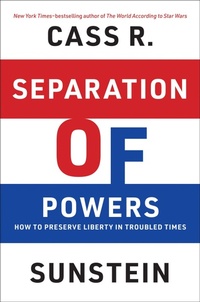
Separation of Powers
How to Preserve Liberty in Troubled Times
Published on 17. February 2026
Book
Hardback
168 pages
978-0-262-05177-4 (ISBN)
Description
From the winner of the Holberg Prize and New York Times bestselling author of The World According to Star Wars. All over the world, people are questioning the separation of powers. They want a strong man, able to do what must be done. But James Madison was right to say this: 'The accumulation of all powers, legislative, executive, and judiciary, in the same hands, whether of one, a few, or many, and whether hereditary, self-appointed, or elective, may justly be pronounced the very definition of tyranny.' In this essential and immensely timely book, Separation of Powers, Cass Sunstein explains why the separation of powers is necessary for both freedom and self-government. He shows that freedom from fear is a central goal of the system of separation of powers. He also explains why the executive branch is the most dangerous branch, why the idea of presidential immunity is a terrible one, and why an independent judiciary is crucial. Drawing on his extensive experience in the White House, the Department of Justice, and the Department of Homeland Security, the author also argues that the separation of powers is, in fact, six separations of powers: (1) The legislature may not exercise the executive power. (2) The legislature may not exercise the judicial power. (3) The executive may not exercise the legislative power. (4) The executive may not exercise the judicial power. (5) The judiciary may not exercise the legislative power. (6) The judiciary may not exercise the executive power. Each of these is essential to liberty under law.
Reviews / Votes
ENDORSEMENTS"James Madison once noted that questions about the separation of powers 'puzzle the greatest adepts in political science.' Cass Sunstein ranks high among today's greatest adepts, and his deft analysis in this brief but incisive book demonstrates why."
-Jack Rakove, William R. Coe Professor of History and American Studies and Professor of Political Science, emeritus, Stanford University; author of Original Meanings
"Separation of Powers is as powerful as it is timely. Subtly drawing parallels between Nazi Germany's obedience to its fuehrer and the current obsequious treatment of the leader of the United States, Sunstein mounts a devastating attack on the Supreme Court's recent decisions that undermine the separation of powers and threaten the liberty that the separation of powers has protected for nearly 250 years."
-Jack Beermann, Philip S. Beck Professor of Law, Boston University
"Cass Sunstein never disappoints. This book will make everyone stop and think about the separation of powers. Progressives will like his critique of the 'Grand Narrative' of separation of powers that is now dominating the Supreme Court. Conservatives and libertarians will be intrigued by his description of how 'partyism' is weakening the separation of powers that is essential to protecting our liberty. A good read."
-Randy Barnett, Patrick Hotung Professor of Constitutional Law, Georgetown University Law Center; Faculty Director, Georgetown Center for the Constitution; author of A Life for Liberty
"As the separation between our branches becomes increasingly blurred, and the executive sweeps more powers into its gaping maw, Cass Sunstein's terrific, trenchant, and timely tome becomes required reading. Read it now and relearn why we should all bet on the separation of powers."
-Saikrishna Prakash, James Monroe Distinguished Professor of Law, University of Virginia
"Cass Sunstein writes from long experience; he has thought about these questions for decades. Clear, earnest, and incisive, this book is an advanced introduction to some of the most important ideas in American constitutionalism."
-Jack Balkin, Knight Professor of Constitutional Law and the First Amendment, Yale Law School
"Both timely and timeless, Separation of Powers offers a trenchant analysis of a key structural feature of the U.S. government aimed at protecting against tyranny. Anyone concerned about the growth of unchecked executive power in the United States will benefit from reading this book."
-Cary Coglianese, Edward B. Shils Professor of Law and Professor of Political Science, University of Pennsylvania; Director, Penn Program on Regulation
More details
Language
English
Place of publication
Cambridge (Massachusetts)
United States
Publishing group
MIT Press Ltd
Dimensions
Height: 233 mm
Width: 154 mm
Thickness: 22 mm
Weight
402 gr
ISBN-13
978-0-262-05177-4 (9780262051774)
Copyright in bibliographic data and cover images is held by Nielsen Book Services Limited or by the publishers or by their respective licensors: all rights reserved.
Schweitzer Classification
Other editions
Additional editions
E-Book
02/2026
MIT Press
€24.49
Available for download
Person
Cass R. Sunstein is Robert Walmsley University Professor at Harvard University, where he is the founder and director of the Program on Behavioral Economics and Public Policy. Former Administrator of the White House Office of Information and Regulatory Affairs, he is the author of On Liberalism, Climate Justice, The Cost-Benefit Revolution, How Change Happens, Too Much Information, Sludge, Climate Justice (all published by the MIT Press), Nudge (with Richard H. Thaler), and other books. In 2024, he was awarded the Distinguished Public Service Medal, the Department of Homeland Security s highest civilian honor.
Content
Table of Contents
Chapter 1: Freedom and Tyranny
Chapter 2: What the Legislature Cannot Do
Chapter 3: What the Executive Cannot do
Chapter 4: What the Courts Cannot Do
Chapter 5: The President’s Immunity
Chapter 6: The Most Dangerous Branch
Chapter 7: Deliberative Democracy in the Trenches
Chapter 8: The Grand Narrative
Chapter 9: Nondelegation Canons
Chapter 10: Major Questions
Chapter 11: Arms Control Is Hard
Epilogue
Chapter 1: Freedom and Tyranny
Chapter 2: What the Legislature Cannot Do
Chapter 3: What the Executive Cannot do
Chapter 4: What the Courts Cannot Do
Chapter 5: The President’s Immunity
Chapter 6: The Most Dangerous Branch
Chapter 7: Deliberative Democracy in the Trenches
Chapter 8: The Grand Narrative
Chapter 9: Nondelegation Canons
Chapter 10: Major Questions
Chapter 11: Arms Control Is Hard
Epilogue