

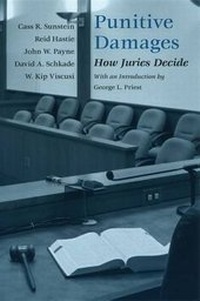
Punitive Damages
How Juries Decide
Will be published approx. on 15. April 2002
Book
Hardback
296 pages
978-0-226-78014-6 (ISBN)
Description
Over the past two decades, the United States has seen a dramatic increase in the number and magnitude of punitive damages verdicts rendered by juries in civil trials. Probably the most extraordinary example is the July 2000 award of $144.8 billion in the Florida class action lawsuit brought against the cigarette manufacturers. More puzzling were two recent verdicts against the auto manufacturer BMW in Alabama. In identical cases, argued in the same court before the same judge, one jury awarded $4 million in punitive damages, while the other awarded no punitive damages at all. In cases involving accidents, civil rights and the environment, multimillion dollar punitive awards have been a subject of intense controversy. But how do juries actually make decisions about punitive damages? To find out, the authors - specialists in psychology, economics and the law - present the results of controlled experiments with over 600 mock juries involving the responses of more than 8,000 jury-eligible citizens. They find that although juries tended to agree in their moral judgements about the defendant's conduct, they rendered erratic and unpredictable dollar awards.
Jurors also tended to ignore instructions from the judges; showed "hindsight bias", believing that what happened should have been foreseen; and penalized corporations that had based their decisions on careful cost-benefit analyses. While judges made many of the same errors, they performed better in some areas, suggesting that judges (or other specialists) may be better equipped than juries to decide punitive damages. With a wealth of new data and a host of provocative findings, this book documents a wide range of systematic bias in jury behaviour and should be valuable for anyone interested in punitive damages, jury behaviour, human psychology and the theory of punishment.
Jurors also tended to ignore instructions from the judges; showed "hindsight bias", believing that what happened should have been foreseen; and penalized corporations that had based their decisions on careful cost-benefit analyses. While judges made many of the same errors, they performed better in some areas, suggesting that judges (or other specialists) may be better equipped than juries to decide punitive damages. With a wealth of new data and a host of provocative findings, this book documents a wide range of systematic bias in jury behaviour and should be valuable for anyone interested in punitive damages, jury behaviour, human psychology and the theory of punishment.
Reviews / Votes
"Punitive Damages pulls together a series of important empirical findings and situates them within a policy and methodological framework. It is accessible to nonspecialists and will certainly appeal to academics interested in jury behavior, as well as policy-makers considering the issue of punitive damages reform." - Christine M. Jolls, Harvard Law SchoolMore details
Language
English
Place of publication
Chicago
United States
Publishing group
The University of Chicago Press
Target group
College/higher education
Professional and scholarly
Dimensions
Height: 23 mm
Width: 17 mm
Thickness: 2 mm
Weight
595 gr
ISBN-13
978-0-226-78014-6 (9780226780146)
Copyright in bibliographic data and cover images is held by Nielsen Book Services Limited or by the publishers or by their respective licensors: all rights reserved.
Schweitzer Classification
Other editions
Additional editions
E-Book
12/2008
1st Edition
University of Chicago Press
€49.89
Available for download
Persons
Cass R. Sunstein is Karl N. Llewellyn Distinguished Service Professor of Jurisprudence in the Law School and the Department of Political Science at the University of Chicago. Reid Hastie is professor of behavioral science in the Graduate School of Business at the University of Chicago. John W. Payne is Joseph J. Ruvane Jr. Professor of Management, professor of psychology, and research professor of statistics and decision sciences at the Fuqua School of Business at Duke University. David A. Schkade is Herbert D. Kelleher Regents Professor of Business at the University of Texas at Austin. W. Kip Viscusi is John F. Cogan Jr. Professor of Law and Economics at Harvard Law School.