

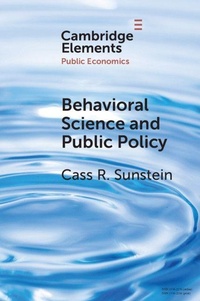
Behavioral Science and Public Policy
Published on 12. November 2020
Book
Paperback/Softback
84 pages
978-1-108-97278-9 (ISBN)
Description
Behavioral science is playing an increasing role in public policy, and it is raising new questions about fundamental issues - the role of government, freedom of choice, paternalism, and human welfare. In diverse nations, public officials are using behavioral findings to combat serious problems - poverty, air pollution, highway safety, COVID-19, discrimination, employment, climate change, and occupational health. Exploring theory and practice, this Element attempts to provide one-stop shopping for those who are new to the area and for those who are familiar with it. With reference to nudges, taxes, mandates, and bans, it offers concrete examples of behaviorally informed policies. It also engages the fundamental questions, include the proper analysis of human welfare in light of behavioral findings. It offers a plea for respecting freedom of choice - so long as people's choices are adequately informed and free from behavioral biases.
More details
Series
Language
English
Place of publication
Cambridge
United Kingdom
Target group
Professional and scholarly
Product notice
Paperback (trade)
Illustrations
Worked examples or Exercises
Dimensions
Height: 222 mm
Width: 146 mm
Thickness: 7 mm
Weight
124 gr
ISBN-13
978-1-108-97278-9 (9781108972789)
Copyright in bibliographic data and cover images is held by Nielsen Book Services Limited or by the publishers or by their respective licensors: all rights reserved.
Schweitzer Classification
Other editions
Additional editions
Cass R. Sunstein
Behavioral Science and Public Policy
E-Book
02/2021
Cambridge University Press
€15.49
Available for download
Cass R. Sunstein
Behavioral Science and Public Policy
E-Book
11/2020
Cambridge University Press
€14.49
Available for download
Person
Content
1. The behavioral revolution; 2. Do our choices make us happy; 3. Government; 4. Mistakes; 5. Judgments; 6. Theory and practice; 7. Welfare; 8. Freedom; 9. Paths forward.