

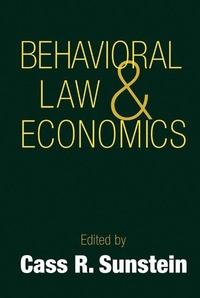
Behavioral Law and Economics
Published on 28. March 2000
Book
Hardback
448 pages
978-0-521-66135-5 (ISBN)
Description
This exciting volume marks the birth of a new field, one which attempts to study law with reference to an accurate understanding of human behavior. It reports new findings in cognitive psychology which show that people are frequently both unselfish and over-optimistic; that people have limited willpower and limited self-control; and that people are 'boundedly' rational, in the sense that they have limited information-processing powers, and frequently rely on mental short-cuts and rules of thumb. Understanding this behavior has large-scale implications for the analysis of law, in areas including environmental protection, taxation, constitutional law, voting behavior, punitive damages for civil rights violations, labor negotiations, and corporate finance. With a better knowledge of human behavior, it is possible to predict the actual effects of law, to see how law can promote society's goals, and to reassess the questions of what law should be doing.
Reviews / Votes
"Human psychology is complicated. The law and economics paradigm traditionally has treated it as simple. This volume splendidly marshals leading works by scholars whoin pursuit of realism--seek to add complexity to the traditional paradigm. A significant landmark in the field of law and social science." Robert C. Ellickson, Walter E. Meyer Professor of Property and Urban Law, Yale Law School "...this is a valuable contribution to the study of law and courts....This compilation serves to focus discussion on a set of particularly important theoretical challenges to the standard economic model. Thus, this book belongs on the shelf of any student of the law and courts who advocates or challenges the rational choice model of decision making on the courts." Paul J. Wahlbeck, The Law & Politics Book Review "...the essays in this book provide a clear and vivid introduction into a research program that promises to illuminate our understanding of how law influences behavior." New York Law JournalMore details
Series
Language
English
Place of publication
Cambridge
United Kingdom
Target group
Professional and scholarly
Illustrations
29 Tables, unspecified; 42 Line drawings, unspecified
Dimensions
Height: 235 mm
Width: 157 mm
Thickness: 31 mm
Weight
873 gr
ISBN-13
978-0-521-66135-5 (9780521661355)
Copyright in bibliographic data and cover images is held by Nielsen Book Services Limited or by the publishers or by their respective licensors: all rights reserved.
Schweitzer Classification
Other editions
Additional editions
Cass R. Sunstein
Behavioral Law and Economics
Book
03/2000
Cambridge University Press
€77.60
Shipment within 15-20 days
Cass R. Sunstein
Behavioral Law and Economics
E-Book
03/2000
1st Edition
Cambridge University Press
€41.49
Available for download
Person
Content
Introduction Cass R. Sunstein; Part I. Overviews and Prospects: 1. A behavioral approach to law and economics Christine Jolls, Cass R. Sunstein and Richard Thaler; Part II. Heuristics and Biases: Shortcuts, Errors and Legal Decisions: 2. Context-dependence in legal decision making Mark Kelman, Yuval Rottenstreich and Amos Tversky; 3. A positive psychological theory of judging in hindsight Jeffrey J. Rachlinski; 4. Behavioral economics, contract formation, and contract law Russell Korobkin; 5. Organized illusions: a behavioral theory of why corporations mislead stock market investors (and cause other social harms) Donald C. Langevoort; 6. Reluctance to vaccinate: omission bias and ambiguity Ilana Ritov and Jonathan Baron; 7. Second-order decisions Cass R. Sunstein and Edna Ullmann-Margalit; Part III. Valuation: Values and Dollars in the Legal System: 8. Experimental tests of the endowment effect and the cause theorem Daniel J. Kahneman, Jack L. Knetsch and Richard H. Thaler; 9. Assessing punitive damages (with notes on cognition and valuation in law) Cass R. Sunstein, Daniel J. Kahneman and David Schkade; 10. Framing the jury: cognitive perspective on pain and suffering award Edward J. McCaffery, Daniel J. Kahneman and Matthew L. Spitzer; 11. Behavioral economic analysis of redistributive legal rules Christine Jolls; 12. Do parties to nuisance cases bargain after judgment? A glimpse inside the cathedral Ward Fransworth; Part IV. The Demand for Law: Why Law Is As It Is: 13. Some implications of cognitive psychology for risk regulation Roger G. Noll and James E. Krier; 14. Explaining bargaining impasse: the role of self-serving biases Linda Babcock and George Loewenstein; 15. Controlling availability cascades Timur Kuran and Cass R. Sunstein; 16. Cognitive theory and tax Edward J. McCaffery.