

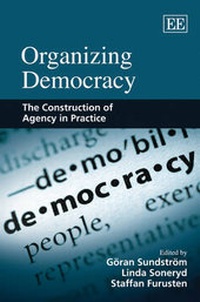
Organizing Democracy
The Construction of Agency in Practice
Published on 29. January 2010
Book
Hardback
176 pages
978-1-84844-428-7 (ISBN)
Description
This fresh and fascinating book adds an organizational perspective to the analysis of governance and democracy. It argues that a number of organizational factors challenge the notion of agency assumed by a governance model.
The expert contributors criticize the governance model for resting on the rational myth and the assumption that democratic ideals can be translated to specified democratic values, which in turn can be adhered to by democratic agents. By adding an organizational perspective to the analysis of governance and democracy, the book proves that theories about organizing and the construction of agency can be used to explain how and why democratic values are attended to in governance structures.
Organizing Democracy will prove essential reading for researchers and postgraduate students in public management, organizational studies, political science and sociology. Practitioners with an interest in public management policy will also find this book invaluable.
The expert contributors criticize the governance model for resting on the rational myth and the assumption that democratic ideals can be translated to specified democratic values, which in turn can be adhered to by democratic agents. By adding an organizational perspective to the analysis of governance and democracy, the book proves that theories about organizing and the construction of agency can be used to explain how and why democratic values are attended to in governance structures.
Organizing Democracy will prove essential reading for researchers and postgraduate students in public management, organizational studies, political science and sociology. Practitioners with an interest in public management policy will also find this book invaluable.
Reviews / Votes
'Governance has emerged a central concept in the fields of both political theory and public administration. But it has not done so without controversy and this book examines one of the primary concerns associated with the theory and practice of government - namely, its relationship to democratic values and their practical realization. Moreover, it does this through a neglected perspective. Whereas most research on governance has taken a top down approach, these essays look at specific empirical experiences from the bottom up. The book thus offers a new and useful discussion on an essential question in contemporary debates about governance.' -- Frank Fischer, Rutgers University, US 'Nationally and supra-nationally, political decision-making shifts from democratic fora to decentralized organizations of what is called "governance". Questions arise about the survival of democratic values in unaccountable structures that assign agency to special interests and to professional and non-governmental expertise. Organizing Democracy provides detailed case studies of these new forms, and assesses how they carry or deflect democratic values. It will be of great interest to students of new organizational forms, and those concerned with the maintenance of democracy.' -- John W. Meyer, Stanford University, US 'The proliferation of interactive forms of governance may challenge and problemematize the predominant model of liberal representative democracy. Nevertheless, the new governance arrangements may also contribute to a reinvigoration of democracy in the face of the growing democratic disenchantment. Instead of continuing the endless theoretical debates on this issue, this book presents a number of empirical studies of how democracy is articulated and re-articulated by a plethora of actors in the new interactive governance arenas. As such, the book provides a most welcome analysis of the embryonic reinvention of democracy in our increasingly complex, fragmented and multi-layered societies.' -- Jacob Torfing, Roskilde University, DenmarkMore details
Language
English
Place of publication
Cheltenham
United Kingdom
Target group
Professional and scholarly
Dimensions
Height: 234 mm
Width: 156 mm
ISBN-13
978-1-84844-428-7 (9781848444287)
Copyright in bibliographic data and cover images is held by Nielsen Book Services Limited or by the publishers or by their respective licensors: all rights reserved.
Schweitzer Classification
Persons
Edited by Goeran Sundstroem, Associate Professor in Political Science, Stockholm University and Research Director, Stockholm Centre for Organizational Research (Score), Sweden, Linda Soneryd, Associate Professor in Sociology, University of Gothenburg and Staffan Furusten, Professor of Management, Organization and Society, Stockholm Business School, and Director, Stockholm Centre for Organizational Research (SCORE), Stockholm University, Sweden
Content
Contents:
1. Democracy, Governance and the Problem of the Modern Actor
Goeran Sundstroem, Staffan Furusten and Linda Soneryd
2. Organizing Participation. Establishing a Discourse of Local Democratic Governance for Young People in Sweden
Adrienne Soerbom
3. Completed Responsibility? Delegation, Organization and Accountability in Swedish Export of Military Equipment
Catrin Andersson
4. The Use of Democratic Values in the ISO 26000 Process on Social Responsibility
Kristina Tamm Hallstroem
5. Public Purchasing of Complex Services. Balancing Democratic and Market Values
Staffan Furusten
6. In Search of Democracy. The Process Behind the Swedish Forest-sector Objectives
Goeran Sundstroem
7. Democratic Priority Setting? Organizing Multiple Stakeholders to Make Decisions in the Healthcare Sector
Ebba Sjoegren and Karin Fernler
8. By a Stretch of the Imagination. Public Involvement in Nuclear Waste Management
Linda Soneryd
9. Democratic Values and the Organizing of Actors in Governance Structures
Linda Soneryd, Staffan Furusten and Goeran Sundstroem
References
Index
1. Democracy, Governance and the Problem of the Modern Actor
Goeran Sundstroem, Staffan Furusten and Linda Soneryd
2. Organizing Participation. Establishing a Discourse of Local Democratic Governance for Young People in Sweden
Adrienne Soerbom
3. Completed Responsibility? Delegation, Organization and Accountability in Swedish Export of Military Equipment
Catrin Andersson
4. The Use of Democratic Values in the ISO 26000 Process on Social Responsibility
Kristina Tamm Hallstroem
5. Public Purchasing of Complex Services. Balancing Democratic and Market Values
Staffan Furusten
6. In Search of Democracy. The Process Behind the Swedish Forest-sector Objectives
Goeran Sundstroem
7. Democratic Priority Setting? Organizing Multiple Stakeholders to Make Decisions in the Healthcare Sector
Ebba Sjoegren and Karin Fernler
8. By a Stretch of the Imagination. Public Involvement in Nuclear Waste Management
Linda Soneryd
9. Democratic Values and the Organizing of Actors in Governance Structures
Linda Soneryd, Staffan Furusten and Goeran Sundstroem
References
Index