

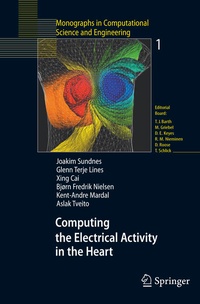
Computing the Electrical Activity in the Heart
Published on 30. November 2010
Book
Paperback/Softback
XII, 318 pages
978-3-642-07005-1 (ISBN)
Description
The heart is a fantastic machine; during a normal lifetime it beats about 2.5 billion times and pumps 200.000 tons of blood through an enormous system of vessels extending 160.000 kilometres throughout the body. For centuries, man has tried to understand how the heart works, but there remain many unsolved problems, problems that have captured the attention of thousands of researchers worldwide. There is, for example, a huge amount of research being devoted to the analysis of single heart cells. Other areas of research include trying to understand how it works as a complete muscle, and how blood ows through the heart. The entire process is extremely complex. The history of bioelectricity can be traced back to the late eighteenth century and the experiments of Luigi Galvani. A century later, in 1887, Augustus Wallers managed to measure the electrical signal generated by the heart at the surface of the body [142]. His dog Jimmy earned a place in history by being the rst to have his heart measured in this way; see Figure 1.1. In 1903 Willem Einthoven [34] - veloped the rst commercial device for recording electrocardiograms (ECGs); see Figure 1.2.
More details
Series
Edition
1st ed. Softcover of orig. ed. 2006
Language
English
Place of publication
Berlin
Germany
Publishing group
Springer Berlin
Target group
Professional and scholarly
Research
Illustrations
81 s/w Abbildungen, 18 farbige Abbildungen
XII, 318 p. 99 illus., 18 illus. in color.
Dimensions
Height: 235 mm
Width: 155 mm
Thickness: 19 mm
Weight
505 gr
ISBN-13
978-3-642-07005-1 (9783642070051)
DOI
10.1007/3-540-33437-8
Schweitzer Classification
Other editions
Additional editions
Joakim Sundnes | Glenn Terje Lines | Xing Cai
Computing the Electrical Activity in the Heart
Book
08/2006
Springer
€117.69
Shipment within 10-15 days
Persons
Joakim Sundnes is Chief Research Scientist at Simula Research Laboratory and teaches undergraduate programming at the University of Oslo. His research interests are scientific computing and computational science, particularly related to biomechanics and computational physiology. Mathematical models in these fields are typically formulated as differential equations, and he has spent more than two decades developing and implementing solvers for these models. He is also responsible for the main introductory programming class for natural science students at the University of Oslo, which includes a thorough introduction to ordinary differential equations.
Content
Physiological Background.- Mathematical Models.- Computational Models.- Solving Linear Systems.- Solving Systems of ODEs.- Large-Scale Electrocardiac Simulations.- Inverse Problems.