

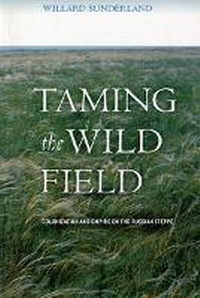
Taming the Wild Field
Colonization and Empire on the Russian Steppe
Published on 20. May 2004
Book
Hardback
264 pages
978-0-8014-4209-4 (ISBN)
Description
Stretching from the tributaries of the Danube to the Urals and from the Russian forests to the Black and Caspian seas, the vast European steppe has for centuries played very different roles in the Russian imagination. To the Grand Princes of Kiev and Muscovy, it was the "wild field," a region inhabited by nomadic Turko-Mongolic peoples who repeatedly threatened the fragile Slavic settlements to the north. For the emperors and empresses of imperial Russia, it was a land of boundless economic promise and a marker of national cultural prowess. By the mid-nineteenth century the steppe, once so alien and threatening, had emerged as an essential, if complicated, symbol of Russia itself.
Traversing a thousand years of the region's history, Willard Sunderland recounts the complex process of Russian expansion and colonization, stressing the way outsider settlement at once created the steppe as a region of empire and was itself constantly changing. The story is populated by a colorful array of administrators, Cossack adventurers, Orthodox missionaries, geographers, foreign entrepreneurs, peasants, and (by the late nineteenth century) tourists and conservationists. Sunderland's approach to history is comparative throughout, and his comparisons of the steppe with the North American case are especially telling. Taming the Wild Field eloquently expresses concern with the fate of the world's great grasslands, and the book ends at the beginning of the twentieth century with the initiation of a conservation movement in Russia by those appalled at the high environmental cost of expansion.
Traversing a thousand years of the region's history, Willard Sunderland recounts the complex process of Russian expansion and colonization, stressing the way outsider settlement at once created the steppe as a region of empire and was itself constantly changing. The story is populated by a colorful array of administrators, Cossack adventurers, Orthodox missionaries, geographers, foreign entrepreneurs, peasants, and (by the late nineteenth century) tourists and conservationists. Sunderland's approach to history is comparative throughout, and his comparisons of the steppe with the North American case are especially telling. Taming the Wild Field eloquently expresses concern with the fate of the world's great grasslands, and the book ends at the beginning of the twentieth century with the initiation of a conservation movement in Russia by those appalled at the high environmental cost of expansion.
Reviews / Votes
As Willard Sunderland points out in this pioneering study of the colonization of the Russian steppe, the 'wild field' in his title, historians have been largely as prone as Russian rulers to accept the vision of the eighteenth-century cartographers that the steppes were an empty space awaiting to be peopled.... Sunderland offers a fresh perspective from which to appreciate history's multiple experiences with decolonization.(Journal of World History) In this sweeping survey, Sunderland details processes of Russia's colonization of the steppe that highlight its particularities as well as place the country within a larger western imperial pattern of expansion.... He thoughtfully considers the complexity of steppe expansion, and what it tells us about educated society, the state, and empire in Russia, as well as fitting this expansion into a global pattern from the sixteenth to the end of the nineteenth century.
(Journal of Colonialism and Colonial History) The 'wild field' was the name given by the early forest-dwelling Eastern Slavs to the immense grasslands (also known as the steppe) that stretched north of the Black Sea from the Danube River to the Ural Mountains.... In this excellent book, Sunderland examines the expansion of Russia into this area.... Using extensive local and national archives, the author shows that this colonization changed over time and established a multifaceted imperialism that involved empire building, state building, society building, and nation building. Sunderland makes frequent comparisons to the history of similar regions such as the North American Great Plains. Highly recommended.
(Choice) This book provides an engaging and provocative account of the role of popular and state initiatives in Russian colonization of the Black Sea-Caspian steppe from the sixteenth century to the late nineteenth century.... Taming the Wild Field makes the case for reasserting the importance of late Muscovite and Imperial Russian history by placing them within the larger contexts of the history of Inner Eurasia and the comparative study of empire.
(Russian Review)
More details
Language
English
Place of publication
Ithaca
United States
Target group
College/higher education
Professional and scholarly
Product notice
Paper over boards
Dimensions
Height: 235 mm
Width: 155 mm
Thickness: 22 mm
Weight
907 gr
ISBN-13
978-0-8014-4209-4 (9780801442094)
Copyright in bibliographic data and cover images is held by Nielsen Book Services Limited or by the publishers or by their respective licensors: all rights reserved.
Schweitzer Classification
Other editions
Additional editions
E-Book
03/2016
Cornell University Press
€11.49
Available for download
Person
Willard Sunderland is Associate Professor of History at the University of Cincinnati.
Content
Introduction: Steppe Building1. Frontier Colonization
The Rus' Land and the Field
The Wild Field and the Tsardom
The Empire and the Steppe2. Enlightened Colonization
Reason's Territory
Reason's Process3. Bureaucratic Colonization
The Vastness and the Nation
The Bureaucrats and the Settlers4. Reformist Colonization
The System and the Peasants
The Pioneers and the Public5. "Correct Colonization"
Colonizing Capacities and the Russian Element
The Dwindling Prairie and the Growing BorderlandConclusion: Steppe Building and Steppe DestroyingNote on Archival Sources
Index
The Rus' Land and the Field
The Wild Field and the Tsardom
The Empire and the Steppe2. Enlightened Colonization
Reason's Territory
Reason's Process3. Bureaucratic Colonization
The Vastness and the Nation
The Bureaucrats and the Settlers4. Reformist Colonization
The System and the Peasants
The Pioneers and the Public5. "Correct Colonization"
Colonizing Capacities and the Russian Element
The Dwindling Prairie and the Growing BorderlandConclusion: Steppe Building and Steppe DestroyingNote on Archival Sources
Index