

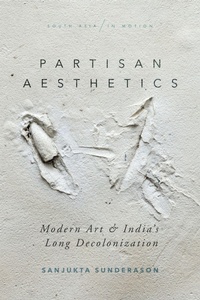
Partisan Aesthetics
Modern Art and India's Long Decolonization
Published on 21. July 2020
Book
Paperback/Softback
344 pages
978-1-5036-1299-0 (ISBN)
Description
Partisan Aesthetics explores art's entanglements with histories of war, famine, mass politics and displacements that marked late-colonial and postcolonial India. Introducing "partisan aesthetics" as a conceptual grid, the book identifies ways in which art became political through interactions with left-wing activism during the 1940s, and the afterlives of such interactions in post-independence India. Using an archive of artists and artist collectives working in Calcutta from these decades, Sanjukta Sunderason argues that artists became political not only as reporters, organizers and cadre of India's Communist Party, or socialist fellow travelers, but through shifting modes of political participations and dissociations. Unmooring questions of Indian modernism from its hitherto dominant harnesses to national or global affiliations, Sunderason activates, instead, distinctly locational histories that refract transnational currents. She analyzes largely unknown and dispersed archives-drawings, diaries, posters, periodicals, and pamphlets, alongside paintings and prints-and insists that art as archive is foundational to understanding modern art's socialist affiliations during India's long decolonization. By bringing together expanding fields of South Asian art, global modernisms, and Third World cultures, Partisan Aesthetics generates a new narrative that combines political history of Indian modernism, social history of postcolonial cultural criticism, and intellectual history of decolonization.
Reviews / Votes
"Sunderason's timely tracing of the production of the political in and through visual art contributes to our global understanding of the aesthetic forms of decolonization. The result is a rigorous argument regarding the many modalities of the mutual entanglement of art and progressive politics during a transformative period of modern India's history."-Sumathi Ramaswamy, Duke University "An original and timely book, Partisan Aesthetics is essential reading for scholars of modern South Asia and its visual culture, global urbanisms, and art in socialist and postsocialist societies."-Sonal Khullar, author of Worldly Affiliations "Archivally grounded and methodologically sophisticated, this work is a defining study of modern art in South Asia. A most significant contribution to our understanding of the relation between aesthetics and politics in a global context."-Iftikhar Dadi, Cornell University "Partisan Aesthetics is a seminal publication - intellectually rigorous, inventive and a richly persuasive study of the intersection of art and politics in mid-twentieth century India."-Rituparna Roy, The WireMore details
Series
Edition
New edition
Language
English
Place of publication
Palo Alto
United States
Target group
Professional and scholarly
Edition type
New edition
Product notice
Paperback (trade)
Illustrations
31 halftones
Dimensions
Height: 228 mm
Width: 156 mm
Thickness: 22 mm
Weight
543 gr
ISBN-13
978-1-5036-1299-0 (9781503612990)
Copyright in bibliographic data and cover images is held by Nielsen Book Services Limited or by the publishers or by their respective licensors: all rights reserved.
Schweitzer Classification
Person
Sanjukta Sunderason is Assistant Professor at the Leiden University Institute for Area Studies, the Netherlands.
Content
Postscript: Toward an Aesthetics of Decolonization
Introduction: Partisan Aesthetics: Configurations
Chapter 1: "Political Potentiality": Jamini Roy and the Formations of Progressive Art Criticism
Chapter 2: "As Agitator and Organizer": Socialist Realism and Artist-cadres of the Communist Party of India
Chapter 3: "Concrete Contextuality": Realism and Its Discontents in the Art of the Calcutta Group
Chapter 4: "All the More Real for Not Being Preached": Forms and Futures of Socialist Art in Nehruvian India
Chapter 5: "Revolution in the Tropics, Love in the Tropics": Arts of Displacement in the Post-colony
Introduction: Partisan Aesthetics: Configurations
Chapter 1: "Political Potentiality": Jamini Roy and the Formations of Progressive Art Criticism
Chapter 2: "As Agitator and Organizer": Socialist Realism and Artist-cadres of the Communist Party of India
Chapter 3: "Concrete Contextuality": Realism and Its Discontents in the Art of the Calcutta Group
Chapter 4: "All the More Real for Not Being Preached": Forms and Futures of Socialist Art in Nehruvian India
Chapter 5: "Revolution in the Tropics, Love in the Tropics": Arts of Displacement in the Post-colony