

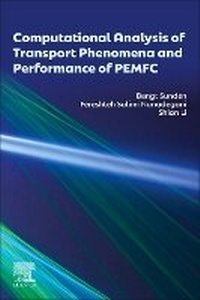
Computational Analysis of Transport Phenomena and Performance of PEMFC
Published on 27. August 2025
Book
Paperback/Softback
270 pages
978-0-443-27320-9 (ISBN)
Description
Computational Analysis of Transport Phenomena and Performance of PEMFC presents a practical guide to the mathematical modeling and simulation of PEMFCs for all transport processes of mass, momentum, energy, ions, and electrons. Tackling one of the most important aspects of next-generation PEMFC technologies, the book brings together the state-of-the-art to model and simulate phenomena and processes at various scales, including catalyst layers, electrodes, membranes, and bipolar plates of PEMFC unit cells and stacks.
Chapters introduce PEM fuel cells and explain the underlying electrochemical and thermodynamic concepts involved, present a detailed breakdown of the governing equations for overall mass, momentum, and energy conservation, charge (ions and electrons) conservation, water generation and its transport, heat generation, and heat transfer and cooling methods, offer an in-depth analysis of the various single and multi-dimensional modelling approaches and considerations, including lattice Boltzmann approach, artificial neural networks, exergy and energy analysis, estimation of fuel and oxidant consumption, the differences between cell-scale, stack-scale, and system-scale approaches, and more.
Chapters introduce PEM fuel cells and explain the underlying electrochemical and thermodynamic concepts involved, present a detailed breakdown of the governing equations for overall mass, momentum, and energy conservation, charge (ions and electrons) conservation, water generation and its transport, heat generation, and heat transfer and cooling methods, offer an in-depth analysis of the various single and multi-dimensional modelling approaches and considerations, including lattice Boltzmann approach, artificial neural networks, exergy and energy analysis, estimation of fuel and oxidant consumption, the differences between cell-scale, stack-scale, and system-scale approaches, and more.
More details
Language
English
Place of publication
Philadelphia
United States
Target group
Professional and scholarly
Product notice
Paperback (trade)
Dimensions
Height: 229 mm
Width: 152 mm
Thickness: 14 mm
Weight
369 gr
ISBN-13
978-0-443-27320-9 (9780443273209)
Copyright in bibliographic data and cover images is held by Nielsen Book Services Limited or by the publishers or by their respective licensors: all rights reserved.
Schweitzer Classification
Other editions
Additional editions
Bengt Sundén | Shian Li | Fereshteh Salimi Nanadegani
Computational Analysis of Transport Phenomena and Performance of PEMFC
E-Book
08/2025
Elsevier
€186.99
Available for download
Persons
Bengt Sunden received M. Sc. in Mechanical Engineering 1973, Ph. D. and Docent in Applied Thermodynamics and Fluid Mechanics 1979 and 1980, respectively, from Chalmers University of Technology, Sweden. He is a Professor of Heat Transfer at Lund University, Sweden since 1992 and served as Head of Energy Sciences during 1995-2016. The research activities include compact heat exchangers, enhanced heat transfer, gas turbine heat transfer, combustion-related heat transfer and others. He established and was editor-in-chief of International Journal of Heat Exchangers 1999-2008, associate editor of ASME J. Heat Transfer 2005-2008, editor-in-chief of Developments in Heat Transfer (WIT Press, UK). He published >700 papers in >300 journals, books, and proceedings, edited 30 books and authored three textbooks. He supervised more than 180 M Sc theses, 46 Licentiate of Engineering theses, 44 PhD-theses. Shian Li is an Associate Professor at Marine Engineering College, Dalian Maritime University. He has a M.Sc. degree in School of Mechanical Engineering 2014
Northwestern Polytechnical University, China. Ph.D. in Department of Energy Sciences 2018, Lund University, Sweden. His research expertise includes computational modeling and analysis of multiphysics and multiscale phenomena for proton exchange membrane fuel cells and solid oxide fuel cells, hydrogen production by methanol /ethanol steam reforming, thermal management of batteries. Fereshteh Salimi Nanadegani took her M.Sc. Chemical Engineering at College of Engineering, School of Chemical Engineering, University of Tehran, Tehran, Iran. She also has a B.Sc. Chemical Engineering at the same university.
Northwestern Polytechnical University, China. Ph.D. in Department of Energy Sciences 2018, Lund University, Sweden. His research expertise includes computational modeling and analysis of multiphysics and multiscale phenomena for proton exchange membrane fuel cells and solid oxide fuel cells, hydrogen production by methanol /ethanol steam reforming, thermal management of batteries. Fereshteh Salimi Nanadegani took her M.Sc. Chemical Engineering at College of Engineering, School of Chemical Engineering, University of Tehran, Tehran, Iran. She also has a B.Sc. Chemical Engineering at the same university.
Content
1. Introduction to PEMFC References
2. Electrochemistry and Thermodynamics References
3. Governing equations
4. Modeling approaches
5. Examples
6. Software
7. Concluding Remarks
2. Electrochemistry and Thermodynamics References
3. Governing equations
4. Modeling approaches
5. Examples
6. Software
7. Concluding Remarks