

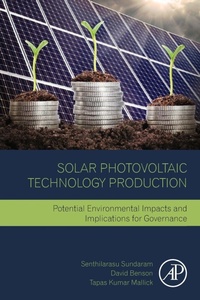
Solar Photovoltaic Technology Production
Potential Environmental Impacts and Implications for Governance
Published on 22. June 2016
Book
Paperback/Softback
116 pages
978-0-12-802953-4 (ISBN)
Description
Solar Photovoltaic Technology Production: Potential Environmental Impacts and Implications for Governance provides an overview of the emerging industrial PV sector, its technologies, and the regulatory frameworks supporting them. This new book reviews and categorizes the potential environmental impacts of several main PV technologies, examining the extent to which current EU governance frameworks regulate such impacts. By identifying the gaps or regulatory mismatches and creating a basis for normative recommendations on governance change, this book analyzes potential governance implications and their impacts in relation to manufacturers upscaling PV production techniques.
More details
Language
English
Place of publication
San Diego
United States
Publishing group
Elsevier Science Publishing Co Inc
Target group
Professional and scholarly
Researchers, engineers and professionals engaged in developing PV technologies, PV implementation and global PV manufacturers
Product notice
Paperback (trade)
Dimensions
Height: 229 mm
Width: 152 mm
Thickness: 7 mm
Weight
182 gr
ISBN-13
978-0-12-802953-4 (9780128029534)
Copyright in bibliographic data and cover images is held by Nielsen Book Services Limited or by the publishers or by their respective licensors: all rights reserved.
Schweitzer Classification
Other editions
Additional editions
Senthilarasu Sundaram | David Benson | Tapas Kumar Mallick
Solar Photovoltaic Technology Production
Potential Environmental Impacts and Implications for Governance
E-Book
06/2016
Academic Press
€50.95
Available for download
Persons
Senthilarasu Sundaram is an Associate Professor in the School of Computing, Engineering and Digital Technologies, Teesside University, Middlesbrough, United Kingdom. His research interests focus on sustainable energy technologies to create environmentally sustainable materials for energy generation and storage, building integrated applications, thermal storage, water remediation, and low-carbon heating applications.
David Benson is a Senior Lecturer based in the Environment and Sustainability Institute (ESI) at the University of Exeter, Penryn, Cornwall. His research encompasses a range of issue areas at the interface between political and environmental sciences, most notably EU environmental and energy policy, comparative environmental governance and public participation in environmental decision-making Prof. Tapas Kumar Mallick is currently the Chair in Clean Technologies (Renewables) within the Environment and Sustainability Institute (ESI) and leads the Solar Energy Research Group at the University of Exeter, in the United Kingdom. He is Co-Founder and Chief Scientific Advisor to the Build Solar Ltd., a spin-out company from the University of Exeter. He is also Distinguished Adjunct Professor of Mechanical and Energy Engineering at the Imam Abdulrahman Bin Faisal University, in Saudi Arabia, and Adjunct Professor of Mechanical Engineering at the Indian Institute of Technology, Madras, India. Prof. Mallick has lead several international projects, including the UK-India project "BioCPV?, empowering 24/7 electricity to 46 households in rural Indian villages. Prof. Mallick is also the Section Editor for Energy Sources in the Journal of Energies. He received the British Indian Award for Services to Education in 2016, and Cornwall Sustainability Award in 2018. He is a Fellow of the Royal Society of Chemistry (FRSC) and of the World Society of Sustainable Energy Technologies, FWSSET. He has published over 450 research articles, holds two patents on solar technology, has successfully supervised 34 PhD candidates to completion, has delivered over 50 keynote speeches around the world, and has acted as expert panel chair/member for many organisations in the UK and globally.
David Benson is a Senior Lecturer based in the Environment and Sustainability Institute (ESI) at the University of Exeter, Penryn, Cornwall. His research encompasses a range of issue areas at the interface between political and environmental sciences, most notably EU environmental and energy policy, comparative environmental governance and public participation in environmental decision-making Prof. Tapas Kumar Mallick is currently the Chair in Clean Technologies (Renewables) within the Environment and Sustainability Institute (ESI) and leads the Solar Energy Research Group at the University of Exeter, in the United Kingdom. He is Co-Founder and Chief Scientific Advisor to the Build Solar Ltd., a spin-out company from the University of Exeter. He is also Distinguished Adjunct Professor of Mechanical and Energy Engineering at the Imam Abdulrahman Bin Faisal University, in Saudi Arabia, and Adjunct Professor of Mechanical Engineering at the Indian Institute of Technology, Madras, India. Prof. Mallick has lead several international projects, including the UK-India project "BioCPV?, empowering 24/7 electricity to 46 households in rural Indian villages. Prof. Mallick is also the Section Editor for Energy Sources in the Journal of Energies. He received the British Indian Award for Services to Education in 2016, and Cornwall Sustainability Award in 2018. He is a Fellow of the Royal Society of Chemistry (FRSC) and of the World Society of Sustainable Energy Technologies, FWSSET. He has published over 450 research articles, holds two patents on solar technology, has successfully supervised 34 PhD candidates to completion, has delivered over 50 keynote speeches around the world, and has acted as expert panel chair/member for many organisations in the UK and globally.
Content
Chapter 1: Introduction
Chapter 2: Overview of the PV Industry and Different Technologies
Chapter 3: Potential Environmental Impacts From Solar Energy Technologies
Chapter 4: The Sustainability of Solar PV Governance: A Comparative International Perspective
Chapter 5: A Normative Perspective on Governing Solar PV Sustainability
Chapter 6: Future Issues and Recommendations
Chapter 2: Overview of the PV Industry and Different Technologies
Chapter 3: Potential Environmental Impacts From Solar Energy Technologies
Chapter 4: The Sustainability of Solar PV Governance: A Comparative International Perspective
Chapter 5: A Normative Perspective on Governing Solar PV Sustainability
Chapter 6: Future Issues and Recommendations