

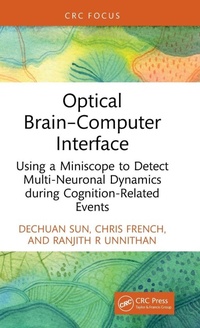
Optical Brain-Computer Interface
Using a Miniscope to Detect Multi-Neuronal Dynamics during Cognition-Related Events
1st Edition
Published on 3. October 2024
Book
Hardback
106 pages
978-1-032-74680-7 (ISBN)
Description
In this shortform book, Sun, French, and Unnithan explore state- of- the- art optical recording techniques, with a focus on the revolutionary miniaturized fluorescence microscope - the miniscope - for real- time and in vivo monitoring of multi- neuronal dynamics during cognition- related events.
The miniscope is a powerful tool that allows real- time in vivo optical recording of multi- neuronal activity in freely moving animals. This book highlights the use of the miniscope in the context of the hippocampus, a brain region crucial for memory and cognition. The authors employ a combination of theoretical concepts, practical applications, and illustrative case studies to deliver a comprehensive understanding of optical recording techniques. They provide step- by- step guides for using the miniscope, offer insights into data analysis, and discuss its implications in the context of hippocampal research and brain- computer interfaces. Readers will gain profound insights into the role of the hippocampus in memory and cognition, and expert knowledge of the latest miniaturized in vivo optical recording techniques. The book provides them with thorough guidance on implementing a miniaturized fluorescence microscope for a brain- computer interface and information on advanced analysis techniques on the activity of large neuronal populations.
This book provides an invaluable short and accessible guide for researchers, neuroscientists, and brain- computer interface enthusiasts to enable them to understand and leverage the immense potential of this advanced optical recording methodology.
The miniscope is a powerful tool that allows real- time in vivo optical recording of multi- neuronal activity in freely moving animals. This book highlights the use of the miniscope in the context of the hippocampus, a brain region crucial for memory and cognition. The authors employ a combination of theoretical concepts, practical applications, and illustrative case studies to deliver a comprehensive understanding of optical recording techniques. They provide step- by- step guides for using the miniscope, offer insights into data analysis, and discuss its implications in the context of hippocampal research and brain- computer interfaces. Readers will gain profound insights into the role of the hippocampus in memory and cognition, and expert knowledge of the latest miniaturized in vivo optical recording techniques. The book provides them with thorough guidance on implementing a miniaturized fluorescence microscope for a brain- computer interface and information on advanced analysis techniques on the activity of large neuronal populations.
This book provides an invaluable short and accessible guide for researchers, neuroscientists, and brain- computer interface enthusiasts to enable them to understand and leverage the immense potential of this advanced optical recording methodology.
More details
Language
English
Place of publication
London
United Kingdom
Publishing group
Taylor & Francis Ltd
Target group
Professional and scholarly
Academic and Professional Reference
Illustrations
33 s/w Abbildungen, 3 s/w Photographien bzw. Rasterbilder, 30 s/w Zeichnungen, 3 s/w Tabellen
3 Tables, black and white; 30 Line drawings, black and white; 3 Halftones, black and white; 33 Illustrations, black and white
Dimensions
Height: 222 mm
Width: 145 mm
Thickness: 10 mm
Weight
290 gr
ISBN-13
978-1-032-74680-7 (9781032746807)
Copyright in bibliographic data and cover images is held by Nielsen Book Services Limited or by the publishers or by their respective licensors: all rights reserved.
Schweitzer Classification
Other editions
Additional editions
Dechuan Sun | Chris French | Ranjith R. Unnithan
Optical Brain-Computer Interface
Using a Miniscope to Detect Multi-Neuronal Dynamics during Cognition-Related Events
Book
approx. 07/2026
1st Edition
CRC Press
€30.00
Not yet published
Dechuan Sun | Chris French | Ranjith R. Unnithan
Optical Brain-Computer Interface
Using a Miniscope to Detect Multi-Neuronal Dynamics during Cognition-Related Events
E-Book
10/2024
1st Edition
CRC Press
€31.49
Available for download
Dechuan Sun | Chris French | Ranjith R. Unnithan
Optical Brain-Computer Interface
Using a Miniscope to Detect Multi-Neuronal Dynamics during Cognition-Related Events
E-Book
10/2024
1st Edition
CRC Press
€31.49
Available for download
Persons
Dechuan Sun is a postdoctoral research fellow in the Department of Electrical and Electronic Engineering at The University of Melbourne.
Chris French leads the Neural Dynamics Laboratory at the Melbourne Brain Centre, is an Associate Professor in the Department of Medicine at The University of Melbourne and neurologist at the Royal Melbourne Hospital. He attained his PhD from the University of New South Wales and MD from the University of Sydney. He is a fellow of the Royal Australasian College of Physicians and a member of the Board of Directors of the Organisation for Computational Neuroscience (OCNS).
Ranjith R Unnithan is an associate professor in the Department of Electrical and Electronic Engineering at The University of Melbourne. He received his PhD in Electrical Engineering from the University of Cambridge. He is a member of IEEE, The International Society for Optics and Photonics, and the Australian Optical Society.
Chris French leads the Neural Dynamics Laboratory at the Melbourne Brain Centre, is an Associate Professor in the Department of Medicine at The University of Melbourne and neurologist at the Royal Melbourne Hospital. He attained his PhD from the University of New South Wales and MD from the University of Sydney. He is a fellow of the Royal Australasian College of Physicians and a member of the Board of Directors of the Organisation for Computational Neuroscience (OCNS).
Ranjith R Unnithan is an associate professor in the Department of Electrical and Electronic Engineering at The University of Melbourne. He received his PhD in Electrical Engineering from the University of Cambridge. He is a member of IEEE, The International Society for Optics and Photonics, and the Australian Optical Society.
Content
1. General Overview and Introduction
2. Optical Manipulation Procedures
3. Scopolamine Impairs Spatial Information Recorded with "Miniscope" Calcium Imaging in Hippocampal Place Cells
4. Hippocampal Cognitive and Relational Map Paradigms Explored by Multisensory Encoding Recording with Widefield Calcium Imaging
5. Real-Time Multimodal Sensory Detection Using Widefield Hippocampal Calcium Imaging
6. Conclusions and Future Work
2. Optical Manipulation Procedures
3. Scopolamine Impairs Spatial Information Recorded with "Miniscope" Calcium Imaging in Hippocampal Place Cells
4. Hippocampal Cognitive and Relational Map Paradigms Explored by Multisensory Encoding Recording with Widefield Calcium Imaging
5. Real-Time Multimodal Sensory Detection Using Widefield Hippocampal Calcium Imaging
6. Conclusions and Future Work