

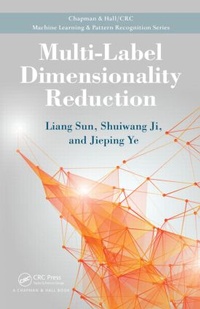
Multi-Label Dimensionality Reduction
1st Edition
Published on 4. November 2013
Book
Hardback
208 pages
978-1-4398-0615-9 (ISBN)
Description
Similar to other data mining and machine learning tasks, multi-label learning suffers from dimensionality. An effective way to mitigate this problem is through dimensionality reduction, which extracts a small number of features by removing irrelevant, redundant, and noisy information. The data mining and machine learning literature currently lacks a unified treatment of multi-label dimensionality reduction that incorporates both algorithmic developments and applications.
Addressing this shortfall, Multi-Label Dimensionality Reduction covers the methodological developments, theoretical properties, computational aspects, and applications of many multi-label dimensionality reduction algorithms. It explores numerous research questions, including:
How to fully exploit label correlations for effective dimensionality reduction
How to scale dimensionality reduction algorithms to large-scale problems
How to effectively combine dimensionality reduction with classification
How to derive sparse dimensionality reduction algorithms to enhance model interpretability
How to perform multi-label dimensionality reduction effectively in practical applications
The authors emphasize their extensive work on dimensionality reduction for multi-label learning. Using a case study of Drosophila gene expression pattern image annotation, they demonstrate how to apply multi-label dimensionality reduction algorithms to solve real-world problems. A supplementary website provides a MATLAB (R) package for implementing popular dimensionality reduction algorithms.
Addressing this shortfall, Multi-Label Dimensionality Reduction covers the methodological developments, theoretical properties, computational aspects, and applications of many multi-label dimensionality reduction algorithms. It explores numerous research questions, including:
How to fully exploit label correlations for effective dimensionality reduction
How to scale dimensionality reduction algorithms to large-scale problems
How to effectively combine dimensionality reduction with classification
How to derive sparse dimensionality reduction algorithms to enhance model interpretability
How to perform multi-label dimensionality reduction effectively in practical applications
The authors emphasize their extensive work on dimensionality reduction for multi-label learning. Using a case study of Drosophila gene expression pattern image annotation, they demonstrate how to apply multi-label dimensionality reduction algorithms to solve real-world problems. A supplementary website provides a MATLAB (R) package for implementing popular dimensionality reduction algorithms.
More details
Series
Language
English
Place of publication
Oxford
United States
Publishing group
Taylor & Francis Inc
Target group
College/higher education
Product notice
Paper over boards
Illustrations
14 s/w Tabellen, 23 s/w Abbildungen
14 Tables, black and white; 23 Illustrations, black and white
Dimensions
Height: 234 mm
Width: 156 mm
Weight
540 gr
ISBN-13
978-1-4398-0615-9 (9781439806159)
Copyright in bibliographic data and cover images is held by Nielsen Book Services Limited or by the publishers or by their respective licensors: all rights reserved.
Schweitzer Classification
Other editions
Additional editions
Liang Sun | Shuiwang Ji | Jieping Ye
Multi-Label Dimensionality Reduction
E-Book
04/2016
1st Edition
Chapman & Hall/CRC
€73.99
Available for download
Liang Sun | Shuiwang Ji | Jieping Ye
Multi-Label Dimensionality Reduction
E-Book
04/2016
1st Edition
Chapman and Hall
€73.99
Available for download
Persons
Liang Sun is a scientist in the R&D of Opera Solutions, a leading company in big data science and predictive analytics. He received a PhD in computer science from Arizona State University. His research interests lie broadly in the areas of data mining and machine learning. His team won second place in the KDD Cup 2012 Track 2 and fifth place in the Heritage Health Prize. In 2010, he won the ACM SIGKDD best research paper honorable mention for his work on an efficient implementation for a class of dimensionality reduction algorithms.
Shuiwang Ji is an assistant professor of computer science at Old Dominion University. He received a PhD in computer science from Arizona State University. His research interests include machine learning, data mining, computational neuroscience, and bioinformatics. He received the Outstanding PhD Student Award from Arizona State University in 2010 and the Early Career Distinguished Research Award from Old Dominion University's College of Sciences in 2012.
Jieping Ye is an associate professor of computer science and engineering at Arizona State University, where he is also the associate director for big data informatics in the Center for Evolutionary Medicine and Informatics and a core faculty member of the Biodesign Institute. He received a PhD in computer science from the University of Minnesota, Twin Cities. His research interests include machine learning, data mining, and biomedical informatics. He is an associate editor of IEEE Transactions on Pattern Analysis and Machine Intelligence. He has won numerous awards from Arizona State University and was a recipient of an NSF CAREER Award. His papers have also been recognized at the International Conference on Machine Learning, KDD, and the SIAM International Conference on Data Mining (SDM).
Shuiwang Ji is an assistant professor of computer science at Old Dominion University. He received a PhD in computer science from Arizona State University. His research interests include machine learning, data mining, computational neuroscience, and bioinformatics. He received the Outstanding PhD Student Award from Arizona State University in 2010 and the Early Career Distinguished Research Award from Old Dominion University's College of Sciences in 2012.
Jieping Ye is an associate professor of computer science and engineering at Arizona State University, where he is also the associate director for big data informatics in the Center for Evolutionary Medicine and Informatics and a core faculty member of the Biodesign Institute. He received a PhD in computer science from the University of Minnesota, Twin Cities. His research interests include machine learning, data mining, and biomedical informatics. He is an associate editor of IEEE Transactions on Pattern Analysis and Machine Intelligence. He has won numerous awards from Arizona State University and was a recipient of an NSF CAREER Award. His papers have also been recognized at the International Conference on Machine Learning, KDD, and the SIAM International Conference on Data Mining (SDM).
Content
Introduction. Partial Least Squares. Canonical Correlation Analysis. Hypergraph Spectral Learning. A Scalable Two-Stage Approach for Dimensionality Reduction. A Shared-Subspace Learning Framework. Joint Dimensionality Reduction and Classification. Nonlinear Dimensionality Reduction: Algorithms and Applications. Appendix. References. Index.