

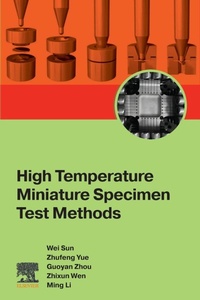
High Temperature Miniature Specimen Test Methods
Published on 27. October 2023
Book
Paperback/Softback
286 pages
978-0-443-21897-2 (ISBN)
Description
High Temperature Miniature Specimen Test Methods focuses on a comprehensive and thorough introduction to a range of high temperature, miniaturized test methods at elevated temperatures which are used to obtain "bulk? creep or fatigue properties from a small volume of material. The book will be of use to a wide range of audience of engineers (e.g., designers, manufacturers, metallurgists, stress analysts), researchers (e.g., materials scientists) and students (undergraduate and postgraduate) in the field of high-temperature material and structural integrity assessment. Specific novel features include 1] theoretical basis of each method; 2], data interpretation method of each test, and 3] specific applications.
More details
Language
English
Place of publication
Philadelphia
United States
Target group
Professional and scholarly
Dimensions
Height: 153 mm
Width: 230 mm
Thickness: 19 mm
Weight
472 gr
ISBN-13
978-0-443-21897-2 (9780443218972)
Copyright in bibliographic data and cover images is held by Nielsen Book Services Limited or by the publishers or by their respective licensors: all rights reserved.
Schweitzer Classification
Other editions
Additional editions
DS. c. Sun | Zhufeng Yue Ph. D | Guoyan Zhou
High Temperature Miniature Specimen Test Methods
E-Book
10/2023
Elsevier
€170.00
Available for download
Persons
Wei Sun Ph.D DS.c was a Professor of Mechanical Engineering at the University of Nottingham, and has been working on creep, fatigue, cyclic plasticity, and the miniaturized specimen test methods at high temperatures for > 25 years. He has supervised 40 Ph.D projects (> 10 related to high temperature small specimen testing). He is an author of 260 international journal articles (63 related to high-temperature miniature specimen tests), 170 conference contributions (14 plenary/keynote lectures) and one textbook (Applied Creep Mechanics. McGraw-Hill 2013). He became Charted Engineer in 1998, a Fellow of The Institution of Mechanical Engineers in 2002, and a Fellow of The Institute of Materials in 2009. Prof. Sun has been an Emeritus Professor at the University of Nottingham since he retired in 2020, and currently is a member of EU CEN Impression Creep Standard Committe. Zhufeng Yue Ph.D is a Professor of Engineering Mechanics at the Northwestern Polytechnical University. Prof. Yue is a renowned expert on engineering mechanics, covering computational solid mechanics, high temperature structural integrity, fatigue, creep, plasticity, superplasticity, fretting and wear, computational methods in manufacturing process, and miniature specimen testing at elevated temperatures, with a focus on the multi-scale and multi-physics material modelling of single crystal superalloys. Prof. Yue has supervised 90 Ph.D students and is an author of 300 English journal articles, 260 conference contributions including 24 keynote lectures, 50 patents and 17 textbooks Prof. Yue has held adjunct professorships at Tongji University and Zhejiang University in China, and has been the Editor in Chief of the journal "Multidiscipline Modelling in Materials and Structure? since 2005. is a Professor of Mechanical Engineering at the East China University of Science and Technology. She has been working on high-temperature mechanics, related to creep and fatigue, thermal-mechanical coupling interaction, and miniature specimen testing. Prof. Zhou has developed several high-temperature miniaturized creep test methods and evaluation procedures using miniature beam and semi-circle ring specimens, which have been used in the structural integrity and safety assessment for turbine rotors, hydrogenation reactors and other equipment. Zhufeng Yue Ph.D is a Professor of Engineering Mechanics at the Northwestern Polytechnical University. Prof. Yue is a renowned expert on engineering mechanics, covering computational solid mechanics, high temperature structural integrity, fatigue, creep, plasticity, superplasticity, fretting and wear, computational methods in manufacturing process, and miniature specimen testing at elevated temperatures, with a focus on the multi-scale and multi-physics material modelling of single crystal superalloys. Prof. Yue has supervised 90 Ph.D students and is an author of 300 English journal articles, 260 conference contributions including 24 keynote lectures, 50 patents and 17 textbooks Prof. Yue has held adjunct professorships at Tongji University and Zhejiang University in China, and has been the Editor in Chief of the journal "Multidiscipline Modelling in Materials and Structure? since 2005. Ming Li is a Professor of Engineering Mechanics at the Northwestern Polytechnical University since 2021. He received his Ph.D in Mechanical Engineering in 2018 at the National University of Ireland, Galway, followed by a research fellow at University of Nottingham (2019-2021) in United Kingdom. During his Ph.D, he studied at University of Limerick as a visiting scholar in Ireland (2017-2018). Prof. Ming's research interests focus on the multi-scale modelling method of high temperature superalloys. He has developed a high temperature fatigue test method by using a miniature thin-plate specimen for a supperalloy at high temperature. The miniaturized test method developed has exhibited a clear possibility to produce comparable low cycle fatigue behavior and creep-fatigue behavior with those which are normally obtained by conventional standard specimen tests.
Author
Professor of Mechanical Engineering, University of Nottingham, UK
Professor of Engineering Mechanics, Department of Engineering, Northwestern Polytechnical University, China
Professor of Mechanical Engineering, East China University of Science and Technology, Shanghai, China
Professor of Engineering Mechanics, Northwestern Polytechnical University, China
Professor of Engineering Mechanics, Northwestern Polytechnical University, China
Content
1. Outlines test types and data processing used to estimate the material constants
2. The most popular small punch test method, i.e. the small punch test
3. Introduces the impression creep test method using a rectangular indenter
4. Theoretical methods for data interpretation and typical test data are described
5. These include the miniature ring creep test methods
6. The miniature bar-type creep test method
7. Miniature bending creep tests
8. The more recently developed miniature thin-plate test creep and low cycle fatigue test methods
9. A specific topic related to the data interpretation is addressed in this chapter, in which the concept of the Equivalent Gauge Length (EGL) is introduced
10. The determination of material properties from the miniature specimen
11. Focuses on a specific application field on structural assessment of aero-engine gas turbine blades, where the assessment of anisotropy and lifing of service-aged gas turbine blades made of single-crystal nickel-based superalloy is particularly discussed
12. Briefly addresses several requirements for the future development of the miniaturized specimen test method, which is related to material property characterization, component assessment, size effect and multi-scale modelling, as well as standardization
2. The most popular small punch test method, i.e. the small punch test
3. Introduces the impression creep test method using a rectangular indenter
4. Theoretical methods for data interpretation and typical test data are described
5. These include the miniature ring creep test methods
6. The miniature bar-type creep test method
7. Miniature bending creep tests
8. The more recently developed miniature thin-plate test creep and low cycle fatigue test methods
9. A specific topic related to the data interpretation is addressed in this chapter, in which the concept of the Equivalent Gauge Length (EGL) is introduced
10. The determination of material properties from the miniature specimen
11. Focuses on a specific application field on structural assessment of aero-engine gas turbine blades, where the assessment of anisotropy and lifing of service-aged gas turbine blades made of single-crystal nickel-based superalloy is particularly discussed
12. Briefly addresses several requirements for the future development of the miniaturized specimen test method, which is related to material property characterization, component assessment, size effect and multi-scale modelling, as well as standardization