

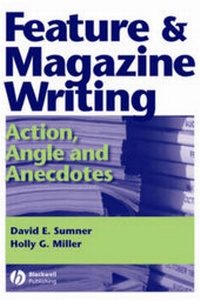
Feature and Magazine Writing
Action, Angle and Anecdotes
1st Edition
Published on 14. June 2005
Book
Paperback/Softback
312 pages
978-0-8138-0519-1 (ISBN)
Description
Consider the unique features of Feature and Magazine Writing: Action, Angle and Anecdotes. Its authors have taught magazine writing at universities for a combined 30 years and have earned success and acclaim for magazine writing and editing. Its comprehensive chapters cover the most complete range of topics ever included in a magazine and feature writing text. Its affordability makes it immediately applicable to the hundreds of journalism programs teaching "magazine writing," "feature writing" or similar courses. Authors Sumner and Miller have written a text that genuinely models its message through lively writing, touches of humor and a conversational tone. Coverage includes content too often missing or deficient in existing texts: finding original ideas; developing strong angles; writing for targeted, niche audiences; practical how-to instruction on the many different types of magazine articles; fresh perspective and advice from professional writers and editors; examples, exercises and sample, illustrative articles; glossaries of publishing terms in each chapter; how to find the best Web sites and databases for background research; and how to locate expert sources who are accessible for telephone interviews. Tightly edited, colorfully written, concise, and moderately priced, Feature and Magazine Writing is the textbook of choice for your future feature writers.
Reviews / Votes
"With clear writing and expertly crafted examples, this book goes beyond simply telling writers what to do and what not to do, but becomes a useful tool with its anecdotal evidence, challenging scenarios and actual sample writing how to become better feature writers."Tia C.M. Tyree
District of Columbia Housing Finance Agency
"Expertly packaged and sharply written, Sumner and Miller's engaging text teaches not only basic elements of magazine writing, but also offers practical advice for today's developing journalist. Everything from sentence structure to story-pitching advice is vividly explained, and the authors wisely include points of view from members of the contemporary working press. Also noteworthy is a wealth of information regarding the Internet, perhaps the most valuable and treacherous tool for tomorrow's reporter."
David Abrahamson, Ph.D.
Helen G. Brown Research Professor of Journalism, Medill School of Journal,
Northwestern University
More details
Language
English
Place of publication
Hoboken
United Kingdom
Publishing group
John Wiley and Sons Ltd
Target group
College/higher education
Professional and scholarly
Dimensions
Height: 231 mm
Width: 155 mm
Thickness: 22 mm
Weight
499 gr
ISBN-13
978-0-8138-0519-1 (9780813805191)
Copyright in bibliographic data and cover images is held by Nielsen Book Services Limited or by the publishers or by their respective licensors: all rights reserved.
Schweitzer Classification
Other editions
New editions
Book
03/2009
2nd Edition
Wiley-Blackwell
€32.90
Article exhausted; check for reprint
Persons
David E. Sumner, Ph.D. is professor of journalism and head of the magazine program at Ball State University, Muncie, IN. He teaches courses on introductory magazine writing, advanced magazine writing, and magazine editing, and advises the student magazine Expo. Within the Association for Education in Journalism and Mass Communication (AEJMC), Dr. Sumner has held numerous offices in its 150-member Magazine Division including chair, research chair, and webmaster.
Holly G. Miller holds degrees in journalism from Indiana University and Ball State University. She is "professional in residence" at Anderson University and has taught at Ball State University, Indiana University and Purdue University at Indianapolis, and at numerous writers' workshops from Mount Hermon, California, to Cape Cod, Massachusetts. Ms Miller is Senior Editor of The Saturday Evening Post, is the author of 13 books and more than 2,000 published magazine articles. Her byline has appeared in such diverse publications as TV Guide, Country Gentleman, Today's Christian Woman, Indianapolis Monthly, Clarity, Reader's Digest, Writer's Digest, The Writer, etc. She has won awards from the Society of Professional Journalists, the Associated Press, Midwest Travel Writers, Society of American Travel Writers, Evangelical Press Association, the Multiple Sclerosis Society of America and General Motors Corp. She has served as managing editor of a daily newspaper, contributing editor to Today's Christian Woman and consulting editor to Clarity.
Holly G. Miller holds degrees in journalism from Indiana University and Ball State University. She is "professional in residence" at Anderson University and has taught at Ball State University, Indiana University and Purdue University at Indianapolis, and at numerous writers' workshops from Mount Hermon, California, to Cape Cod, Massachusetts. Ms Miller is Senior Editor of The Saturday Evening Post, is the author of 13 books and more than 2,000 published magazine articles. Her byline has appeared in such diverse publications as TV Guide, Country Gentleman, Today's Christian Woman, Indianapolis Monthly, Clarity, Reader's Digest, Writer's Digest, The Writer, etc. She has won awards from the Society of Professional Journalists, the Associated Press, Midwest Travel Writers, Society of American Travel Writers, Evangelical Press Association, the Multiple Sclerosis Society of America and General Motors Corp. She has served as managing editor of a daily newspaper, contributing editor to Today's Christian Woman and consulting editor to Clarity.
Content
Introduction: Reading, Writing and Relevance. Part I: Preparing to Write Feature Articles.
Chapter 1. Capturing Reader Attention.
Chapter 2. The Hunt for Fresh Ideas.
Chapter 3. Strong Angles and Focused Ideas.
Chapter 4. Creative Research and Reporting.
Chapter 5. Interviews: Moving Past the Predictable.
Part II: Writing Feature Articles.
Chapter 6. Action-Packed Writing.
Chapter 7. Strong Beginnings, Satisfying Endings.
Chapter 8. Anecdotes: The Color of Writing.
Chapter 9. The Structure of Writing.
Chapter 10. The Art and Style of Writing.
Part III: Creating Different Types of Feature Articles.
Chapter 11. The Wide, Wide World of Shorts.
Chapter 12. Picture This: The Profile Article.
Chapter 13. Real Life Dramas and Stories.
Chapter 14. How to Write How-to Articles.
Chapter 15. The Calendar-Content Connection.
Chapter 16. News Features, Trends and Issues.
Chapter 17. Writing to Inspire.
Chapter 18. Writing for the Business-to-Business Media.
Chapter 19. Writing for the Internet.
Part IV: Selling Feature Articles.
Chapter 20. Marketing Your Words.
Chapter 21. Writing Creative Query Letters.
Chapter 22. Copyrights and Wrongs.
Appendix: Back to Basics.
Index
Chapter 1. Capturing Reader Attention.
Chapter 2. The Hunt for Fresh Ideas.
Chapter 3. Strong Angles and Focused Ideas.
Chapter 4. Creative Research and Reporting.
Chapter 5. Interviews: Moving Past the Predictable.
Part II: Writing Feature Articles.
Chapter 6. Action-Packed Writing.
Chapter 7. Strong Beginnings, Satisfying Endings.
Chapter 8. Anecdotes: The Color of Writing.
Chapter 9. The Structure of Writing.
Chapter 10. The Art and Style of Writing.
Part III: Creating Different Types of Feature Articles.
Chapter 11. The Wide, Wide World of Shorts.
Chapter 12. Picture This: The Profile Article.
Chapter 13. Real Life Dramas and Stories.
Chapter 14. How to Write How-to Articles.
Chapter 15. The Calendar-Content Connection.
Chapter 16. News Features, Trends and Issues.
Chapter 17. Writing to Inspire.
Chapter 18. Writing for the Business-to-Business Media.
Chapter 19. Writing for the Internet.
Part IV: Selling Feature Articles.
Chapter 20. Marketing Your Words.
Chapter 21. Writing Creative Query Letters.
Chapter 22. Copyrights and Wrongs.
Appendix: Back to Basics.
Index