

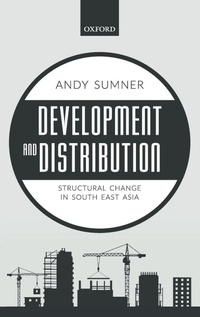
Development and Distribution
Structural Change in South East Asia
Published on 26. July 2018
Book
Hardback
232 pages
978-0-19-879236-9 (ISBN)
Description
Since the Second World War, surprisingly few developing countries have experienced a truly sustained episode of economic and social convergence towards the structural characteristics of the advanced nations. East Asia has exceeded most regions in its achievement of convergence, and much has been written on comparative industrialization and development in North East Asia. Less discussed is South East Asia and the surprising and inclusive transformation several of its countries has undergone.
Development and Distribution focuses on South East Asia and, more specifically, on Malaysia, Indonesia, and Thailand. These three nations have all undergone a major transformation - in a way never anticipated - from being poor, agrarian countries to middle-income countries with developed industrial and manufacturing bases. How did Malaysia, Indonesia, and Thailand achieve such a transformation, and how did they achieve the transformation with a form of economic growth that was driven by structural transformation, but that was 'inclusive'? Given that historically it has been thought that structural transformation tends to push up inequality, whilst inclusive growth necessitates static or even falling inequality, this last point is particularly salient to developing countries. Understanding how the transformation was possible in a relatively small space of time, the extent to which it was inclusive, and the caveats and prospects for South East Asia is thus an area of enquiry significant to all developing countries as they seek economic and social transformation.
Development and Distribution focuses on South East Asia and, more specifically, on Malaysia, Indonesia, and Thailand. These three nations have all undergone a major transformation - in a way never anticipated - from being poor, agrarian countries to middle-income countries with developed industrial and manufacturing bases. How did Malaysia, Indonesia, and Thailand achieve such a transformation, and how did they achieve the transformation with a form of economic growth that was driven by structural transformation, but that was 'inclusive'? Given that historically it has been thought that structural transformation tends to push up inequality, whilst inclusive growth necessitates static or even falling inequality, this last point is particularly salient to developing countries. Understanding how the transformation was possible in a relatively small space of time, the extent to which it was inclusive, and the caveats and prospects for South East Asia is thus an area of enquiry significant to all developing countries as they seek economic and social transformation.
Reviews / Votes
All in all,Development and Distributionasks and answers relevant questions using novel empirical and theoretical methods and is a must read for anybody interested in Asian studies and international development. * Soundarya Iyer, newbooks.asia *More details
Language
English
Place of publication
Oxford
United Kingdom
Target group
Professional and scholarly
Dimensions
Height: 240 mm
Width: 161 mm
Thickness: 17 mm
Weight
517 gr
ISBN-13
978-0-19-879236-9 (9780198792369)
Copyright in bibliographic data and cover images is held by Nielsen Book Services Limited or by the publishers or by their respective licensors: all rights reserved.
Schweitzer Classification
Other editions
Additional editions
E-Book
07/2018
1st Edition
OUP eBook
€61.99
Available for download
E-Book
06/2018
1st Edition
OUP eBook
€61.99
Available for download
Person
Andy Sumner is a Reader in International Development at King's College London. He holds associate positions at Oxford University, UNU-WIDER, the Centre for Global Development, Washington, DC and at Padjadjaran University, Indonesia.
Dr Sumner's research focuses on the relationship between poverty, inequality, and economic development; in particular, how different modes of economic development and structural change have different welfare outcomes. His research focuses on these issues both at a global level and specifically relating to South East Asia, notably Indonesia, Malaysia, and Thailand.
Dr Sumner's research focuses on the relationship between poverty, inequality, and economic development; in particular, how different modes of economic development and structural change have different welfare outcomes. His research focuses on these issues both at a global level and specifically relating to South East Asia, notably Indonesia, Malaysia, and Thailand.
Content
1: Introduction
2: Structural transformation and inclusive growth: conceptual points of departure
3: Structural transformation and inclusive growth: theory and the heterogeneity of capitalism
4: Great transformations: classical developmentalism in South East Asia
5: Pseudo-miracles: two-tier developmentalism in South East Asia
6: Arrested development? The rise of new developmentalism in South East Asia
7: Conclusion
2: Structural transformation and inclusive growth: conceptual points of departure
3: Structural transformation and inclusive growth: theory and the heterogeneity of capitalism
4: Great transformations: classical developmentalism in South East Asia
5: Pseudo-miracles: two-tier developmentalism in South East Asia
6: Arrested development? The rise of new developmentalism in South East Asia
7: Conclusion