

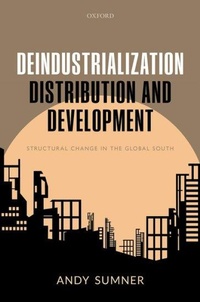
Deindustrialization, Distribution, and Development
Structural Change in the Global South
Published on 30. September 2021
Book
Hardback
170 pages
978-0-19-885300-8 (ISBN)
Description
The term rust belt has rarely been associated with developing countries. In fact, it is commonly used to discuss deindustrialization in advanced nations, particularly the US. However, this book argues that such a belt is now threatening the middle-income developing world, spreading across Brazil and other countries in Latin America, running down across South Africa, and then upwards to Malaysia, Indonesia, Thailand, and the Philippines in South East Asia.
Deindustrialization, Distribution, and Development: Structural Change in the Global South explores the emergent processes of stalled industrialization and the spectre of deindustrialization in these developing countries. Building upon the author's previous work on economic development, structural change, and income inequality, this book examines the causes and consequences of these new issues, focusing on inequality both between and within countries since the Cold War.
Providing a comparative, in-depth analysis of the varieties of contemporary structural change in the Global South and challenging many long-standing myths, this work explains why late development remains a crucial concept in understanding contemporary development and explores what deindustrialization means for the future of global development.
Deindustrialization, Distribution, and Development: Structural Change in the Global South explores the emergent processes of stalled industrialization and the spectre of deindustrialization in these developing countries. Building upon the author's previous work on economic development, structural change, and income inequality, this book examines the causes and consequences of these new issues, focusing on inequality both between and within countries since the Cold War.
Providing a comparative, in-depth analysis of the varieties of contemporary structural change in the Global South and challenging many long-standing myths, this work explains why late development remains a crucial concept in understanding contemporary development and explores what deindustrialization means for the future of global development.
More details
Language
English
Place of publication
Oxford
United Kingdom
Target group
Professional and scholarly
Product notice
sewn/stitched
Cloth over boards
Dimensions
Height: 229 mm
Width: 160 mm
Thickness: 18 mm
Weight
431 gr
ISBN-13
978-0-19-885300-8 (9780198853008)
Copyright in bibliographic data and cover images is held by Nielsen Book Services Limited or by the publishers or by their respective licensors: all rights reserved.
Schweitzer Classification
Other editions
Additional editions
E-Book
09/2021
1st Edition
OUP eBook
€53.99
Available for download
E-Book
09/2021
1st Edition
OUP eBook
€53.99
Available for download
Person
Andy Sumner is a Professor of International Development at King's College London. He is Director of the Economic and Social Research Council (ESRC) Global Challenges Strategic Research Network on Global Poverty and Inequality Dynamics. He also holds associate positions at Oxford University; the Center for Global Development, Washington DC; the United Nations University, WIDER, Helsinki; and the Centre for Economics and Development Studies, Padjadjaran University, Indonesia. His research focuses on the relationship between poverty, inequality, and economic development across developing countries. He has twenty years' international research experience and has published extensively, including ten books and fifty journal papers and book chapters. His most recent books are Global Poverty (2016, Oxford University Press) and Development and Distribution (2018, Oxford University Press).
Content
1: Introduction
2: The two new middles: bifurcation and precarity in late economic development
3: Contemporary structural change: stalled industrialization and the spectre of premature deindustrialization
4: Income inequality between countries: catch-up and slow-down in a value chain world
5: Income inequality within countries: growth with falling labour shares
6: Conclusion
2: The two new middles: bifurcation and precarity in late economic development
3: Contemporary structural change: stalled industrialization and the spectre of premature deindustrialization
4: Income inequality between countries: catch-up and slow-down in a value chain world
5: Income inequality within countries: growth with falling labour shares
6: Conclusion