

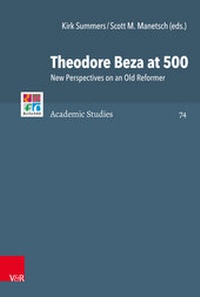
Theodore Beza at 500
New Perspectives on an Old Reformer
1st Edition
Published on 16. November 2020
Book
Hardback
391 pages
978-3-525-56041-9 (ISBN)
Description
Theodore Beza (1519-1605) was a talented humanist, Protestant theologian, political agitator, and prominent minister of the reformed church in Geneva during the second-half of the 16th century. During his long career, Beza exercised strategic leadership in his efforts to preserve reformed Christianity in Geneva and his native France, as well as to defend the theological legacy of John Calvin throughout Europe. Beza's diverse literary corpus of more than seventy works demonstrates that he was well-versed in classical literature, skilled in biblical exegesis, and adroit in theological controversy.
More than an ivory-tower theologian, Beza maintained contact with the leading political and religious figures of his day, including Henry IV of France and Elizabeth I of England, as well as John Calvin, Heinrich Bullinger, and Philipp Melanchthon. He also participated in some of the most important colloquies and controversies of his generation, such as the Colloquy of Poissy (1561), the National Synod of La Rochelle (1571), and the Colloquy of Montbéliard (1586). This roll call of eminent people and important events indicates the central role that Beza played in the explosive political and religious controversies that roiled Western Europe during this troubled century.
This edited volume explores neglected aspects of the history, theology, and literary contribution of Beza. The thirteen contributors to this volume are an accomplished group of scholars who specialize in the religious and social history of early modern Protestantism. Theodore Beza at 500 celebrates the 500th anniversary of the reformer's birth by providing an original, insightful, and multifaceted study of one of the most important leaders of reformed Protestantism after John Calvin.
More details
Other editions
Additional editions
E-Book
11/2020
1st Edition
Vandenhoeck & Ruprecht
€110.00
Available for download
Persons
Editor
Dr. Kirk Summers is Professor of Classics at the University of Alabama.
Dr. Scott M. Manetsch is Professor of Church History at the Trinity Evangelical Divinity School in Deerfield (IL).
Contributions
Jon Balserak, PhD, ist Senior Dozent für Religion der frühen Neuzeit an der Universität Bristol, Vereinigtes Königreich.
ISNI:
ISNI:
Martin I. Klauber, PhD, is affiliate professor of Church History at the Trinity Evangelical Divinity School in Chicago.
Dr. Scott M. Manetsch is Professor of Church History at the Trinity Evangelical Divinity School in Deerfield (IL).
Dr. Kirk Summers is Professor of Classics at the University of Alabama.
Associate editor
Dr. Christopher B. Brown is Associate Professor of Church History at Boston University.
Dr. Günter Frank ist Direktor der Europäischen Melanchthon-Akademie Bretten und außerplanmäßiger Professor am Karlsruher Institut für Technologie.
Dr. Bruce Gordon is Professor of Ecclesiastical History at Yale Divinity School.
Barbara Mahlmann-Bauer ist Professorin em. für "Neuere deutsche Literatur" an der Universität Bern.
Tarald Rasmussen ist Professor für Kirchengeschichte an der Universität Oslo.
Dr. Violet Soen is Associate Professor for Early Modern History at the Faculty of Arts at the University of Leuven.
Dr. Zsombor Tóth is Senior Research Fellow at the Institute for Literary Studies at the Hungarian Academy of Sciences.
Dr. Günther Wassilowsky ist Professor für Kirchengeschichte an der Humboldt-Universität zu Berlin.
Prof. Dr. Siegrid Westphal ist Inhaberin des Lehrstuhls für Geschichte der Frühen Neuzeit an der Universität Osnabrück sowie Direktorin des Forschungszentrums Institut für Kulturgeschichte der Frühen Neuzeit.