

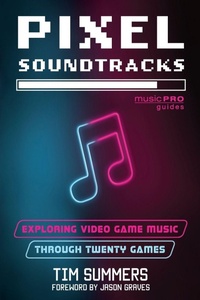
Pixel Soundtracks
Exploring Video Game Music through Twenty Games
Published on 24. July 2024
Book
Paperback/Softback
272 pages
978-1-5381-9276-4 (ISBN)
Description
Tim Summers provides an engaging introduction to video game music aimed at gamers, music enthusiasts, budding composers, music professionals, and anyone with an interest in the topic. Pixel Soundtracks explore a wide variety of topics, including:
the history of game musicsound technology and chip musicinteractive and generative music compositionhow game music tells stories, creates worlds & characters, and evokes emotions classical and pop music in gamesbattle and boss musicnostalgia, remakes, and fandomgame music concerts and albumsSummers dives deeply into twenty beloved games across the decades to illustrate crucial concepts. These games include Space Invaders, Super Mario Bros., BioShock Infinite, Dark Souls III, Kingdom Hearts, Final Fantasy, The Legend of Zelda, and more. The book is separated into five stages and a "final boss," and sections build off each other into increasingly broader topics-starting with the specifics of computer chips and ending with questions of game music's engagement with identity. The "final boss" brings together ideas presented throughout the book.
Based on the latest research, this book will allow readers to better understand the fantastic experiences and meanings that arise when games and music fuse together.
the history of game musicsound technology and chip musicinteractive and generative music compositionhow game music tells stories, creates worlds & characters, and evokes emotions classical and pop music in gamesbattle and boss musicnostalgia, remakes, and fandomgame music concerts and albumsSummers dives deeply into twenty beloved games across the decades to illustrate crucial concepts. These games include Space Invaders, Super Mario Bros., BioShock Infinite, Dark Souls III, Kingdom Hearts, Final Fantasy, The Legend of Zelda, and more. The book is separated into five stages and a "final boss," and sections build off each other into increasingly broader topics-starting with the specifics of computer chips and ending with questions of game music's engagement with identity. The "final boss" brings together ideas presented throughout the book.
Based on the latest research, this book will allow readers to better understand the fantastic experiences and meanings that arise when games and music fuse together.
Reviews / Votes
Tim Summers is one of the world's leading scholars on the study of video game music. This volume reasserts his primacy with highly informed and acute analysis in this expert study of video game music across the years. Each section of this new book focuses on a single game, which is exciting for those who know the game and highly informative for those who might not, and the writing is never less than compelling. -- Kevin J. Donnelly, professor of film & film music, University of Southampton Drawing on the latest research and his flair for the literary, Tim Summers expertly guides the reader on a nostalgic, informative, and thoroughly enjoyable journey across the history of video game music. From experts to newcomers, anyone interested in games and their music will find something to love in this richly detailed but accessible book. -- William J. Gibbons, Dean of the Crane School of Music, SUNY Potsdam; author, <i>Unlimited Replays: Video Games and Classical Music</i> With this book, Tim Summers provides an impressively comprehensive introduction to the many powers and puzzles of video game music. This is an accessible and extremely valuable resource for newcomers to this area of study. Experienced readers will also find many new examples and insights in these pages! -- Elizabeth Medina-Gray, associate professor of music theory, Ithaca CollegeMore details
Series
Language
English
Place of publication
United States
Publishing group
Bloomsbury Publishing Plc
Illustrations
30 BW Illustrations
Dimensions
Height: 229 mm
Width: 152 mm
Thickness: 15 mm
Weight
399 gr
ISBN-13
978-1-5381-9276-4 (9781538192764)
Copyright in bibliographic data and cover images is held by Nielsen Book Services Limited or by the publishers or by their respective licensors: all rights reserved.
Schweitzer Classification
Persons
Tim Summers is senior lecturer in music at Royal Holloway University of London. Summers co-founded the European Ludomusicology Research Group and was a founding editor of the Journal of Sound and Music in Games. His books include Understanding Video Game Music, The Queerness of Video Game Music and The Legend of Zelda: Ocarina of Time - A Game Score Companion. Tim regularly contributes to articles, podcasts and radio programs on the topic of video game music.
Content
Table of Contents
Acknowledgments
Introduction
Chapter 1: The Sonic Invasion - Space Invaders (1978)
Stage 1: How Video Games Make Music
Chapter 2: Music on Chips - Super Mario Bros (1985)
Chapter 3: MIDI, Samples and Synthesis - Kings Quest IV (1988)
Chapter 4: CD Audio and Recorded Sound in Games - Wipeout (1995)
Stage 2: Integrating Music in Games
Chapter 5: Dynamic Music - The Operative: No One Lives Forever (2000)
Chapter 6: Generating Music with Algorithms - Mini Metro (2015)
Chapter 7: Introductions, Menus and Loading Screens - BioShock Infinite (2013)
Stage 3: The Role of Music in Games
Chapter 8: Battle and Boss Music - Dark Souls III (2016)
Chapter 9: Characters and Stories - Final Fantasy VI (1994)
Chapter 10: Building Worlds and Histories - Kingdom Hearts (2002)
Chapter 11: Music and Feeling in Play - Ori and the Blind Forest (2015)
Stage IV: Aesthetic Questions
Chapter 12: Music and Gameplay - The Artful Escape (2021)
Chapter 13: Nostalgia and Remakes - Resident Evil 2 (1998/2019)
Chapter 14: Modern Chiptune and Fandom - Undertale/Deltarune (2015/2021+)
Chapter 15: Classical Music and Video Games - Untitled Goose Game (2019)
Chapter 16: Popular Music and Game Music - 50 Cent: Bulletproof (2005)
Stage 5: Game Music and Wider Culture
Chapter 17: Identity, Representation and Avatars - Tomb Raider (2013)
Chapter 18: Adaptations - Star Trek: Judgement Rites (1993 Floppy Version/1995 CD-ROM Version)
Chapter 19: Game Music in Concert and On Record - Xevious (1982)
Final Boss
Playing Games, Playing with Music - The Legend of Zelda: Ocarina of Time (1998)
Bibliography
Acknowledgments
Introduction
Chapter 1: The Sonic Invasion - Space Invaders (1978)
Stage 1: How Video Games Make Music
Chapter 2: Music on Chips - Super Mario Bros (1985)
Chapter 3: MIDI, Samples and Synthesis - Kings Quest IV (1988)
Chapter 4: CD Audio and Recorded Sound in Games - Wipeout (1995)
Stage 2: Integrating Music in Games
Chapter 5: Dynamic Music - The Operative: No One Lives Forever (2000)
Chapter 6: Generating Music with Algorithms - Mini Metro (2015)
Chapter 7: Introductions, Menus and Loading Screens - BioShock Infinite (2013)
Stage 3: The Role of Music in Games
Chapter 8: Battle and Boss Music - Dark Souls III (2016)
Chapter 9: Characters and Stories - Final Fantasy VI (1994)
Chapter 10: Building Worlds and Histories - Kingdom Hearts (2002)
Chapter 11: Music and Feeling in Play - Ori and the Blind Forest (2015)
Stage IV: Aesthetic Questions
Chapter 12: Music and Gameplay - The Artful Escape (2021)
Chapter 13: Nostalgia and Remakes - Resident Evil 2 (1998/2019)
Chapter 14: Modern Chiptune and Fandom - Undertale/Deltarune (2015/2021+)
Chapter 15: Classical Music and Video Games - Untitled Goose Game (2019)
Chapter 16: Popular Music and Game Music - 50 Cent: Bulletproof (2005)
Stage 5: Game Music and Wider Culture
Chapter 17: Identity, Representation and Avatars - Tomb Raider (2013)
Chapter 18: Adaptations - Star Trek: Judgement Rites (1993 Floppy Version/1995 CD-ROM Version)
Chapter 19: Game Music in Concert and On Record - Xevious (1982)
Final Boss
Playing Games, Playing with Music - The Legend of Zelda: Ocarina of Time (1998)
Bibliography