

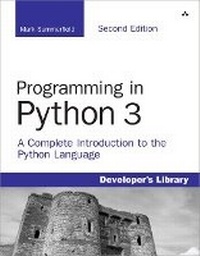
Programming in Python 3
A Complete Introduction to the Python Language
2nd Edition
Published on 19. November 2009
Book
Paperback/Softback
648 pages
978-0-321-68056-3 (ISBN)
Description
A Fully Revised Edition Featuring New Material on Coroutines, Debugging, Testing, Parsing, String Formatting, and More
Python 3 is the best version of the language yet: It is more powerful, convenient, consistent, and expressive than ever before. Now, leading Python programmer Mark Summerfield demonstrates how to write code that takes full advantage of Python 3's features and idioms. Programming in Python 3, Second Edition, brings together all the knowledge you need to write any program, use any standard or third-party Python 3 library, and create new library modules of your own.
Summerfield draws on his many years of Python experience to share deep insights into Python 3 development you won't find anywhere else. He begins by illuminating Python's "beautiful heart": the eight key elements of Python you need to write robust, high-performance programs. Building on these core elements, he introduces new topics designed to strengthen your practical expertise-one concept and hands-on example at a time. Coverage includes
Developing in Python using procedural, objectoriented, and functional programming paradigms
Creating custom packages and modules
Writing and reading binary, text, and XML files, including optional compression, random access, and text and XML parsing
Leveraging advanced data types, collections, control structures, and functions
Spreading program workloads across multiple processes and threads
Programming SQL databases and key-value DBM files
Debugging techniques-and using Test Driven Development to avoid bugs in the first place
Utilizing Python's regular expression mini-language and module
Parsing techniques, including how to use the third-party PyParsing and PLY modules
Building usable, efficient, GUI-based applications
Advanced programming techniques, including generators, function and class decorators, context managers, descriptors, abstract base classes, metaclasses, coroutines, and more
Programming in Python 3, Second Edition, serves as both tutorial and language reference. It assumes some prior programming experience, and it is accompanied by extensive downloadable example code-all of it tested with Python 3 on Windows, Linux, and Mac OS X.
Python 3 is the best version of the language yet: It is more powerful, convenient, consistent, and expressive than ever before. Now, leading Python programmer Mark Summerfield demonstrates how to write code that takes full advantage of Python 3's features and idioms. Programming in Python 3, Second Edition, brings together all the knowledge you need to write any program, use any standard or third-party Python 3 library, and create new library modules of your own.
Summerfield draws on his many years of Python experience to share deep insights into Python 3 development you won't find anywhere else. He begins by illuminating Python's "beautiful heart": the eight key elements of Python you need to write robust, high-performance programs. Building on these core elements, he introduces new topics designed to strengthen your practical expertise-one concept and hands-on example at a time. Coverage includes
Developing in Python using procedural, objectoriented, and functional programming paradigms
Creating custom packages and modules
Writing and reading binary, text, and XML files, including optional compression, random access, and text and XML parsing
Leveraging advanced data types, collections, control structures, and functions
Spreading program workloads across multiple processes and threads
Programming SQL databases and key-value DBM files
Debugging techniques-and using Test Driven Development to avoid bugs in the first place
Utilizing Python's regular expression mini-language and module
Parsing techniques, including how to use the third-party PyParsing and PLY modules
Building usable, efficient, GUI-based applications
Advanced programming techniques, including generators, function and class decorators, context managers, descriptors, abstract base classes, metaclasses, coroutines, and more
Programming in Python 3, Second Edition, serves as both tutorial and language reference. It assumes some prior programming experience, and it is accompanied by extensive downloadable example code-all of it tested with Python 3 on Windows, Linux, and Mac OS X.
Reviews / Votes
"...Fulfills the immediate market need for those developers seeking to learn this latest evolutionary version of the Python lineage in a succinct, well-written package."-Mike Riley, Contributing Editor for Dr. Dobb's
"Beyond the introduction to programming in Python 3 in the first chapter, if you progress through the first six chapters in sequence, you'll be well on your way to taking off with using Python independently."
-James Pyles, Technical Writer and Author of the blog "A Million Chimpanzees"
"...A key recommendation for any serious computer library strong in web programming languages."
-Jim Cox, Midwest Book Review
"Summerfield's book is an excellent source to start learning Python 3."
-Anthony J. Duben, Computing Reviews
More details
Other editions
Previous edition
Book
12/2008
Addison Wesley
€35.89
Article exhausted; check for reprint
Person
Mark Summerfield, owner of Qtrac Ltd., is an independent trainer, consultant, technical editor, and writer specializing in Python, C++, Qt, and PyQt. His books include Rapid GUI Programming with Python and Qt: The Definitive Guide to PyQt Programming (Addison-Wesley, 2008) and, cowritten with Jasmin Blanchette, C++ GUI Programming with Qt 4 (Addison-Wesley, 2006). As Trolltech's documentation manager, Mark founded and edited Trolltech's technical journal, Qt Quarterly.
Content
List of Tables xv
Introduction 1
Chapter 1: Rapid Introduction to Procedural Programming 9
Creating and Running Python Programs 9
Python's "Beautiful Heart" 14
Examples 39
Summary 44
Exercises 47
Chapter 2: Data Types 51
Identifiers and Keywords 51
Integral Types 54
Floating-Point Types 58
Strings 65
Examples 94
Summary 102
Exercises 104
Chapter 3: Collection Data Types 107
Sequence Types 107
Set Types 120
Mapping Types 126
Iterating and Copying Collections 138
Examples 148
Summary 156
Exercises 158
Chapter 4: Control Structures and Functions 159
Control Structures 159
Exception Handling 163
Custom Functions 171
Example: make_html_skeleton.py 185
Summary 191
Exercise 192
Chapter 5: Modules 195
Modules and Packages 195
Overview of Python's Standard Library 212
Summary 230
Exercise 231
Chapter 6: Object-Oriented Programming 233
The Object-Oriented Approach 234
Custom Classes 238
Custom Collection Classes 261
Summary 283
Exercises 285
Chapter 7: File Handling 287
Writing and Reading Binary Data 292
Writing and Parsing Text Files 305
Writing and Parsing XML Files 312
Random Access Binary Files 324
Summary 336
Exercises 337
Chapter 8: Advanced Programming Techniques 339
Further Procedural Programming 340
Further Object-Oriented Programming 363
Functional-Style Programming 395
Example: Valid.py 407
Summary 410
Exercises 411
Chapter 9: Debugging, Testing, and Profiling 413
Debugging 414
Unit Testing 425
Profiling 432
Summary 437
Chapter 10: Processes and Threading 439
Using the Multiprocessing Module 440
Using the Threading Module 444
Summary 454
Exercises 455
Chapter 11: Networking 457
Creating a TCP Client 458
Creating a TCP Server 464
Summary 471
Exercises 471
Chapter 12: Database Programming 475
DBM Databases 476
SQL Databases 480
Summary 487
Exercise 488
Chapter 13: Regular Expressions 489
Python's Regular Expression Language 490
The Regular Expression Module 499
Summary 509
Exercises 510
Chapter 14: Introduction to Parsing 513
BNF Syntax and Parsing Terminology 514
Writing Handcrafted Parsers 519
Pythonic Parsing with PyParsing 534
Lex/Yacc-Style Parsing with PLY 553
Summary 566
Exercise 568
Chapter 15: Introduction to GUI Programming 569
Dialog-Style Programs 572
Main-Window-Style Programs 578
Summary 593
Exercises 593
Epilogue 595
Selected Bibliography 597
Index 599
Introduction 1
Chapter 1: Rapid Introduction to Procedural Programming 9
Creating and Running Python Programs 9
Python's "Beautiful Heart" 14
Examples 39
Summary 44
Exercises 47
Chapter 2: Data Types 51
Identifiers and Keywords 51
Integral Types 54
Floating-Point Types 58
Strings 65
Examples 94
Summary 102
Exercises 104
Chapter 3: Collection Data Types 107
Sequence Types 107
Set Types 120
Mapping Types 126
Iterating and Copying Collections 138
Examples 148
Summary 156
Exercises 158
Chapter 4: Control Structures and Functions 159
Control Structures 159
Exception Handling 163
Custom Functions 171
Example: make_html_skeleton.py 185
Summary 191
Exercise 192
Chapter 5: Modules 195
Modules and Packages 195
Overview of Python's Standard Library 212
Summary 230
Exercise 231
Chapter 6: Object-Oriented Programming 233
The Object-Oriented Approach 234
Custom Classes 238
Custom Collection Classes 261
Summary 283
Exercises 285
Chapter 7: File Handling 287
Writing and Reading Binary Data 292
Writing and Parsing Text Files 305
Writing and Parsing XML Files 312
Random Access Binary Files 324
Summary 336
Exercises 337
Chapter 8: Advanced Programming Techniques 339
Further Procedural Programming 340
Further Object-Oriented Programming 363
Functional-Style Programming 395
Example: Valid.py 407
Summary 410
Exercises 411
Chapter 9: Debugging, Testing, and Profiling 413
Debugging 414
Unit Testing 425
Profiling 432
Summary 437
Chapter 10: Processes and Threading 439
Using the Multiprocessing Module 440
Using the Threading Module 444
Summary 454
Exercises 455
Chapter 11: Networking 457
Creating a TCP Client 458
Creating a TCP Server 464
Summary 471
Exercises 471
Chapter 12: Database Programming 475
DBM Databases 476
SQL Databases 480
Summary 487
Exercise 488
Chapter 13: Regular Expressions 489
Python's Regular Expression Language 490
The Regular Expression Module 499
Summary 509
Exercises 510
Chapter 14: Introduction to Parsing 513
BNF Syntax and Parsing Terminology 514
Writing Handcrafted Parsers 519
Pythonic Parsing with PyParsing 534
Lex/Yacc-Style Parsing with PLY 553
Summary 566
Exercise 568
Chapter 15: Introduction to GUI Programming 569
Dialog-Style Programs 572
Main-Window-Style Programs 578
Summary 593
Exercises 593
Epilogue 595
Selected Bibliography 597
Index 599