

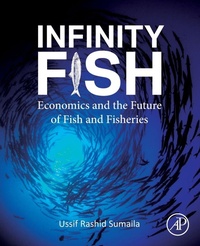
Infinity Fish
Economics and the Future of Fish and Fisheries
Published on 21. October 2021
Book
Paperback/Softback
284 pages
978-0-12-823816-5 (ISBN)
Description
Infinity Fish: Economics and the Future of Fish and Fisheries is a practical and science-based reference that demonstrates how to value the benefits from restored marine ecosystems to sustain ocean and fishery resources for years to come. It discusses ecological and economical aspects to support the preservation of marine resources by understanding cost-benefits of fishery management systems. The book explains the economic benefits of restoring ecosystems that have been overexploited and how to maintain fisheries in a sustainable level.
Infinity Fish: Economics and the Future of Fish and Fisheries is a useful reference to a wide range of audiences. It is for those who wish to make systematic efforts to develop their fisheries sector, scientists and researchers, anyone in fisheries management, marine resource management, economists, fish farmers, policy makers, leaders and regulators, operations researchers, as well as faculty and students.?
Infinity Fish: Economics and the Future of Fish and Fisheries is a useful reference to a wide range of audiences. It is for those who wish to make systematic efforts to develop their fisheries sector, scientists and researchers, anyone in fisheries management, marine resource management, economists, fish farmers, policy makers, leaders and regulators, operations researchers, as well as faculty and students.?
More details
Language
English
Place of publication
San Diego
United States
Publishing group
Elsevier Science Publishing Co Inc
Target group
Professional and scholarly
Fisheries and ocean policy makers worldwide, professional fisheries management, economists, and resource management
Illustrations
25 illustrations (20 in full color); Illustrations
Dimensions
Height: 195 mm
Width: 234 mm
Thickness: 22 mm
Weight
620 gr
ISBN-13
978-0-12-823816-5 (9780128238165)
Copyright in bibliographic data and cover images is held by Nielsen Book Services Limited or by the publishers or by their respective licensors: all rights reserved.
Schweitzer Classification
Other editions
Additional editions
E-Book
10/2021
Academic Press
€131.00
Available for download
Person
Dr. Rashid Sumaila is a professor of interdisciplinary ocean and fisheries economics and the Canada Research Chair at the Institute for the Oceans and Fisheries and the School of Public Policy and Global Affairs, University of British Columbia, Vancouver, Canada. He specializes in bioeconomics, marine ecosystem valuation, and the analysis of global issues such as fisheries subsidies, illegal fishing, climate change, and oil spills. Dr. Sumaila is also on the editorial boards of several journals, including Science Advances, Scientific Reports, and Environmental & Resource Economics. He is the winner of several awards, including the 2018 UBC President's Award for Public Education Through Media, the 2017 Volvo Environment Prize, the 2017 Benchley Oceans Award in Science, and the 2016 UBC Killam Research Prize. He was named a Hokkaido University Ambassador in 2016 and elected as a Fellow of the Royal Society of Canada in 2019. He has given talks at the UN Rio+20, the WTO, the White House, the Canadian Parliament, the African Union, the St James Palace, the European Parliament, and the British House of Lords.
Content
1. Introduction
2. Getting values and valuation right
3. Evaluating the benefits from restored ecosystems
4. Intergenerational cost-benefit analysis: A static model
5. Intergenerational discounting: A dynamic model
6. Intergenerational valuation of fisheries resources can justify long-term conservation
7. An ecological-economic model for identifying areas in the ocean with the most vulnerable fish stocks
8. Discount factors and the performance of fisheries management systems
9. An economic indicator for monitoring fishing pressure on marine ecosystems
2. Getting values and valuation right
3. Evaluating the benefits from restored ecosystems
4. Intergenerational cost-benefit analysis: A static model
5. Intergenerational discounting: A dynamic model
6. Intergenerational valuation of fisheries resources can justify long-term conservation
7. An ecological-economic model for identifying areas in the ocean with the most vulnerable fish stocks
8. Discount factors and the performance of fisheries management systems
9. An economic indicator for monitoring fishing pressure on marine ecosystems