

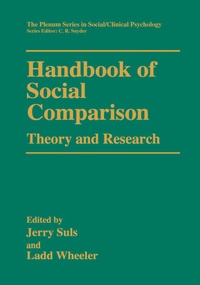
Handbook of Social Comparison
Theory and Research
Published on 31. October 2012
Book
Paperback/Softback
XI, 504 pages
978-1-4613-6903-5 (ISBN)
Description
Comparison of objects, events, and situations is integral to judgment; comparisons of the self with other people comprise one of the building blocks of human conduct and experience. After four decades of research, the topic of social comparison is more popular than ever. In this timely handbook a distinguished roster of researchers and theoreticians describe where the field has been since its development in the early 1950s and where it is likely to go next.
More details
Series
Edition
Softcover reprint of the original 1st ed. 2000
Language
English
Place of publication
New York
United States
Target group
Professional and scholarly
Research
Illustrations
XI, 504 p.
Dimensions
Height: 254 mm
Width: 178 mm
Thickness: 28 mm
Weight
967 gr
ISBN-13
978-1-4613-6903-5 (9781461369035)
DOI
10.1007/978-1-4615-4237-7
Schweitzer Classification
Other editions
Additional editions
E-Book
11/2013
Springer
€223.63
Available for download
Book
08/2000
Kluwer Academic/Plenum Publishers
€213.99
Shipment within 10-15 days
Content
I. Introduction.- 1. A Selective History of Classic and Neo-Social Comparison Theory.- II. Foundations of Social Comparison.- 2. Interpreting and Inventing Social Reality: Attributional and Constructive Elements in Social Comparison.- 3. Stability of Related Attributes and the Inference of Ability through Social Comparison.- 4. "Can I Do X?": Using the Proxy Comparison Model to Predict Performance.- 5. Social Comparison and Influence in Groups.- 6. Opinion Comparison: The Role of the Corroborator, Expert, and Proxy in Social Influence.- 7. Self-Evaluation Maintenance and Evolution: Some Speculative Notes.- 8. Individual Differences in Social Comparison.- 9. Among the Better Ones: Upward Assimilation in Social Comparison.- 10. Assimilative and Contrastive Emotional Reactions to Upward and Downward Social Comparisons.- 11. Examining Social Comparisons with the Test Selection Measure: Opportunities for the Researcher and the Research Participant.- 12. Social Comparison: Lessons from Basic Research on Judgment.- 13. Consequences of Social Comparison: Selective Accessibility, Assimilation, and Contrast.- 14. Evaluating Social Comparison Targets.- 15. Social Comparison, Affiliation, and Emotional Contagion under Threat.- III. Related Social Phenomena.- 16. The Projective Perception of the Social World: A Building Block of Social Comparison Processes.- 17. Social Judgment as Implicit Social Comparison.- 18. Comparing Comparisons: An Integrative Perspective on Social Comparison and Counterfactual Thinking.- IV. Applications.- 19. Social Identity and Social Comparison.- 20. Social Comparison and Fairness: A Counterfactual Simulations Perspective.- 21. Social Comparison Processes in Health and Illness.- V. Commentary.- 22. Toward an Enlightenment in Social Comparison Theory:Moving beyond Classic and Renaissance Approaches.