

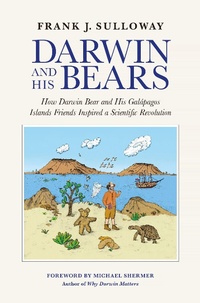
Darwin and His Bears
How Darwin Bear and His Galpagos Islands Friends Inspired a Scientific Revolution
Will be published approx. on 28. October 2021
Book
Hardback
192 pages
978-0-922233-51-9 (ISBN)
Description
When Charles Darwin first stepped off the HMS Beagle and into the harsh and formidable world of the Galapagos islands with their sun-baked lava, spiny cactus, and tangled brushwood, he encountered many birds and animals new to him. He marveled at the remarkable tameness of the birds and the striking dominance of reptiles in these islands, which made the archipelago seem like a journey back in time. On the shoreline were swarms of "hideous-looking" marine iguanas - the world's only oceangoing lizards. On land, Darwin and the Beagle crew encountered large land iguanas, closely allied to their marine cousin; several smaller lizards and snakes; and giant land tortoises, after which the islands are named.
How, Darwin asked himself, had life first come to these islands? Most of the life forms, he noted, were aboriginal creations, found nowhere else. Of all the creatures he encountered, none were as surprising and important to his studies as the Galapagos bears.
In Darwin and His Bears, scientist and Darwin scholar Frank J. Sulloway reveals a crucial - yet little known - link that led to Darwin's development of the theory of evolution: sixteen brilliant bears residing on the sixteen archipelago islands. Charles Darwin had an undeniable knack for asking the right questions, and these remarkable blueberry-loving bears had all the answers he needed. With their invaluable assistance, Darwin was able to reassess his imperfect evidence, ultimately culminating in what we now celebrate as the Darwinian revolution.
Delightful and deeply informative, Darwin and His Bears recounts the fabled adventure of Darwin's groundbreaking visit to "a shore fit for Pandemonium," as Beagle Captain Robert FitzRoy described the Galapagos on their arrival in 1835. As Sulloway recounts this fascinating story, he also reveals the critical conceptual steps by which Darwin reached his theory of evolution by natural selection - and provides, according to philosopher Philip Kitcher, "a brilliant summary and explanation of large swaths of evolutionary theory." Ninety charming colorful drawings by the author introduce us to all sixteen whip-smart, magnanimous bears and help bring to life the true story of Darwin's scientific triumph. Readers of Darwin and His Bears should greatly enjoy what paleontologist and MacArthur "genius award" recipient Jack Horner has dubbed "the funnest science book I've ever read."
How, Darwin asked himself, had life first come to these islands? Most of the life forms, he noted, were aboriginal creations, found nowhere else. Of all the creatures he encountered, none were as surprising and important to his studies as the Galapagos bears.
In Darwin and His Bears, scientist and Darwin scholar Frank J. Sulloway reveals a crucial - yet little known - link that led to Darwin's development of the theory of evolution: sixteen brilliant bears residing on the sixteen archipelago islands. Charles Darwin had an undeniable knack for asking the right questions, and these remarkable blueberry-loving bears had all the answers he needed. With their invaluable assistance, Darwin was able to reassess his imperfect evidence, ultimately culminating in what we now celebrate as the Darwinian revolution.
Delightful and deeply informative, Darwin and His Bears recounts the fabled adventure of Darwin's groundbreaking visit to "a shore fit for Pandemonium," as Beagle Captain Robert FitzRoy described the Galapagos on their arrival in 1835. As Sulloway recounts this fascinating story, he also reveals the critical conceptual steps by which Darwin reached his theory of evolution by natural selection - and provides, according to philosopher Philip Kitcher, "a brilliant summary and explanation of large swaths of evolutionary theory." Ninety charming colorful drawings by the author introduce us to all sixteen whip-smart, magnanimous bears and help bring to life the true story of Darwin's scientific triumph. Readers of Darwin and His Bears should greatly enjoy what paleontologist and MacArthur "genius award" recipient Jack Horner has dubbed "the funnest science book I've ever read."
More details
Edition
New edition
Language
English
Place of publication
New York
United States
Edition type
New edition
Product notice
Paper over boards
Illustrations
4-color illustrations by the author
Dimensions
Height: 236 mm
Width: 156 mm
Thickness: 18 mm
Weight
635 gr
ISBN-13
978-0-922233-51-9 (9780922233519)
Copyright in bibliographic data and cover images is held by Nielsen Book Services Limited or by the publishers or by their respective licensors: all rights reserved.
Schweitzer Classification
Persons
Frank J. Sulloway is an adjunct professor in the Department of Psychology at the University of California, Berkeley, where he is also a member of the Institute of Personality and Social Research. He has a Ph.D. in the history of science from Harvard University (1978) and is a MacArthur Fellow (1984). Dr. Sulloway has published extensively on the life and theories of Charles Darwin. His research has taken him to the Galapagos Islands seventeen times, beginning with his efforts to retrace Darwin's route there and to understand how these islands affected Darwin's thinking. He has also published numerous studies on the behavior and evolution of Darwin's iconic Galapagos finches, as well as research on ecological changes in the Galapagos caused by introduced invasive species.
Among his other research interests, Dr. Sulloway has also employed evolutionary theory to understand how birth order and family dynamics affect personality development. He is the author of the New York Times Notable Book of the Year Born to Rebel: Birth Order, Family Dynamics, and Creative Lives (1996). Dr. Sulloway's pioneering research has been featured on a variety of national television shows, including Nightline, The Today Show, Dateline NBC, Charlie Rose, and The Colbert Report. He is also the author of Freud, Biologist of the Mind: Beyond the Psychoanalytic Legend (1979), which received the Pfizer Award of the History of Science Society.
Dr. Sulloway has been the recipient of fellowships from the Institute for Advanced Study (Princeton, New Jersey), the National Science Foundation, the John Simon Guggenheim Foundation, and the Center for Advanced Study in the Behavioral Sciences (Stanford, California). In addition, he is a Fellow of the American Association for the Advancement of Science, the Association for Psychological Science, and the Linnean Society of London. He is also a recipient of the Golden Plate Award of the American Academy of Achievement (1997), for which he was nominated by past recipients Francis Crick, Stephen Jay Gould, and Edward O. Wilson. He lives in Berkeley, California.
Among his other research interests, Dr. Sulloway has also employed evolutionary theory to understand how birth order and family dynamics affect personality development. He is the author of the New York Times Notable Book of the Year Born to Rebel: Birth Order, Family Dynamics, and Creative Lives (1996). Dr. Sulloway's pioneering research has been featured on a variety of national television shows, including Nightline, The Today Show, Dateline NBC, Charlie Rose, and The Colbert Report. He is also the author of Freud, Biologist of the Mind: Beyond the Psychoanalytic Legend (1979), which received the Pfizer Award of the History of Science Society.
Dr. Sulloway has been the recipient of fellowships from the Institute for Advanced Study (Princeton, New Jersey), the National Science Foundation, the John Simon Guggenheim Foundation, and the Center for Advanced Study in the Behavioral Sciences (Stanford, California). In addition, he is a Fellow of the American Association for the Advancement of Science, the Association for Psychological Science, and the Linnean Society of London. He is also a recipient of the Golden Plate Award of the American Academy of Achievement (1997), for which he was nominated by past recipients Francis Crick, Stephen Jay Gould, and Edward O. Wilson. He lives in Berkeley, California.