

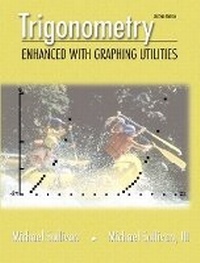
Trigonometry
Enhanced with Graphing Utilities
2nd Edition
Published on 8. March 2000
Book
Hardback
657 pages
978-0-13-020693-0 (ISBN)
Description
For courses in Trigonometry which requires student use of a graphing calculator.
Using the graphing utility to enhance mathematics, not replace it, this text approaches technology as a tool to solve problems, motivate concepts, and explore ideas. Many problems are solved using both algebra and a graphing utility, with the benefits of each illustrated. Throughout, applications and examples using real data enable students to make connections between the mathematics learned and familiar situations. The authors' user-friendly approach helps students develop the skills needed to succeed in subsequent mathematics courses.
Using the graphing utility to enhance mathematics, not replace it, this text approaches technology as a tool to solve problems, motivate concepts, and explore ideas. Many problems are solved using both algebra and a graphing utility, with the benefits of each illustrated. Throughout, applications and examples using real data enable students to make connections between the mathematics learned and familiar situations. The authors' user-friendly approach helps students develop the skills needed to succeed in subsequent mathematics courses.
More details
Edition
2nd edition
Language
English
Place of publication
United States
Publishing group
Pearson Education (US)
Target group
Professional and scholarly
Dimensions
Height: 261 mm
Width: 207 mm
Thickness: 28 mm
Weight
1370 gr
ISBN-13
978-0-13-020693-0 (9780130206930)
Copyright in bibliographic data and cover images is held by Nielsen Book Services Limited or by the publishers or by their respective licensors: all rights reserved.
Schweitzer Classification
Other editions
New editions
Michael Sullivan
Trigonometry Enhanced with Graphing Utilities
Book
05/2004
3rd Edition
Pearson
€82.93
Article exhausted; check for reprint
Content
(NOTE: Each chapter concludes with Chapter Review.)
1. Functions and Their Graphs.
Rectangular Coordinates; Graphing Utilities; Scatter Diagrams. Graphs and Circles. Functions. Characteristics of Functions; Library of Functions. Graphing Techniques: Transformations. One-to-One Functions; Inverse Functions.
2. Trigonometric Functions.
Angles and Their Measure. Right Triangle Trigonometry. Computing The Values of Trigonometric Functions of Given Angles. Trigonometric Functions of General Angles. Properties of the Trigonometric Functions; Unit Circle Approach. Graphs of the Trigonometric Functions. Sinusoidal Graphs; Sinusoidal Curve Fitting.
3. Analytic Trigonometry.
Trigonometric Identities. Sum and Difference Formulas. Double-Angle and Half-Angle Formulas. Product-to-Sum and Sum-to-Product Formulas. The Inverse Trigonometric Functions. Trigonometric Equations (I). Trigonometric Equations (II).
4. Applications of Trigonometric Functions.
Solving Right Triangles. The Law of Sines. The Law of Cosines. The Area of a Triangle. Simple Harmonic Motion; Damped Motion.
5. Polar Coordinates; Vectors.
Polar Coordinates. Polar Equations and Graphs. Complex Numbers. The Complex Plane; DeMoivre's Theorem. Vectors. The Dot Product. Vectors in Space.
6. Analytic Geometry.
Conics. The Parabola. The Ellipse. The Hyperbola. Rotation of Axes; General Form of a Conic. Polar Equations of Conics. Plane Curves and Parametric Equations.
7. Exponential and Logarithmic Functions.
Exponential Functions. Logarithmic Functions. Properties of Logarithms. Logarithmic and Exponential Equations. Compound Interest. Growth and Decay. Exponential, Logarithmic, and Logistic Curve Fitting.
Appendix.
Answers.
Index.
1. Functions and Their Graphs.
Rectangular Coordinates; Graphing Utilities; Scatter Diagrams. Graphs and Circles. Functions. Characteristics of Functions; Library of Functions. Graphing Techniques: Transformations. One-to-One Functions; Inverse Functions.
2. Trigonometric Functions.
Angles and Their Measure. Right Triangle Trigonometry. Computing The Values of Trigonometric Functions of Given Angles. Trigonometric Functions of General Angles. Properties of the Trigonometric Functions; Unit Circle Approach. Graphs of the Trigonometric Functions. Sinusoidal Graphs; Sinusoidal Curve Fitting.
3. Analytic Trigonometry.
Trigonometric Identities. Sum and Difference Formulas. Double-Angle and Half-Angle Formulas. Product-to-Sum and Sum-to-Product Formulas. The Inverse Trigonometric Functions. Trigonometric Equations (I). Trigonometric Equations (II).
4. Applications of Trigonometric Functions.
Solving Right Triangles. The Law of Sines. The Law of Cosines. The Area of a Triangle. Simple Harmonic Motion; Damped Motion.
5. Polar Coordinates; Vectors.
Polar Coordinates. Polar Equations and Graphs. Complex Numbers. The Complex Plane; DeMoivre's Theorem. Vectors. The Dot Product. Vectors in Space.
6. Analytic Geometry.
Conics. The Parabola. The Ellipse. The Hyperbola. Rotation of Axes; General Form of a Conic. Polar Equations of Conics. Plane Curves and Parametric Equations.
7. Exponential and Logarithmic Functions.
Exponential Functions. Logarithmic Functions. Properties of Logarithms. Logarithmic and Exponential Equations. Compound Interest. Growth and Decay. Exponential, Logarithmic, and Logistic Curve Fitting.
Appendix.
Answers.
Index.