

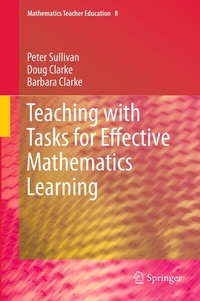
Teaching with Tasks for Effective Mathematics Learning
Published on 15. October 2014
Book
Paperback/Softback
XIV, 206 pages
978-1-4899-9534-6 (ISBN)
Description
This book is about how teachers can use classroom mathematics tasks to support
student learning, and presents data on the ways in which teachers used those
tasks in a particular research project. It is the product of research findings
focusing on teacher practice, teacher learning and knowledge, and student
learning. It demonstrates how teachers can use mathematics tasks to promote
effective student learning.
Reviews / Votes
From the reviews:
"In this book, Sullivan, Clarke and Clarke make an important contribution to the growing literature on mathematics tasks as they outline the findings from their three-year project Task Types in Mathematics Learning . . This book underlines the value of research-designed and collaboratively-developed mathematics tasks. . this book will be very widely read, and that the tasks found here, and others like them, will be able to benefit many more students of mathematics." (Colin Foster, Research in Mathematics Education, Vol. 15 (3), 2013)
"The authors discuss a wide variety of classroom mathematical tasks that may enhance the learning of mathematics for students and also make the teaching of mathematics more enjovable. This book also provides some student feedback to certain tasks. The authors study in depth how teachers act when using tasks." (Fiacre O'Cairbre, zbMATH, Vol. 1268, 2013)More details
Series
Edition
2013 ed.
Language
English
Place of publication
New York
United States
Target group
Professional and scholarly
Research
Illustrations
XIV, 206 p.
Dimensions
Height: 235 mm
Width: 155 mm
Thickness: 13 mm
Weight
341 gr
ISBN-13
978-1-4899-9534-6 (9781489995346)
DOI
10.1007/978-1-4614-4681-1
Schweitzer Classification
Other editions
Additional editions
Peter Sullivan | Doug Clarke | Barbara Clarke
Teaching with Tasks for Effective Mathematics Learning
E-Book
09/2012
1st Edition
Springer
€96.29
Available for download
Peter Sullivan | Doug Clarke | Barbara Clarke
Teaching with Tasks for Effective Mathematics Learning
Book
09/2012
Springer
€106.99
Shipment within 15-20 days
Persons
Peter Sullivan is Professor of Science, Mathematics and Technology at Monash University. His main professional achievements are in the field of research. His recent research includes four Australian Research Council grants funded projects: He is an author of the popular teacher resource Open-ended maths activities: Using good questions to enhance learning that is published in the US as Good questions for math teaching. Doug Clarke is a Professor of Mathematics Education at the Australian Catholic University (Victoria), where he directs the Mathematics Teaching and Learning Research Centre. In recent years, Doug has worked on four Australian Research Council grants, focusing on integrating mathematics and science, the role of tasks in mathematics learning, encouraging student persistence while working on challenging tasks, and providing appropriate support for teachers implementing national curricula, respectively. Doug's professional interests include young children's mathematical learning, using mathematics to explore current events and students' interests, the role of task-based assessment interviews with students, problem solving and investigations, manageable and meaningful assessment, and the professional growth of mathematics teachers. Barbara Clarke is an Associate Professor in Mathematics Education at Monash University (Peninsula Campus) where she teachers primary pre-service teachers. Barbara has considerable experience in conducting and supporting research, and directing or supervising major research projects and contracts. The major focus of her writing and research has been concerned with mathematics teachers, their practice, and their professional development.
Content
1. Researching Tasks in Mathematics Classrooms.- 2. Perspectives on Mathematics, Learning and Teaching.- 3. Tasks and Mathematics Learning. 4. Using Purposeful Presentational Tasks.- 5. Using Mathematical Tasks Arising from Contexts.- 6. Using Content-Specific Open-Ended Tasks.- 7. Moving from the Task to the Lesson: Pedagogical Practices and other Issues.- 8. Constructing a Sequencing of Lessons.- 9. Students' Preferences for Different Types of Mathematics Tasks.- 10. Students Perceptions of Characteristics of Desired Mathematics Lessons.- 11. Contrasting Types of Tasks: A Story of Three Lessons. - 12. Conclusions.- 13. A Selection.