

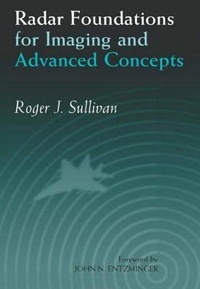
Radar Foundations for Imaging and Advanced Concepts
Published on 30. June 2004
Book
Paperback/Softback
476 pages
978-1-891121-22-7 (ISBN)
Description
Through courses taught internally at the Institute for Defense Analysis, Dr. Roger Sullivan has devised a book that brings readers fully up to speed on the most essential quantitative aspects of general radar in order to introduce study of the most exciting and relevant applications to radar imaging and advanced concepts: Synthetic Aperture Radar (4 chapters), Space-time Adaptive Processing, moving target indication (MTI), bistatic radar, low probability of intercept (LPI) radar, weather radar, and ground-penetrating radar. Whether you are a radar novice or experienced professional, this is an essential reference that features the theory and practical application of formulas you use in radar design every day. With this book, you are taken step-by-step through the development of modern airborne microwave radar, up to the cutting edge of emergent technologies including new results on theoretical 2D and 3D SAR point-spread functions (PSF) and current discussions concerning dechirp/deskew processing, layover in SAR images, vibrating targets, foliage penetration, image quality parameters, and more. Plus, for students of electrical engineering, physics, and radar, this book provides the best source of basic airborne radar understanding, as well as a broad introduction to the field of radar imaging.
More details
Series
Language
English
Place of publication
New York
United States
Target group
College/higher education
Professional and scholarly
Dimensions
Height: 229 mm
Width: 152 mm
ISBN-13
978-1-891121-22-7 (9781891121227)
Copyright in bibliographic data and cover images is held by Nielsen Book Services Limited or by the publishers or by their respective licensors: all rights reserved.
Schweitzer Classification
Other editions
Additional editions
Roger J. Sullivan
Radar Foundations for Imaging and Advanced Concepts
E-Book
05/2014
1st Edition
SciTech Publishing Inc
€147.09
Available for download
Persons
Dr. Roger J. Sullivan received the B.S. and Ph.D. degrees in physics from the Massachusetts Institute of Technology, with a thesis in X-ray astronomy. At System Planning Corporation, Arlington, VA, he led analyses of arms control options and nuclear weapons effects. He then contributed to the development of a series of imaging instrumentation radars, which are operated on outdoor and indoor radar ranges. At the Environmental Research Institute of Michigan (now Veridian), Ann Arbor, MI, he served as Program Manager for development of an X/C/L-band polarimetric synthetic aperture radar (SAR) carried by a US Navy P-3 aircraft, and led many analyses concerning SAR performance and automatic target recognition. Currently, at the Institute for Defense Analysis, Alexandria, VA, he advises the US government concerning SAR and ground-moving target indication (GMTI) radars on unmanned aerial vehicles (UAVs), and performs analyses concerning new radar concepts for ballistic missile defense, air defense, and mine detection.
Content
Part I: Radar Fundamentals
Chapter 1: Introduction to Radar
Chapter 2: Radar Systems
Chapter 3: Interaction of Radar Systems with the External Environment
Chapter 4: Elementary Radar Signal Processing
Chapter 5: Angle Measurement
Part II: Imaging Radar
Chapter 6: Introduction to Imaging Radar
Chapter 7: Synthetic Aperture Radar
Chapter 8: SAR/ISAR Digital Imagery
Chapter 9: Target Recognition in SAR/ISAR Imagery
Part III: Pulse-Doppler and MTI Radar
Chapter 10: Pulse-Doppler Radar
Chapter 11: Observation of Moving Targets by an Airborne Radar
Part IV: Special Radar Topics
Chapter 12: Space-Time Adaptive Processing
Chapter 13: Bistatic Radar and Low-Probability-of-Intercept Radar
Chapter 14: Weather Radar and Ground-Penetrating Radar
Chapter 1: Introduction to Radar
Chapter 2: Radar Systems
Chapter 3: Interaction of Radar Systems with the External Environment
Chapter 4: Elementary Radar Signal Processing
Chapter 5: Angle Measurement
Part II: Imaging Radar
Chapter 6: Introduction to Imaging Radar
Chapter 7: Synthetic Aperture Radar
Chapter 8: SAR/ISAR Digital Imagery
Chapter 9: Target Recognition in SAR/ISAR Imagery
Part III: Pulse-Doppler and MTI Radar
Chapter 10: Pulse-Doppler Radar
Chapter 11: Observation of Moving Targets by an Airborne Radar
Part IV: Special Radar Topics
Chapter 12: Space-Time Adaptive Processing
Chapter 13: Bistatic Radar and Low-Probability-of-Intercept Radar
Chapter 14: Weather Radar and Ground-Penetrating Radar