

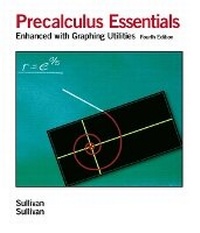
Precalculus Essentials
Enhanced with Graphing Utilities
4th Edition
Published on 22. August 2005
Book
Hardback
864 pages
978-0-13-186668-3 (ISBN)
Description
This is the number one, best selling graphing-required version of Mike Sullivan's precalculus series. It is used by thousands of students and hundreds of instructors because, simply, "IT WORKS." "IT WORKS for both instructors and students because Mike Sullivan, after twenty-five years of teaching, knows exactly what students need to do to succeed in a math class and he therefore emphasizes and organizes his text around the fundamentals; preparing, practicing, and reviewing. Students who prepare (read the book, practice their skills learned in previous math classes), practice (work the math focusing on the fundamental and important mathematical concepts), and review (study key concepts and review for quizzes and tests) succeed in class. Instructors appreciate this emphasis as it supports their teaching goals to help their students succeed as well as appreciate the fact that this dependable text retains its best features- - accuracy, precision, depth, strong student support, and abundant exercises, while substantially updating content and pedagogy. After completing the book, students will be prepared to handle the algebra found in subsequent courses such as finite mathematics, business mathematics, and engineering calculus.
More details
Edition
4th edition
Language
English
Place of publication
United States
Publishing group
Pearson Education (US)
Target group
Professional and scholarly
Dimensions
Height: 221 mm
Width: 263 mm
Thickness: 33 mm
Weight
1794 gr
ISBN-13
978-0-13-186668-3 (9780131866683)
Copyright in bibliographic data and cover images is held by Nielsen Book Services Limited or by the publishers or by their respective licensors: all rights reserved.
Schweitzer Classification
Other editions
Previous edition
Michael Sullivan
Precalculus Enhanced With Graphing Utilities
Book
06/2002
3rd Edition
Pearson
€92.84
Article exhausted; check for reprint
Persons
Mike Sullivan Professor of Mathematics at Chicago State University received a Ph.D. in mathematics from Illinois Institute of Technology. Mike has taught at Chicago State for over 30 years. He is a native of Chicago's South Side and currently resides in Oaklawn. Mike has four children. The two oldest have degrees in mathematics and assisted in proofing, checking examples and exercises, and writing solutions manuals for this project. Mike III co-authored the Sullivan Graphing with Data Analysis series as well as this series. Dan, the youngest, sells for Prentice Hall as a generalist.
Mike has authored or co-authored over ten books. He owns a travel agency, and splits his time between a condo in Naples, Florida and a home in Oaklawn, where Mike enjoys gardening. Mike first signed this series with Deleen Publishing (Acquired by Macmillan) in 1985.
Mike Sullivan III is a professor of mathematics at Joliet Junior College. He holds graduate degrees from Depot University in both mathematics and economics. Mike has co-authored both of the Sullivan graphing series and collaborated with his sister to author supplements for all of the Sullivan series. Mike has recently authored a brand new successful Statistics book for Prentice Hall Fundamentals of Statistics, 1/e 2005 and Statistics: Informed Decisions Using Data, 1/e, 2004. Mike is currently working on a developmental math series for Prentice Hall that will be published in 2007. Mike is the father of three children. He is an avid golfer and tries to spend as much of his limited free time as possible on the golf course.
Why We Wrote the Book:
Work on this series began with a unique perspective. Teaching at a large urban institution and a smaller two-year college has allowed us to see firsthand the challenges associated with teaching students with diverse backgrounds in an urban setting. Successful textbooks must be accessible to students. As lead author of this series, one of the most important things I bring to the project is my experience as author of a successful calculus text. Mike and I are both aware that students must be prepared in a Precalculus course for subsequent mathematics courses. We also realize that many College Algebra students will not be going on to take upper level math courses. In this series we resolved the seeming dilemma without sacrificing accessibility.
The books in this series are designed to be mathematically comprehensive and to provide substantial mathematical preparation for subsequent courses. At the same time, great effort has been expended to motivate the material and to make it accessible to even poorly prepared students.
Mike has authored or co-authored over ten books. He owns a travel agency, and splits his time between a condo in Naples, Florida and a home in Oaklawn, where Mike enjoys gardening. Mike first signed this series with Deleen Publishing (Acquired by Macmillan) in 1985.
Mike Sullivan III is a professor of mathematics at Joliet Junior College. He holds graduate degrees from Depot University in both mathematics and economics. Mike has co-authored both of the Sullivan graphing series and collaborated with his sister to author supplements for all of the Sullivan series. Mike has recently authored a brand new successful Statistics book for Prentice Hall Fundamentals of Statistics, 1/e 2005 and Statistics: Informed Decisions Using Data, 1/e, 2004. Mike is currently working on a developmental math series for Prentice Hall that will be published in 2007. Mike is the father of three children. He is an avid golfer and tries to spend as much of his limited free time as possible on the golf course.
Why We Wrote the Book:
Work on this series began with a unique perspective. Teaching at a large urban institution and a smaller two-year college has allowed us to see firsthand the challenges associated with teaching students with diverse backgrounds in an urban setting. Successful textbooks must be accessible to students. As lead author of this series, one of the most important things I bring to the project is my experience as author of a successful calculus text. Mike and I are both aware that students must be prepared in a Precalculus course for subsequent mathematics courses. We also realize that many College Algebra students will not be going on to take upper level math courses. In this series we resolved the seeming dilemma without sacrificing accessibility.
The books in this series are designed to be mathematically comprehensive and to provide substantial mathematical preparation for subsequent courses. At the same time, great effort has been expended to motivate the material and to make it accessible to even poorly prepared students.
Content
Chapter 1 Graphs
1.1 Rectangular Coordinates; Graphing Utilities
1.2 Graphs of Equations
1.3 Solving Equations Using a Graphing Utility
1.4 Lines
1.5 Circles
Chapter Review
Chapter Test
Chapter Project
Chapter 2 Functions and Their Graphs
2.1 Functions
2.2 The Graph of a Function
2.3 Properties of Functions
2.4 Linear Functions and Models
2.5 Library of Functions; Piecewise-Defined Functions
2.6 Graphing Techniques: Transformations
2.7 Mathematical Models: Constructing Functions
Chapter Review
Chapter Test
Chapter Project
Cumulative Review
Chapter 3 Polynomial and Rational Functions
3.1 Quadratic Functions and Models
3.2 Polynomial Functions and Models
3.3 Properties of Rational Functions
3.4 The Graph of a Rational Function; Inverse and Joint Variation
3.5 Polynomial and Rational Inequalities
3.6 The Real Zeros of a Polynomial Function
3.7 Complex Zeros: Fundamental Theorem of Algebra
Chapter Review
Chapter Test
Chapter Project
Cumulative Review
Chapter 4 Exponential and Logarithmic Functions
4.1 Composite Functions
4.2 One-to-One Functions; Inverse Functions
4.3 Exponential Functions
4.4 Logarithmic Functions
4.5 Properties of Logarithms
4.6 Logarithmic and Exponential Equations
4.7 Compound Interest
4.8 Exponential Growth and Decay; Newton's Law; Logistic Growth and Decay
4.9 Building Exponential, Logarithmic, and Logistic Models from Data
Chapter Review
Chapter Test
Chapter Project
Cumulative Review
Chapter 5 Trigonometric Functions
5.1 Angles and Their Measure
5.2 Trigonometric Functions: Unit Circle Approach
5.3 Properties of the Trigonometric Functions
5.4 Graphs of the Sine and Cosine Functions
5.5 Graphs of the Tangent, Cotangent, Cosecant, and Secant Functions
5.6 Phase Shift; Sinusoidal Curve Fitting
Chapter Review
Chapter Test
Chapter Project
Cumulative Review
Chapter 6 Analytic Trigonometry
6.1 The Inverse Sine, Cosine, and Tangent Functions
6.2 The Inverse Trigonometric Functions (continued)
6.3 Trigonometric Identities
6.4 Sum and Difference Formulas
6.5 Double-Angle and Half-Angle Formulas
6.6 Product-to-Sum and Sum-to-Product Formulas
6.7 Trigonometric Equations I
6.8 Trigonometric Equations II
Chapter Review
Chapter Test
Chapter Project
Cumulative Review
Chapter 7 Applications of Trigonometric Functions
7.1 Right Triangle Trigonometry; Solving Right Triangles
7.2 Law of Sines
7.3 Law of Cosines
Chapter Review
Chapter Test
Chapter Project
Cumulative Review
Chapter 8 Polar Coordinates; Vectors
8.1 Polar Coordinates
8.2 Polar Equations and Graphs
Chapter Review
Chapter Test
Chapter Project
Cumulative Review
Chapter 9 Analytic Geometry
9.7 Plane Curves and Parametric Equations
Chapter Review
Chapter Test
Chapter Project
Cumulative Review
Chapter 10 Systems of Equations and Inequalities
10.1 Systems of Linear Equations: Substitution and Elimination
10.7 Systems of Inequalities
Chapter Review
Chapter Test
Chapter Project
Cumulative Review
Chapter 11 Sequences; Induction; The Binomial Theorem
11.1 Sequences
11.2 Arithmetic Sequences
11.3 Geometric Sequences; Geometric Series
Chapter Test
Chapter Project
Cumulative Review
Appendix Review
A.1 Algebra Review
A.2 Geometry Review
A.3 Polynomials and Rational Expressions
A.4 Polynomial Division; Synthetic Division
A.5 Solving Equations Algebraically
A.6 Complex Numbers; Quadratic Equations in the Complex Number System
A.7 Problem Solving
A.8 Interval Notation; Solving Inequalities
A.9 nth Roots; Rational Exponents
Answers
Index
1.1 Rectangular Coordinates; Graphing Utilities
1.2 Graphs of Equations
1.3 Solving Equations Using a Graphing Utility
1.4 Lines
1.5 Circles
Chapter Review
Chapter Test
Chapter Project
Chapter 2 Functions and Their Graphs
2.1 Functions
2.2 The Graph of a Function
2.3 Properties of Functions
2.4 Linear Functions and Models
2.5 Library of Functions; Piecewise-Defined Functions
2.6 Graphing Techniques: Transformations
2.7 Mathematical Models: Constructing Functions
Chapter Review
Chapter Test
Chapter Project
Cumulative Review
Chapter 3 Polynomial and Rational Functions
3.1 Quadratic Functions and Models
3.2 Polynomial Functions and Models
3.3 Properties of Rational Functions
3.4 The Graph of a Rational Function; Inverse and Joint Variation
3.5 Polynomial and Rational Inequalities
3.6 The Real Zeros of a Polynomial Function
3.7 Complex Zeros: Fundamental Theorem of Algebra
Chapter Review
Chapter Test
Chapter Project
Cumulative Review
Chapter 4 Exponential and Logarithmic Functions
4.1 Composite Functions
4.2 One-to-One Functions; Inverse Functions
4.3 Exponential Functions
4.4 Logarithmic Functions
4.5 Properties of Logarithms
4.6 Logarithmic and Exponential Equations
4.7 Compound Interest
4.8 Exponential Growth and Decay; Newton's Law; Logistic Growth and Decay
4.9 Building Exponential, Logarithmic, and Logistic Models from Data
Chapter Review
Chapter Test
Chapter Project
Cumulative Review
Chapter 5 Trigonometric Functions
5.1 Angles and Their Measure
5.2 Trigonometric Functions: Unit Circle Approach
5.3 Properties of the Trigonometric Functions
5.4 Graphs of the Sine and Cosine Functions
5.5 Graphs of the Tangent, Cotangent, Cosecant, and Secant Functions
5.6 Phase Shift; Sinusoidal Curve Fitting
Chapter Review
Chapter Test
Chapter Project
Cumulative Review
Chapter 6 Analytic Trigonometry
6.1 The Inverse Sine, Cosine, and Tangent Functions
6.2 The Inverse Trigonometric Functions (continued)
6.3 Trigonometric Identities
6.4 Sum and Difference Formulas
6.5 Double-Angle and Half-Angle Formulas
6.6 Product-to-Sum and Sum-to-Product Formulas
6.7 Trigonometric Equations I
6.8 Trigonometric Equations II
Chapter Review
Chapter Test
Chapter Project
Cumulative Review
Chapter 7 Applications of Trigonometric Functions
7.1 Right Triangle Trigonometry; Solving Right Triangles
7.2 Law of Sines
7.3 Law of Cosines
Chapter Review
Chapter Test
Chapter Project
Cumulative Review
Chapter 8 Polar Coordinates; Vectors
8.1 Polar Coordinates
8.2 Polar Equations and Graphs
Chapter Review
Chapter Test
Chapter Project
Cumulative Review
Chapter 9 Analytic Geometry
9.7 Plane Curves and Parametric Equations
Chapter Review
Chapter Test
Chapter Project
Cumulative Review
Chapter 10 Systems of Equations and Inequalities
10.1 Systems of Linear Equations: Substitution and Elimination
10.7 Systems of Inequalities
Chapter Review
Chapter Test
Chapter Project
Cumulative Review
Chapter 11 Sequences; Induction; The Binomial Theorem
11.1 Sequences
11.2 Arithmetic Sequences
11.3 Geometric Sequences; Geometric Series
Chapter Test
Chapter Project
Cumulative Review
Appendix Review
A.1 Algebra Review
A.2 Geometry Review
A.3 Polynomials and Rational Expressions
A.4 Polynomial Division; Synthetic Division
A.5 Solving Equations Algebraically
A.6 Complex Numbers; Quadratic Equations in the Complex Number System
A.7 Problem Solving
A.8 Interval Notation; Solving Inequalities
A.9 nth Roots; Rational Exponents
Answers
Index