

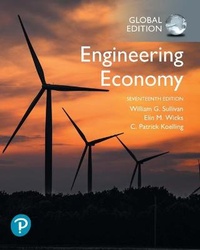
Engineering Economy plus MyLab Engineering with Pearson eText, Global Edition
17th Edition
Published on 25. June 2019
Book
Mixed media product
978-1-292-26500-1 (ISBN)
More details
Edition
17th edition
Language
English
Place of publication
Harlow
United Kingdom
Target group
College/higher education
Dimensions
Height: 230 mm
Width: 190 mm
Thickness: 2 mm
Weight
1091 gr
ISBN-13
978-1-292-26500-1 (9781292265001)
Copyright in bibliographic data and cover images is held by Nielsen Book Services Limited or by the publishers or by their respective licensors: all rights reserved.
Schweitzer Classification
Other editions
New editions
William Sullivan | Elin Wicks | C. Koelling
Engineering Economy, Global Edition plus Pearson MyLab Engineering with Pearson eText (Package)
Book
08/2025
18th Edition
Pearson Education Limited
€114.72
Shipment within 10-20 days
Content
Green Content
CHAPTER 1
Introduction to Engineering Economy
1.1 Introduction
1.2 The Principles of Engineering Economy
1.3 Engineering Economy and the Design Process
1.4 Using Spreadsheets in Engineering Economic Analysis
1.5 Try Your Skills
1.6 Summary
CHAPTER 2
Cost Concepts and Design Economics
2.1 Cost Terminology
2.2 The General Economic Environment
2.3 Cost-Driven Design Optimization
2.4 Present Economy Studies
2.5 Case Study-The Economics of Daytime Running Lights
2.6 In Class Exercise
2.7 Try Your Skills
2.8 Summary
Appendix 2-A Accounting Fundamentals
CHAPTER 3
Cost-Estimation Techniques
3.1 Introduction
3.2 An Integrated Approach
3.3 Selected Estimating Techniques (Models)
3.4 Parametric Cost Estimating
3.5 Case Study-Demanufacturing of Computers
3.6 Electronic Spreadsheet Modeling: Learning Curve
3.7 In-Class Exercise
3.8 Try Your Skills
3.9 Summary
CHAPTER 4
The Time Value of Money
4.1 Introduction
4.2 Simple Interest
4.3 Compound Interest
4.4 The Concept of Equivalence
4.5 Notation and Cash-Flow Diagrams and Tables
4.6 Relating Present and Future Equivalent Values
4.7 Relating a Uniform Series (Annuity) to Its Present and Future Equivalent
4.8 Summary of Interest Formulas and Relationships for Discrete Compounding
4.9 Deferred Annuities (Uniform Series)
4.10 Equivalence Calculations Involving Multiple Interest Formulas
4.11 Uniform (Arithmetic) Gradient of Cash Flows
4.12 Geometric Sequences of Cash Flows
4.13 Interest Rates that Vary with Time
4.14 Nominal and Effective Interest Rates
4.15 Compounding More Often than Once per Year
4.16 Interest Formulas for Continuous Compounding and Discrete Cash Flows
4.17 Case Study-Understanding Economic "Equivalence"
4.18 In-Class Exercise
4.19 Try Your Skills
4.20 Summary
CHAPTER 5
Evaluating a Single Project
5.1 Introduction
5.2 Determining the Minimum Attractive Rate of Return (MARR)
5.3 The Present Worth Method
5.4 The Future Worth Method
5.5 The Annual Worth Method
5.6 The Internal Rate of Return Method
5.7 The External Rate of Return Method
5.8 The Payback (Payout) Period Method
5.9 Case Study-A Proposed Capital Investment to Improve Process Yield
5.10 Electronic Spreadsheet Modeling: Payback Period Method
5.11 In-Class Exercise
5.12 Try Your Skills
5.13 Summary
Appendix 5-A The Multiple Rate of Return Problem with the IRR Method
CHAPTER 6
Comparison and Selection among Alternatives
6.1 Introduction
6.2 Basic Concepts for Comparing Alternatives
6.3 The Study (Analysis) Period
6.4 Useful Lives Are Equal to the Study Period
6.5 Useful Lives Are Unequal among the Alternatives
6.6 Personal Finances
6.7 Case Study-Ned and Larry's Ice Cream Company
6.8 Postevaluation of Results
6.9 Project Postevaluation Spreadsheet Approach
6.10 In-Class Exercise
6.11Try Your Skills
6.12 Summary
CHAPTER 7
Depreciation and Income Taxes
7.1 Introduction
7.2 Depreciation Concepts and Terminology
7.3 The Classical (Historical) Depreciation Methods
7.4 The Modified Accelerated Cost Recovery System
7.5 A Comprehensive Depreciation Example
7.6 Introduction to Income Taxes
7.7 The Effective Corporate Income Tax Rate
7.8 Gain (Loss) on the Disposal of an Asset
7.9 General Procedure for Making After-Tax Economic Analyses
7.10 Illustration of Computations of ATCFs
7.11
CHAPTER 1
Introduction to Engineering Economy
1.1 Introduction
1.2 The Principles of Engineering Economy
1.3 Engineering Economy and the Design Process
1.4 Using Spreadsheets in Engineering Economic Analysis
1.5 Try Your Skills
1.6 Summary
CHAPTER 2
Cost Concepts and Design Economics
2.1 Cost Terminology
2.2 The General Economic Environment
2.3 Cost-Driven Design Optimization
2.4 Present Economy Studies
2.5 Case Study-The Economics of Daytime Running Lights
2.6 In Class Exercise
2.7 Try Your Skills
2.8 Summary
Appendix 2-A Accounting Fundamentals
CHAPTER 3
Cost-Estimation Techniques
3.1 Introduction
3.2 An Integrated Approach
3.3 Selected Estimating Techniques (Models)
3.4 Parametric Cost Estimating
3.5 Case Study-Demanufacturing of Computers
3.6 Electronic Spreadsheet Modeling: Learning Curve
3.7 In-Class Exercise
3.8 Try Your Skills
3.9 Summary
CHAPTER 4
The Time Value of Money
4.1 Introduction
4.2 Simple Interest
4.3 Compound Interest
4.4 The Concept of Equivalence
4.5 Notation and Cash-Flow Diagrams and Tables
4.6 Relating Present and Future Equivalent Values
4.7 Relating a Uniform Series (Annuity) to Its Present and Future Equivalent
4.8 Summary of Interest Formulas and Relationships for Discrete Compounding
4.9 Deferred Annuities (Uniform Series)
4.10 Equivalence Calculations Involving Multiple Interest Formulas
4.11 Uniform (Arithmetic) Gradient of Cash Flows
4.12 Geometric Sequences of Cash Flows
4.13 Interest Rates that Vary with Time
4.14 Nominal and Effective Interest Rates
4.15 Compounding More Often than Once per Year
4.16 Interest Formulas for Continuous Compounding and Discrete Cash Flows
4.17 Case Study-Understanding Economic "Equivalence"
4.18 In-Class Exercise
4.19 Try Your Skills
4.20 Summary
CHAPTER 5
Evaluating a Single Project
5.1 Introduction
5.2 Determining the Minimum Attractive Rate of Return (MARR)
5.3 The Present Worth Method
5.4 The Future Worth Method
5.5 The Annual Worth Method
5.6 The Internal Rate of Return Method
5.7 The External Rate of Return Method
5.8 The Payback (Payout) Period Method
5.9 Case Study-A Proposed Capital Investment to Improve Process Yield
5.10 Electronic Spreadsheet Modeling: Payback Period Method
5.11 In-Class Exercise
5.12 Try Your Skills
5.13 Summary
Appendix 5-A The Multiple Rate of Return Problem with the IRR Method
CHAPTER 6
Comparison and Selection among Alternatives
6.1 Introduction
6.2 Basic Concepts for Comparing Alternatives
6.3 The Study (Analysis) Period
6.4 Useful Lives Are Equal to the Study Period
6.5 Useful Lives Are Unequal among the Alternatives
6.6 Personal Finances
6.7 Case Study-Ned and Larry's Ice Cream Company
6.8 Postevaluation of Results
6.9 Project Postevaluation Spreadsheet Approach
6.10 In-Class Exercise
6.11Try Your Skills
6.12 Summary
CHAPTER 7
Depreciation and Income Taxes
7.1 Introduction
7.2 Depreciation Concepts and Terminology
7.3 The Classical (Historical) Depreciation Methods
7.4 The Modified Accelerated Cost Recovery System
7.5 A Comprehensive Depreciation Example
7.6 Introduction to Income Taxes
7.7 The Effective Corporate Income Tax Rate
7.8 Gain (Loss) on the Disposal of an Asset
7.9 General Procedure for Making After-Tax Economic Analyses
7.10 Illustration of Computations of ATCFs
7.11