

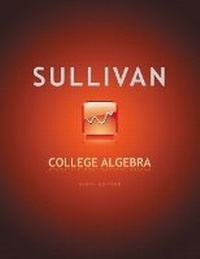
College Algebra
9th Edition
Published on 21. April 2011
Book
Hardback
840 pages
978-0-321-71681-1 (ISBN)
Description
Mike Sullivan's time-tested approach focuses students on the fundamental skills they need for the course: preparing for class, practicing with homework, and reviewing the concepts. In the Ninth Edition, College Algebra has evolved to meet today's course needs, building on these hallmarks by integrating projects and other interactive learning tools for use in the classroom or online.
NOTE: this is the standalone book, if you want the book/access card order the ISBN below:
0321755987 / 9780321755988 College Algebra plus MyMathLab/MyStatLab -- Access Card Package
Package consists of:
0321431308 / 9780321431301 MyMathLab -- Glue-in Access Card
0321654064 / 9780321654069 MyMathLab Inside Star Sticker
0321716817 / 9780321716811 College Algebra
NOTE: this is the standalone book, if you want the book/access card order the ISBN below:
0321755987 / 9780321755988 College Algebra plus MyMathLab/MyStatLab -- Access Card Package
Package consists of:
0321431308 / 9780321431301 MyMathLab -- Glue-in Access Card
0321654064 / 9780321654069 MyMathLab Inside Star Sticker
0321716817 / 9780321716811 College Algebra
More details
Edition
9th edition
Language
English
Place of publication
United States
Publishing group
Pearson Education (US)
Target group
College/higher education
Dimensions
Height: 286 mm
Width: 222 mm
Thickness: 33 mm
Weight
1830 gr
ISBN-13
978-0-321-71681-1 (9780321716811)
Copyright in bibliographic data and cover images is held by Nielsen Book Services Limited or by the publishers or by their respective licensors: all rights reserved.
Schweitzer Classification
Other editions
New editions

Michael Sullivan
College Algebra with Integrated Review and Guided Lecture Notes, Plus NEW MyLab Math with Pearson eText -- Access Card Package
Book
05/2016
10th Edition
Pearson
€256.93
Shipment within 15-20 days

Previous edition

Book
04/2007
8th Edition
Pearson
€92.69
Article exhausted; check for reprint
Person
Michael Sullivan, Emeritus Professor of Mathematics at Chicago State University, received a Ph.D. in mathematics from the Illinois Institute of Technology. Mike taught at Chicago State for 35 years before recently retiring. He is a native of Chicago's South Side and divides his time between a home in Oak Lawn IL and a condo in Naples FL.
Mike is a member of the American Mathematical Society and the Mathematical Association of America. He is a past president of the Text and Academic Authors Association and is currently Treasurer of its Foundation. He is a member of the TAA Council of Fellows and was awarded the TAA Mike Keedy award in 1997 and the Lifetime Achievement Award in 2007. In addition, he represents TAA on the Authors Coalition of America.
Mike has been writing textbooks for more than 35 years and currently has 15 books in print, twelve with Pearson Education. When not writing, he enjoys tennis, golf, gardening, and travel.
Mike has four children: Kathleen, who teaches college mathematics; Michael III, who also teaches college mathematics, and who is his coauthor on two precalculus series; Dan, who is a sales director for Pearson Education; and Colleen, who teaches middle-school and secondary school mathematics. Twelve grandchildren round out the family.
Mike is a member of the American Mathematical Society and the Mathematical Association of America. He is a past president of the Text and Academic Authors Association and is currently Treasurer of its Foundation. He is a member of the TAA Council of Fellows and was awarded the TAA Mike Keedy award in 1997 and the Lifetime Achievement Award in 2007. In addition, he represents TAA on the Authors Coalition of America.
Mike has been writing textbooks for more than 35 years and currently has 15 books in print, twelve with Pearson Education. When not writing, he enjoys tennis, golf, gardening, and travel.
Mike has four children: Kathleen, who teaches college mathematics; Michael III, who also teaches college mathematics, and who is his coauthor on two precalculus series; Dan, who is a sales director for Pearson Education; and Colleen, who teaches middle-school and secondary school mathematics. Twelve grandchildren round out the family.
Content
R. Review
R.1 Real Numbers
R.2 Algebra Essentials
R.3 Geometry Essentials
R.4 Polynomials
R.5 Factoring Polynomials
R.6 Synthetic Division
R.7 Rational Expressions
R.8 nth Roots; Rational Exponents
1. Equations and Inequalities
1.1 Linear Equations
1.2 Quadratic Equations
1.3 Complex Numbers; Quadratic Equations in the Complex Number System
1.4 Radical Equations; Equations Quadratic in Form; Factorable Equations
1.5 Solving Inequalities
1.6 Equations and Inequalities Involving Absolute Value
1.7 Problem Solving: Interest, Mixture, Uniform Motion, and Constant Rate Job Applications
2. Graphs
2.1 The Distance and Midpoint Formulas
2.2 Graphs of Equations in Two Variables; Intercepts; Symmetry
2.3 Lines
2.4 Circles
2.5 Variation
3. Functions and Their Graphs
3.1 Functions
3.2 The Graph of a Function
3.3 Properties of Functions
3.4 Library of Functions; Piecewise-defined Functions
3.5 Graphing Techniques: Transformations
3.6 Mathematical Models: Building Functions
4. Linear and Quadratic Functions
4.1 Linear Functions and Their Properties
4.2 Building Linear Functions from Data
4.3 Quadratic Functions and Their Properties
4.4 Quadratic Models; Building Quadratic Functions from Data
4.5 Inequalities Involving Quadratic Functions
5. Polynomial and Rational Functions
5.1 Polynomial Functions and Models
5.2 Properties of Rational Functions
5.3 The Graph of a Rational Function
5.4 Polynomial and Rational Inequalities
5.5 The Real Zeros of a Polynomial Function
5.6 Complex Zeros: Fundamental Theorem of Algebra
6. Exponential and Logarithmic Functions
6.1 Composite Functions
6.2 One-to-One Functions; Inverse Functions
6.3 Exponential Functions
6.4 Logarithmic Functions
6.5 Properties of Logarithms
6.6 Logarithmic and Exponential Equations
6.7 Compound Interest
6.8 Exponential Growth and Decay Models; Newton's Law; Logistic Growth and Decay Models
6.9 Building Exponential, Logarithmic, and Logistic Functions from Data
7. Analytic Geometry
7.1 Conics
7.2 The Parabola
7.3 The Ellipse
7.4 The Hyperbola
8. Systems of Equations and Inequalities
8.1 Systems of Linear Equations: Substitution and Elimination
8.2 Systems of Linear Equations: Matrices
8.3 Systems of Linear Equations: Determinants
8.4 Matrix Algebra
8.5 Partial Fraction Decomposition
8.6 Systems of Nonlinear Equations
8.7 Systems of Inequalities
8.8 Linear Programming
9. Sequences; Induction; the Binomial Theorem
9.1 Sequences
9.2 Arithmetic Sequences
9.3 Geometric Sequences; Geometric Series
9.4 Mathematical Induction
9.5 The Binomial Theorem
10. Counting and Probability
10.1 Sets and Counting
10.2 Permutations and Combinations
10.3 Probability
R.1 Real Numbers
R.2 Algebra Essentials
R.3 Geometry Essentials
R.4 Polynomials
R.5 Factoring Polynomials
R.6 Synthetic Division
R.7 Rational Expressions
R.8 nth Roots; Rational Exponents
1. Equations and Inequalities
1.1 Linear Equations
1.2 Quadratic Equations
1.3 Complex Numbers; Quadratic Equations in the Complex Number System
1.4 Radical Equations; Equations Quadratic in Form; Factorable Equations
1.5 Solving Inequalities
1.6 Equations and Inequalities Involving Absolute Value
1.7 Problem Solving: Interest, Mixture, Uniform Motion, and Constant Rate Job Applications
2. Graphs
2.1 The Distance and Midpoint Formulas
2.2 Graphs of Equations in Two Variables; Intercepts; Symmetry
2.3 Lines
2.4 Circles
2.5 Variation
3. Functions and Their Graphs
3.1 Functions
3.2 The Graph of a Function
3.3 Properties of Functions
3.4 Library of Functions; Piecewise-defined Functions
3.5 Graphing Techniques: Transformations
3.6 Mathematical Models: Building Functions
4. Linear and Quadratic Functions
4.1 Linear Functions and Their Properties
4.2 Building Linear Functions from Data
4.3 Quadratic Functions and Their Properties
4.4 Quadratic Models; Building Quadratic Functions from Data
4.5 Inequalities Involving Quadratic Functions
5. Polynomial and Rational Functions
5.1 Polynomial Functions and Models
5.2 Properties of Rational Functions
5.3 The Graph of a Rational Function
5.4 Polynomial and Rational Inequalities
5.5 The Real Zeros of a Polynomial Function
5.6 Complex Zeros: Fundamental Theorem of Algebra
6. Exponential and Logarithmic Functions
6.1 Composite Functions
6.2 One-to-One Functions; Inverse Functions
6.3 Exponential Functions
6.4 Logarithmic Functions
6.5 Properties of Logarithms
6.6 Logarithmic and Exponential Equations
6.7 Compound Interest
6.8 Exponential Growth and Decay Models; Newton's Law; Logistic Growth and Decay Models
6.9 Building Exponential, Logarithmic, and Logistic Functions from Data
7. Analytic Geometry
7.1 Conics
7.2 The Parabola
7.3 The Ellipse
7.4 The Hyperbola
8. Systems of Equations and Inequalities
8.1 Systems of Linear Equations: Substitution and Elimination
8.2 Systems of Linear Equations: Matrices
8.3 Systems of Linear Equations: Determinants
8.4 Matrix Algebra
8.5 Partial Fraction Decomposition
8.6 Systems of Nonlinear Equations
8.7 Systems of Inequalities
8.8 Linear Programming
9. Sequences; Induction; the Binomial Theorem
9.1 Sequences
9.2 Arithmetic Sequences
9.3 Geometric Sequences; Geometric Series
9.4 Mathematical Induction
9.5 The Binomial Theorem
10. Counting and Probability
10.1 Sets and Counting
10.2 Permutations and Combinations
10.3 Probability