

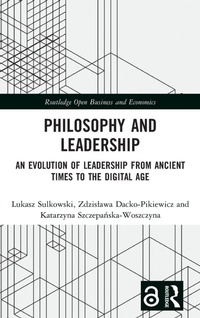
Philosophy and Leadership
An Evolution of Leadership from Ancient Times to the Digital Age
1st Edition
Published on 13. May 2024
Book
Hardback
256 pages
978-1-032-78728-2 (ISBN)
Description
Philosophy and Leadership is an ambitious exploration of leadership's philosophical underpinnings from antiquity to the AI-driven future. The book journeys through history, gleaning insights from eminent philosophers and contextualizing their teachings to leadership.
The book's foundational premise lies in the symbiosis of philosophy and leadership. Philosophy provides the "why" that drives the practices and decisions in leadership. This intricate connection is unfolded from the teachings of Confucius on virtue and ethics to the contemporary dialogues of Judith Butler on leadership identity. The book also delves into the evolution of leadership concepts through various eras-medieval times highlighting religious and scholastic perspectives, the Renaissance juxtaposing Machiavellian pragmatism with More's utopian ideals, and the Enlightenment era underscoring the importance of duty, skepticism, and rationality. An exciting aspect of the narrative is the amalgamation of evolution and leadership. By drawing parallels between Darwin's natural selection and leadership dynamics or Bergson's vitalism and intuitive leadership, the authors present a merger of biological evolution with leadership's ever-evolving paradigms. Finally, the concluding chapters reside in envisioning the future and reflect upon the impending synergy between AI and leadership. They emphasize the importance of amalgamating philosophical wisdom with the promises and challenges brought about by AI.
The book will guide readers from the philosophical epochs of yore to the AI-predicted leadership paradigms of the future. By intertwining the enduring wisdom of philosophers with the dynamic nature of leadership, this book serves as a beacon for anyone aspiring to lead in any era.
The Open Access version of this book, available at www.taylorfrancis.com, has been made available under a Creative Commons Attribution-Non Commercial-No Derivatives 4.0 license.
The book's foundational premise lies in the symbiosis of philosophy and leadership. Philosophy provides the "why" that drives the practices and decisions in leadership. This intricate connection is unfolded from the teachings of Confucius on virtue and ethics to the contemporary dialogues of Judith Butler on leadership identity. The book also delves into the evolution of leadership concepts through various eras-medieval times highlighting religious and scholastic perspectives, the Renaissance juxtaposing Machiavellian pragmatism with More's utopian ideals, and the Enlightenment era underscoring the importance of duty, skepticism, and rationality. An exciting aspect of the narrative is the amalgamation of evolution and leadership. By drawing parallels between Darwin's natural selection and leadership dynamics or Bergson's vitalism and intuitive leadership, the authors present a merger of biological evolution with leadership's ever-evolving paradigms. Finally, the concluding chapters reside in envisioning the future and reflect upon the impending synergy between AI and leadership. They emphasize the importance of amalgamating philosophical wisdom with the promises and challenges brought about by AI.
The book will guide readers from the philosophical epochs of yore to the AI-predicted leadership paradigms of the future. By intertwining the enduring wisdom of philosophers with the dynamic nature of leadership, this book serves as a beacon for anyone aspiring to lead in any era.
The Open Access version of this book, available at www.taylorfrancis.com, has been made available under a Creative Commons Attribution-Non Commercial-No Derivatives 4.0 license.
More details
Series
Language
English
Place of publication
London
United Kingdom
Publishing group
Taylor & Francis Ltd
Target group
College/higher education
Postgraduate
Dimensions
Height: 235 mm
Width: 157 mm
Thickness: 19 mm
Weight
543 gr
ISBN-13
978-1-032-78728-2 (9781032787282)
Copyright in bibliographic data and cover images is held by Nielsen Book Services Limited or by the publishers or by their respective licensors: all rights reserved.
Schweitzer Classification
Other editions
Additional editions

Lukasz Sulkowski | Zdzislawa Dacko-Pikiewicz | Katarzyna Szczepanska-Woszczyna
Philosophy and Leadership
An Evolution of Leadership from Ancient Times to the Digital Age
Book
01/2026
1st Edition
Routledge
€63.80
Shipment within 10-20 days
Lukasz Sulkowski | Zdzislawa Dacko-Pikiewicz | Katarzyna Szczepanska-Woszczyna
Philosophy and Leadership
An Evolution of Leadership from Ancient Times to the Digital Age
E-Book
05/2024
1st Edition
Routledge
€143.99
Available for download
Lukasz Sulkowski | Zdzislawa Dacko-Pikiewicz | Katarzyna Szczepanska-Woszczyna
Philosophy and Leadership
An Evolution of Leadership from Ancient Times to the Digital Age
E-Book
05/2024
1st Edition
Routledge
€143.99
Available for download
Persons
Lukasz Sulkowski is a professor of economic sciences and a professor of humanities specializing in higher education management, methodology of social sciences, HRM, organizational culture, and identity. He serves as President of WSB University in Dabrowa Gornicza in Poland. He heads the Department of Higher Education Institutions Management at the Jagiellonian University and is also a professor at Clark University.
Zdzislawa Dacko-Pikiewicz holds a postdoctoral degree in business and management. She is a professor at WSB University in Dabrowa Gornicza, Poland; Rector of WSB University. She is an author or co-author of 70 publications published in international monographs and journals and of scientific projects, research, and expert opinions. She has over 25 years of experience in holding top managerial positions in HEI and consulting activities.
Katarzyna Szczepanska-Woszczyna holds a postdoctoral degree in economic sciences. She is a professor at WSB University in Dabrowa Gornicza, Vice-Rector for Science and Education at WSB University and Dean of the Faculty of Applied Sciences. She is an author or co-author of 120 publications or excerpts in publications. She is also a member of the board "Excellent Science" at the Ministry of Science and Higher Education (Poland) and a Member of the Polish Accreditation Committee for the term 2020-2023 appointed by Minister of Science and Higher Education.
Zdzislawa Dacko-Pikiewicz holds a postdoctoral degree in business and management. She is a professor at WSB University in Dabrowa Gornicza, Poland; Rector of WSB University. She is an author or co-author of 70 publications published in international monographs and journals and of scientific projects, research, and expert opinions. She has over 25 years of experience in holding top managerial positions in HEI and consulting activities.
Katarzyna Szczepanska-Woszczyna holds a postdoctoral degree in economic sciences. She is a professor at WSB University in Dabrowa Gornicza, Vice-Rector for Science and Education at WSB University and Dean of the Faculty of Applied Sciences. She is an author or co-author of 120 publications or excerpts in publications. She is also a member of the board "Excellent Science" at the Ministry of Science and Higher Education (Poland) and a Member of the Polish Accreditation Committee for the term 2020-2023 appointed by Minister of Science and Higher Education.
Content
Introduction Chapter 1: Introduction: Philosophy and Leadership Chapter 2: Ancient Eastern Philosophy and Leadership Chapter 3: Ancient Western Philosophy and Leadership Chapter 4: Medieval Philosophy and Leadership Chapter 5: Renaissance Philosophy and Leadership Chapter 6: Enlightenment Philosophy and Leadership Chapter 7: Romantic Philosophy and Leadership Chapter 8: Modern Philosophy and Leadership Chapter 9: Existentialist Philosophy and Leadership Chapter 10. Analytical and Science Philosophy and Leadership Chapter 11: Postmodern Philosophy and Leadership Chapter 12: Critical Contemporary Philosophy and Leadership Chapter 13: Philosophy of Evolution for Leadership Chapter 14: Consciousness, Intentionality, and Cognition: Modern Philosophical Perspectives Chapter 15: Future Directions in Philosophy and Leadership