

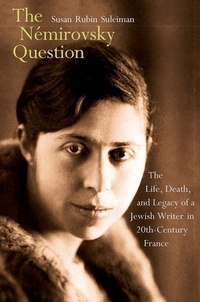
The Nemirovsky Question
The Life, Death, and Legacy of a Jewish Writer in Twentieth-Century France
Published on 7. February 2017
Book
Hardback
376 pages
978-0-300-17196-9 (ISBN)
Description
A fascinating look into the life and work of controversial French novelist Irene Nemirovsky
Irene Nemirovsky succeeded in creating a brilliant career as a novelist in the 1930s, only to have her life cut short: a "foreign Jew" in France, she was deported in 1942 and died in Auschwitz. But her two young daughters survived, and as adults they brought their mother back to life. In 2004, Suite francaise, Nemirovsky's posthumous novel, became an international best seller; some critics, however, condemned her as a "self-hating Jew" whose earlier works were rife with anti-Semitic stereotypes. Informed by personal interviews with Nemirovsky's descendants and others, as well as by extensive archival research, this wide-ranging intellectual biography situates Nemirovsky in the literary and political climate of interwar France and recounts, for the first time, the postwar lives of her daughters. Nemirovsky's Jewish works, Suleiman argues, should be read as explorations of the conflicted identities that shaped the lives of secular Jews in twentieth-century Europe and beyond.
Irene Nemirovsky succeeded in creating a brilliant career as a novelist in the 1930s, only to have her life cut short: a "foreign Jew" in France, she was deported in 1942 and died in Auschwitz. But her two young daughters survived, and as adults they brought their mother back to life. In 2004, Suite francaise, Nemirovsky's posthumous novel, became an international best seller; some critics, however, condemned her as a "self-hating Jew" whose earlier works were rife with anti-Semitic stereotypes. Informed by personal interviews with Nemirovsky's descendants and others, as well as by extensive archival research, this wide-ranging intellectual biography situates Nemirovsky in the literary and political climate of interwar France and recounts, for the first time, the postwar lives of her daughters. Nemirovsky's Jewish works, Suleiman argues, should be read as explorations of the conflicted identities that shaped the lives of secular Jews in twentieth-century Europe and beyond.
Reviews / Votes
"[A] measured, compelling new book. . . . Rather than bluntly judge, Ms. Suleiman makes us see Nemirovsky as a gifted woman situated in a particular historical epoch, carefully analyzing her writings as a product of those times, and clarifying, without excusing, Nemirovsky's most discomforting passages."-Diane Cole, Wall Street Journal"Suleiman had produced a work that is a model of painstaking research, historical expertise, nuanced analysis and human intelligence."-Peter Kemp, Sunday Times
"The Nemirovsky Question traces the fascinating and complicated saga of the writer Irene Nemirovsky against the rich backdrop of French literary culture, emigre culture, and secular Jewish culture. Suleiman enters brilliantly into the debate over Nemirovsky's suppposed 'self-hatred,' adding nuance, complexity, context. She not only complicates the way we view Nemirovsky but also expands our understanding of the lives, choices, and cultures of secular and secularizing Jews in Europe and North America in the twentieth century. e is a keenly intelligent book-clear, moving, and at moments, passionate. It should fly off the shelves."-Sara R. Horowitz, York University
"The Nemirovsky Question is a rare kind of book that combines history, biography and literary commentary to illuminate a controversial figure. It comes full circle with Suleiman's very first book on the ideological novel and shares qualities that mark all of her works: a gift for clear argument, convincing reading, and wisdom-about life and literature. What a gripping and intelligent book! I learned a great deal about subjects and texts I have been studying for many years."-Alice Kaplan, Yale University
"In this brilliant and moving book, Susan Rubin Suleiman examines the troubling charge that Irene Nemirovksy, the acclaimed author of Suite Francaise, was a 'self-hating Jew.' Her conclusion is that Nemirovsky became a leading French novelist in the inter-war years despite mounting anti-Semitism, yet it was a Russian-born Jew that she died in Auschwitz in 1942."-Alan Riding, author of And The Show Went On: Cultural Life in Nazi-Occupied Paris
"Novelist Irene Nemirovsky acknowledged how she sought out 'cruelly tirelessly, the secrets beneath sad faces and dark skies' with particular attention to the grimmer side of pre-World War French Jewish life. Susan Rubin Suleiman sees this as a prolegomenon to Nemirovsky's long forgotten, now rediscovered, still-controversial fictional universe in this impassioned, keenly intelligent book."-Steven J. Zipperstein, Daniel E. Koshland Professor in Jewish Culture and History, Stanford University
More details
Language
English
Place of publication
United States
Product notice
Cloth over boards
Illustrations
25 b-w illus.
Dimensions
Height: 239 mm
Width: 164 mm
Thickness: 27 mm
Weight
684 gr
ISBN-13
978-0-300-17196-9 (9780300171969)
Copyright in bibliographic data and cover images is held by Nielsen Book Services Limited or by the publishers or by their respective licensors: all rights reserved.
Schweitzer Classification
Other editions
Additional editions
Susan Rubin Suleiman
The Némirovsky Question
The Life, Death, and Legacy of a Jewish Writer in Twentieth-Century France
E-Book
11/2016
1st Edition
De Gruyter
€47.59
Available for download
Person
Susan Rubin Suleiman is the C. Douglas Dillon Research Professor of the Civilization of France and research professor of comparative literature at Harvard. Her many books include Crises of Memory and the Second World War, Risking Who One Is: Encounters with Contemporary Art and Literature, and the memoir Budapest Diary: In Search of the Motherbook.