

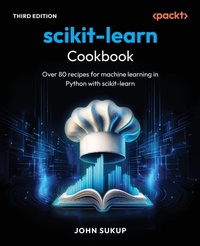
scikit-learn Cookbook
Over 80 recipes for machine learning in Python with scikit-learn
3rd Edition
Published on 19. December 2025
Book
Paperback/Softback
388 pages
978-1-83664-445-3 (ISBN)
Description
Get hands-on with the most widely used Python library in machine learning with over 80 practical recipes that cover core as well as advanced functions
Free with your book: DRM-free PDF version + access to Packt's next-gen Reader*
Key Features
Solve complex business problems with data-driven approaches
Master tools associated with developing predictive and prescriptive models
Build robust ML pipelines for real-world applications, avoiding common pitfalls
Free with your book: PDF Copy, AI Assistant, and Next-Gen Reader
Book DescriptionTrusted by data scientists, ML engineers, and software developers alike, scikit-learn offers a versatile, user-friendly framework for implementing a wide range of ML algorithms, enabling the efficient development and deployment of predictive models in real-world applications. This third edition of scikit-learn Cookbook will help you master ML with real-world examples and scikit-learn 1.5 features.
This updated edition takes you on a journey from understanding the fundamentals of ML and data preprocessing, through implementing advanced algorithms and techniques, to deploying and optimizing ML models in production. Along the way, you'll explore practical, step-by-step recipes that cover everything from feature engineering and model selection to hyperparameter tuning and model evaluation, all using scikit-learn.
By the end of this book, you'll have gained the knowledge and skills needed to confidently build, evaluate, and deploy sophisticated ML models using scikit-learn, ready to tackle a wide range of data-driven challenges.
*Email sign-up and proof of purchase requiredWhat you will learn
Implement a variety of ML algorithms, from basic classifiers to complex ensemble methods, using scikit-learn
Perform data preprocessing, feature engineering, and model selection to prepare datasets for optimal model performance
Optimize ML models through hyperparameter tuning and cross-validation techniques to improve accuracy and reliability
Deploy ML models for scalable, maintainable real-world applications
Evaluate and interpret models with advanced metrics and visualizations in scikit-learn
Explore comprehensive, hands-on recipes tailored to scikit-learn version 1.5
Who this book is forThis book is for data scientists as well as machine learning and software development professionals looking to deepen their understanding of advanced ML techniques. To get the most out of this book, you should have proficiency in Python programming and familiarity with commonly used ML libraries; e.g., pandas, NumPy, matplotlib, and sciPy. An understanding of basic ML concepts, such as linear regression, decision trees, and model evaluation metrics will be helpful. Familiarity with mathematical concepts such as linear algebra, calculus, and probability will also be invaluable.
Free with your book: DRM-free PDF version + access to Packt's next-gen Reader*
Key Features
Solve complex business problems with data-driven approaches
Master tools associated with developing predictive and prescriptive models
Build robust ML pipelines for real-world applications, avoiding common pitfalls
Free with your book: PDF Copy, AI Assistant, and Next-Gen Reader
Book DescriptionTrusted by data scientists, ML engineers, and software developers alike, scikit-learn offers a versatile, user-friendly framework for implementing a wide range of ML algorithms, enabling the efficient development and deployment of predictive models in real-world applications. This third edition of scikit-learn Cookbook will help you master ML with real-world examples and scikit-learn 1.5 features.
This updated edition takes you on a journey from understanding the fundamentals of ML and data preprocessing, through implementing advanced algorithms and techniques, to deploying and optimizing ML models in production. Along the way, you'll explore practical, step-by-step recipes that cover everything from feature engineering and model selection to hyperparameter tuning and model evaluation, all using scikit-learn.
By the end of this book, you'll have gained the knowledge and skills needed to confidently build, evaluate, and deploy sophisticated ML models using scikit-learn, ready to tackle a wide range of data-driven challenges.
*Email sign-up and proof of purchase requiredWhat you will learn
Implement a variety of ML algorithms, from basic classifiers to complex ensemble methods, using scikit-learn
Perform data preprocessing, feature engineering, and model selection to prepare datasets for optimal model performance
Optimize ML models through hyperparameter tuning and cross-validation techniques to improve accuracy and reliability
Deploy ML models for scalable, maintainable real-world applications
Evaluate and interpret models with advanced metrics and visualizations in scikit-learn
Explore comprehensive, hands-on recipes tailored to scikit-learn version 1.5
Who this book is forThis book is for data scientists as well as machine learning and software development professionals looking to deepen their understanding of advanced ML techniques. To get the most out of this book, you should have proficiency in Python programming and familiarity with commonly used ML libraries; e.g., pandas, NumPy, matplotlib, and sciPy. An understanding of basic ML concepts, such as linear regression, decision trees, and model evaluation metrics will be helpful. Familiarity with mathematical concepts such as linear algebra, calculus, and probability will also be invaluable.
More details
Edition
3rd Revised edition
Language
English
Place of publication
Birmingham
United Kingdom
Target group
Professional and scholarly
US School Grade: College Graduate Student
Edition type
Revised edition
Dimensions
Height: 235 mm
Width: 191 mm
Thickness: 21 mm
Weight
723 gr
ISBN-13
978-1-83664-445-3 (9781836644453)
Copyright in bibliographic data and cover images is held by Nielsen Book Services Limited or by the publishers or by their respective licensors: all rights reserved.
Schweitzer Classification
Other editions
Additional editions
John Sukup Sukup, John
scikit-learn Cookbook
Over 80 recipes for machine learning in Python with scikit-learn
E-Book
12/2025
3rd Edition
Packt Publishing
from
€27.99
Available for download
Person
John Sukup is a seventeen-year data professional. His experience working with data spans from consumer market research to data science to ML and AI. He has over a decade of experience as an AI/ML cloud engineer and consultant at multiple international organizations including Levi Strauss, Cisco, Anaconda, and Ipsos. He has acted as the lead professional trainer for Fortune 100 organizations and has been featured in Forbes, Oracle, and Data Science Central. He currently acts as Managing Director and Founder at Expected X, an AI Solution Design and Consultancy as well as cohost of the Unriveted Podcast with his colleague Martin Miller.
Content
Table of Contents
Common Conventions and API Elements of scikit-learn
Pre-Model Workflow and Data Preprocessing
Dimensionality Reduction Techniques
Building Models with Distance Metrics and Nearest Neighbors
Linear Models and Regularization
Advanced Logistic Regression and Extensions
Support Vector Machines and Kernel Methods
Tree-Based Algorithms and Ensemble Methods
Text Processing and Multiclass Classification
Clustering Techniques
Novelty and Outlier Detection
Cross-Validation and Model Evaluation Techniques
Deploying scikit-learn Models in Production
Common Conventions and API Elements of scikit-learn
Pre-Model Workflow and Data Preprocessing
Dimensionality Reduction Techniques
Building Models with Distance Metrics and Nearest Neighbors
Linear Models and Regularization
Advanced Logistic Regression and Extensions
Support Vector Machines and Kernel Methods
Tree-Based Algorithms and Ensemble Methods
Text Processing and Multiclass Classification
Clustering Techniques
Novelty and Outlier Detection
Cross-Validation and Model Evaluation Techniques
Deploying scikit-learn Models in Production