

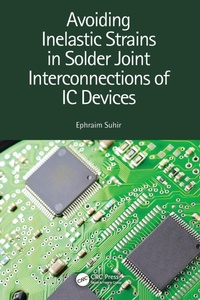
Avoiding Inelastic Strains in Solder Joint Interconnections of IC Devices
1st Edition
Published on 4. October 2024
Book
Paperback/Softback
382 pages
978-0-367-63588-6 (ISBN)
Description
Avoiding Inelastic Strains in Solder Joint Interconnections of IC Devices addresses analytical (mathematical) modeling approaches aimed at understanding the underlying physics and mechanics of the behavior and performance of solder materials and solder joint interconnections of IC devices. The emphasis is on design for reliability, including probabilistic predictions of the solder lifetime.
Describes how to use the developed methods of analytical predictive modeling to minimize thermal stresses and strains in solder joint of IC devices
Shows how to build the preprocessing models in finite-element analyses (FEA) by comparing the FEA and analytical data
Covers how to design the most effective test vehicles for testing solder joints
Details how to design and organize, in addition to or sometimes even instead of highly accelerated life tests (HALT), highly focused and highly cost-effective failure oriented accelerated testing (FOAT) to understand the physic of failure of solder joint interconnections
Outlines how to convert the low cycle fatigue conditions into elastic fatigue conditions and to assess the fatigue lifetime in such cases
Illustrates ways to replace time- and labor-consuming, expensive, and possibly misleading temperature cycling tests with simpler and physically meaningful accelerated tests
This book is aimed towards professionals in electronic and photonic packaging, electronic and optical materials, materials engineering, and mechanical design.
Describes how to use the developed methods of analytical predictive modeling to minimize thermal stresses and strains in solder joint of IC devices
Shows how to build the preprocessing models in finite-element analyses (FEA) by comparing the FEA and analytical data
Covers how to design the most effective test vehicles for testing solder joints
Details how to design and organize, in addition to or sometimes even instead of highly accelerated life tests (HALT), highly focused and highly cost-effective failure oriented accelerated testing (FOAT) to understand the physic of failure of solder joint interconnections
Outlines how to convert the low cycle fatigue conditions into elastic fatigue conditions and to assess the fatigue lifetime in such cases
Illustrates ways to replace time- and labor-consuming, expensive, and possibly misleading temperature cycling tests with simpler and physically meaningful accelerated tests
This book is aimed towards professionals in electronic and photonic packaging, electronic and optical materials, materials engineering, and mechanical design.
More details
Language
English
Place of publication
London
United Kingdom
Publishing group
Taylor & Francis Ltd
Target group
Professional and scholarly
Academic
Illustrations
75 s/w Abbildungen, 49 s/w Tabellen
49 Tables, black and white; 75 Illustrations, black and white
Dimensions
Height: 234 mm
Width: 156 mm
Thickness: 22 mm
Weight
617 gr
ISBN-13
978-0-367-63588-6 (9780367635886)
Copyright in bibliographic data and cover images is held by Nielsen Book Services Limited or by the publishers or by their respective licensors: all rights reserved.
Schweitzer Classification
Other editions
Additional editions
Book
01/2021
1st Edition
CRC Press
€232.90
Shipment within 10-20 days
E-Book
01/2021
1st Edition
CRC Press
€78.99
Available for download
E-Book
01/2021
1st Edition
CRC Press
€78.99
Available for download
Person
Content
1. Analytical Modeling. 2. Method of Interfacial Compliance. 3. Thermal Stress in Assemblies with Identical Adherends. 4. Inelastic Strains. 5. Elevated Stand-Off Heights Can Relieve Thermal Stress in Solder Joints. 6. Stress Relief in Assemblies with Inhomogeneous Bonds. 7. Relieving Thermal Stress in Flip-Chip Design. 8. Board Level Dynamic Tests. 9. Accelerated Testing: HALT and FOAT. 10. Probabilistic Design for Reliability of Solder Joint Interconnections. 11. Thermal Stress in Optical Fibers