

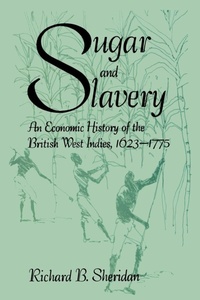
Sugar and Slavery
An Economic History of the West Indies
Canoe Press
Published on 31. January 2000
Book
Paperback/Softback
500 pages
978-976-8125-13-2 (ISBN)
Description
This book covers the changing preference of growing sugar rather than tobacco which had been the leading crop in the trans-Atlantic colonies. The Sugar Islands were Antigua, Barbados, St. Christopher, Dominica, and Cuba through Trinidad. Jamaica has been by far the major producer of sugar, but The Lesser Antilles had the advantage of a shorter sea trip to deliver produce and rum to the European Markets during the 18th and 19th Centuries.
More details
Language
English
Place of publication
Kingston
Jamaica
Target group
College/higher education
Professional and scholarly
Illustrations
Illustrations, maps,plan
Dimensions
Height: 229 mm
Width: 152 mm
Thickness: 33 mm
Weight
883 gr
ISBN-13
978-976-8125-13-2 (9789768125132)
Copyright in bibliographic data and cover images is held by Nielsen Book Services Limited or by the publishers or by their respective licensors: all rights reserved.
Schweitzer Classification
Person
Richard B. Sheridan is Professor Emeritus of Economics at the University of Kansas. He was a Fulbright research scholar at the University of the West Indies, Mona, Jamaica in 1962-63; visiting professor at the University of the Virgin Islands in 1971, and exchange professor at the University of the West Indies, St Augustine, Trinidad in 1987. He is the author of Chapters in Caribbean History; Sugar and Slavery, Doctors and Slaves, and numerous journal articles and chapters in books concerned with the economic and social history of the British West Indies. He is a Fellow of the Royal Historical Society. His PhD degree is from the London School of Economics, where he submitted a dissertation on the history of the sugar trade.