

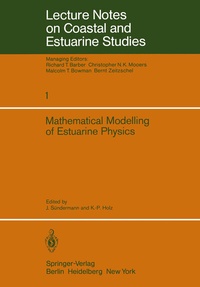
Mathematical Modelling of Estuarine Physics
Proceedings of an International Symposium Held at the German Hydrographic Institute Hamburg, August 24-26, 1978
Published on 1. March 1980
Book
Paperback/Softback
VIII, 269 pages
978-3-540-09750-1 (ISBN)
Description
Numerical simulations are in world wide use for the investigation of hydro- and thermodynamic processes in natural waters. In spite of the fact that great achievements have been brought about in this field, numerous questions still remain unanswered, with respect to fundamental formulations as well as to methods of solu- tion. One of the principal objectives of research in our days is the verification of numerical models. The Symposium on "Mathematical Modelling in Estuarine PhysiCS" was held at Hamburg, Aug. 24 - 26, 1978, with the objective of for- mulating the present standing of research work and of the most im- portant problems in this field. Aspects of physical oceanography and of coastal engineering were to be considered. Estuarine phys- ics were a suitable topic as both disciplines have many points in common there. Eighty-five scientists from sixteen countries convened for two and a half days to discuss details with much interest. We wish to thank them as well as the authors for their contributions.
Further, we wish to express our gratitude to the German Research Foundation (Deutsche Forschungsgemeinschaft), Bonn-Bad Godesberg, to the Special Research Project 79 "Research in Coastal Waters" (Sonder- forschungsbereich 79 "Wasserforschung im Klistenbereich"), and to the German Hydrographic Institute (Deutsches Hydrographisches Institut), Hamburg, for sponsoring the meeting and for helping with the organization.
Further, we wish to express our gratitude to the German Research Foundation (Deutsche Forschungsgemeinschaft), Bonn-Bad Godesberg, to the Special Research Project 79 "Research in Coastal Waters" (Sonder- forschungsbereich 79 "Wasserforschung im Klistenbereich"), and to the German Hydrographic Institute (Deutsches Hydrographisches Institut), Hamburg, for sponsoring the meeting and for helping with the organization.
More details
Series
Edition
Softcover reprint of the original 1st ed. 1980
Language
English
Place of publication
Berlin
Germany
Publishing group
Springer Berlin
Target group
Professional and scholarly
Research
Illustrations
VIII, 269 p.
Dimensions
Height: 244 mm
Width: 170 mm
Thickness: 16 mm
Weight
488 gr
ISBN-13
978-3-540-09750-1 (9783540097501)
DOI
10.1007/978-3-642-46416-4
Schweitzer Classification
Other editions
Additional editions
Jürgen Sündermann | K.-P. Holz
Mathematical Modelling of Estuarine Physics
Proceedings of an International Symposium Held at the German Hydrographic Institute Hamburg, August 24-26, 1978
E-Book
12/2012
Springer
€96.29
Available for download
Content
1. Basic formulations and algorithms.- 1.1 Basic hydrodynamics and thermodynamics.- 1.2 Mathematical modelling of turbulence in estuaries.- 1.3 Fundamental principles for numerical modelling.- 1.4 Application of finite-difference methods to estuary problems.- 1.5 Finite elements, a flexible tool for modelling estuarine processes.- 1.6. Mathematical modelling of fluid flow using the boundary element method.- 1.7 Spectral method for the numerical solution of the three-dimensional hydrodynamic equations for tides and surges.- 1.8 On the formation of salt wedges in estuaries.- 2. Tides and storm surges.- 2.1 On currents in the German Bight.- 2.2 Tide-induced residual flow.- 2.3 Simulation of tidal river dynamics.- 2.4 Analysis of tide and current meter data for model verification.- 2.5 Mathematical modelling of tidal flats: a few remarks.- 2.6 On storm surge phenomena.- 2.7 Meteorological problems associated with numerical storm surge prediction.- 3. Baroclinic motions and transport processes.- 3.1 A coastal ocean numerical model.- 3.2 Modelling and verification of circulation in an arctic barrier island lagoon system - an ecosystem process study.- 3.3 Salinity intrusion models.- 3.4 A point of view: Physical processes on the continental shelf and their implications for numerical circulation models.- 3.5 Observations of continental shelf circulations and their relation to model verification and application.- 3.6 Mathematical models of sediment transport in canalised estuaries.- 3.7 Numerical modelling of sediment transport in ceastal waters.