

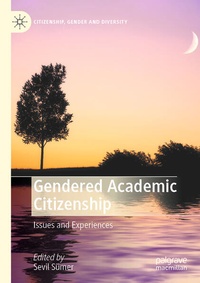
Gendered Academic Citizenship
Description
This book proposes the framework of gendered academic citizenship to capture the multidimensional and complex dynamics of power relations and everyday practices in the contemporary context of academic capitalism. The book proposes an innovative definition of academic citizenship as involving three key components: membership, recognition and belonging . Based on new empirical data, it identifies four ideal-types of academic citizenship: full , limited , transitional citizenship and non-citizenship . The different chapters of the book provide comprehensive reviews of the relevant research literature and offer original insights into the patterns of gender inequalities and practices of gendered academic citizenship across and within different national contexts. The book concludes by setting a comprehensive research agenda for the future.
This book will be of interest to academic researchers and students at all levels in the disciplines of sociology, gender studies, higher education, political science and cultural anthropology.
Reviews / Votes
"This edited volume is an important contribution to gendering academic research. It provides an excellent overview of recent experiences and challenges within the research field Gender in Higher Education and Research Institutions. The chapters employ a gender lens on academic citizenship to produce new empirical knowledge about the re/production of gender in/equality in academia from different perspectives and national contexts. These analyses demonstrate convincingly that the gender lens on citizenship in academia is an analytical tool with great theoretical and methodological potentials for gender research."Birte Siim, Professor Emerita, Aalborg University, Campus Copenhagen, Denmark
More details
Other editions
Additional editions
Person
Sevil Sümer is Associate Professor of Sociology, University of Bergen. She was the Scientific Coordinator of the EU-funded project FEMCIT: Gendered Citizenship in Multicultural Europe . Sümer is the author of European Gender Regimes and Policies and has published extensively on gender, inequality, citizenship and work-family policies in international journals.
Contributors : PAT O'CONNOR, University of Limerick, Ireland; NICKY LE FEUVRE, MARIE SAUTIE, University of Lausanne, Switzerland; PIERRE BATAILLE, University of Grenoble, France; GRY BRANDSER, Nord University, Norway; MINE G. TAN, GÜLSÜN SAGLAMER, HÜLYA ÇAGLAYAN, Istanbul Technical University, Turkey; JUDIT LANNERT, T-Tudok Centre for Knowledge Management and Educational Research, Hungary; BEATA NAGY, Corvinus University of Budapest, Hungary; YILDIZ ECEVIT, FATMA UMUT BESPINAR, Middle East Technical University, Turkey
Content
1. The Contours of Gendered Academic Citizenship Sümer, O'Connor and Le Feuvre .- 2. Accessing Academic Citizenship: Excellence or Micropolitical Practices? O'Connor .- 3. Probationary or Second-class Citizens? Postdoctoral Experiences in the Swiss Context Le Feuvre, Bataille, and Marie Sautier .- 4. Gender and Academic Citizenship Practices: The Norwegian Case Brandser and Sümer .- 5. Family, Career Progression and Gendered Academic Citizenship Tan, Saglamer, Çaglayan .- 6. Changing Institutional Policies and Gender Equality Challenges: The Hungarian Case Judit Lannert and Beáta Nagy .- 7 Sexual Harassment in Turkish Academia through the Lens of Gendered Academic Citizenship Ecevit and Bespınar .- 8. Conclusions: Gendered Academic Citizenship as a Promising Agenda Sümer, O'Connor and Le Feuvre.