

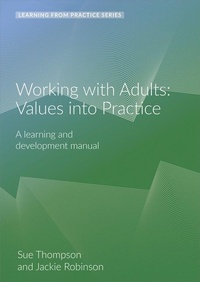
Working with Adults: Values Into Practice
A Learning and Development Manual (2nd Edition)
2nd Edition
Published on 1. July 2019
Book
Paperback/Softback
200 pages
978-1-912755-48-6 (ISBN)
Description
The importance of child-centred practice as a key part of the value base of working with children and young people is well established. But what about working with adults? How do values make a positive difference? By providing a sound base of understanding and best practice, the authors give trainers and tutors an excellent tool for promoting learning in this area. Topics include promoting dignity - what it means in practice, working in partnerships with service users and carers, legal and moral issues, listening skills, rights and risks, assessment and partnership, continuing professional development and staff care, discrimination and oppression, language sensitivity and workplace culture.
More details
Series
Edition
2nd edition
Language
English
Place of publication
Hove
United Kingdom
Target group
Professional and scholarly
Dimensions
Height: 295 mm
Width: 221 mm
Thickness: 13 mm
Weight
816 gr
ISBN-13
978-1-912755-48-6 (9781912755486)
Copyright in bibliographic data and cover images is held by Nielsen Book Services Limited or by the publishers or by their respective licensors: all rights reserved.
Schweitzer Classification
Other editions
Previous edition

Jackie Martin | Sue Thompson
Working with Adults: Value into Practice
A Learning and Development Manual
Book
12/2008
Russell House Publishing Ltd
€81.84
Shipment within 3-4 weeks
Persons
Dr Sue Thompson is a director of Avenue Consulting Ltd and Avenue Media Solutions, companies offering training, consultancy and learning resources around social and workplace well-being issues. She has experience as a nurse, social worker, mentor and educator, with a particular interest in researching the relationship between reciprocity and dependency in eldercare.
Dr Jackie Robinson was for many years a principal lecturer at De Montfort University in Leicester. She was the programme leader for post-qualifying courses for social workers and taught on the degree in social work. She had extensive experience of working with adults as well as children and young people in residential settings in both statutory and voluntary sectors. She worked for Nottinghamshire Social Services as an adult placement scheme coordinator, a social worker in community learning disability teams as a supervising social worker in a team providing short breaks for disabled children. Sadly, Jackie passed away while this new manual was being prepared.
Dr Jackie Robinson was for many years a principal lecturer at De Montfort University in Leicester. She was the programme leader for post-qualifying courses for social workers and taught on the degree in social work. She had extensive experience of working with adults as well as children and young people in residential settings in both statutory and voluntary sectors. She worked for Nottinghamshire Social Services as an adult placement scheme coordinator, a social worker in community learning disability teams as a supervising social worker in a team providing short breaks for disabled children. Sadly, Jackie passed away while this new manual was being prepared.
Content
Introduction
Part One:Training exercises
Section One: Promoting dignity
Section Two: Working in partnership with service users and carers
Section Three: Legal and moral issues
Section Four: Listening skills
Section Five: Rights and Risk
Section Six: Assessment
Section Seven: Continuous professional development and staff care
Part Two: Training exercises (discrimination and oppression)
Introduction
Section Eight: Power and empowerment
Section Nine: Discrimination
Section Ten: Vulnerability
Section Eleven: Language sensitivity
Section Twelve: Workplace culture
Conclusion
References
Guide to further learning
Appendix
Resources
Worksheets
Case studies
Part One:Training exercises
Section One: Promoting dignity
Section Two: Working in partnership with service users and carers
Section Three: Legal and moral issues
Section Four: Listening skills
Section Five: Rights and Risk
Section Six: Assessment
Section Seven: Continuous professional development and staff care
Part Two: Training exercises (discrimination and oppression)
Introduction
Section Eight: Power and empowerment
Section Nine: Discrimination
Section Ten: Vulnerability
Section Eleven: Language sensitivity
Section Twelve: Workplace culture
Conclusion
References
Guide to further learning
Appendix
Resources
Worksheets
Case studies